


Page 197 - Review of Medical Microbiology and Immunology ( PDFDrive )
P. 197
mebooksfree.com
                                                                            mebooksfree.com
 mebooksfree.com

            mebooksfree.com
                                            mebooksfree.com
                                                                            mebooksfree.com
                                                                                                                                           mebooksfree.com
                                                                                                            mebooksfree.com
 mebooksfree.com  mebooksfree.com           mebooksfree.com          in resistance and are not used for diagnostic purposes.               mebooksfree.com
                       PART II  Clinical Bacteriology
                 186
                    tuberculosis, or cause hematogenous dissemination result-
                                                                        Circulating antibodies also form, but they play no role
                    ing in no immediate disease but with the risk of reactiva-
                                                                     Patients deficient in cellular immunity, such as patients
                    tion in later life.
                       Figure 21–2 also describes secondary tuberculosis with
                                                                     with acquired immunodeficiency syndrome (AIDS), are at
                    a cavity in the upper lobes. This can cause disease directly
                                                                     much higher risk for disseminated, life-threatening tuber-
                    or result in reactivation disease in later life with central
                                                                     another cause of defective cellular immunity that predis-
                    nervous system lesions, vertebral osteomyelitis (Pott’s dis-
                    ease), or involvement of other organs.
                                                                     poses to severe tuberculosis. This emphasizes the impor-
                       Mycobacterium tuberculosis produces no exotoxins and   culosis.  Mutations  in the  interferon-γ  receptor  gene  are
                                                                     tance of activation of macrophages by interferon-γ in the
 mebooksfree.com  mebooksfree.com           mebooksfree.com          reaction. PPD is used as the antigen in the tuberculin skin           mebooksfree.com
                    does not contain endotoxin in its cell wall. In fact, no
                                                                     host defense against M. tuberculosis.
                                                                            mebooksfree.com
                                                                                                            mebooksfree.com
                                                                        Prior infection can be detected by a positive tuberculin
                    mycobacteria produce toxins. The organism preferentially
                                                                     skin test result, which is due to a delayed hypersensitivity
                    infects macrophages and other reticuloendothelial cells.
                    Mycobacterium tuberculosis survives and multiplies within
                                                                     test. The intermediate-strength preparation of PPD, which
                    a cellular vacuole called a phagosome. The organism pro-
                                                                     contains five tuberculin units, is usually used. The skin test
                    duces a protein called “exported repetitive protein” that
                    prevents the phagosome from fusing with the lysosome,
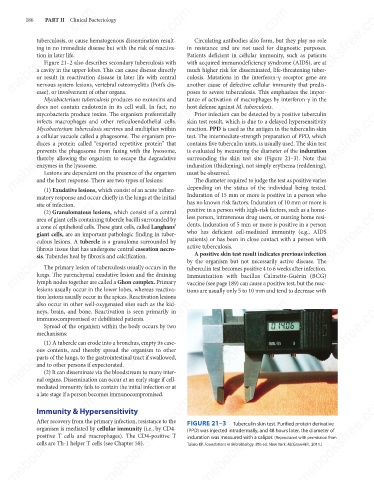
                                                                     is evaluated by measuring the diameter of the induration
                                                                     surrounding the  skin  test  site (Figure  21–3). Note  that
                    thereby allowing the organism to escape the degradative
                                                                     induration (thickening), not simply erythema (reddening),
                    enzymes in the lysosome.
                                                                     must be observed.
                       Lesions are dependent on the presence of the organism
                    and the host response. There are two types of lesions:
                                                                        The diameter required to judge the test as positive varies
                       (1) Exudative lesions, which consist of an acute inflam-
                                                                     Induration of 15 mm or more is positive in a person who
                    matory response and occur chiefly in the lungs at the initial   depending  on  the  status  of  the  individual  being  tested.
                                                                     has no known risk factors. Induration of 10 mm or more is
                                                                                                            mebooksfree.com
                                                                            mebooksfree.com
 mebooksfree.com  mebooksfree.com           mebooksfree.com          dents. Induration of 5 mm or more is positive in a person             mebooksfree.com
                    site of infection.
                                                                     positive in a person with high-risk factors, such as a home-
                       (2) Granulomatous lesions, which consist of a central
                                                                     less person, intravenous drug users, or nursing home resi-
                    area of giant cells containing tubercle bacilli surrounded by
                    a zone of epithelioid cells. These giant cells, called Langhans’
                                                                     who has deficient cell-mediated immunity (e.g., AIDS
                    giant cells, are an important pathologic finding in tuber-
                                                                     patients) or has been in close contact with a person with
                    culous lesions. A tubercle is a granuloma surrounded by
                                                                     active tuberculosis.
                    fibrous tissue that has undergone central caseation necro-
                                                                        A positive skin test result indicates previous infection
                    sis. Tubercles heal by fibrosis and calcification.
                                                                     by the organism but not necessarily active disease. The
                       The primary lesion of tuberculosis usually occurs in the
                                                                     tuberculin test becomes positive 4 to 6 weeks after infection.
                    lungs. The parenchymal exudative lesion and the draining
                    lymph nodes together are called a Ghon complex. Primary
                                                                     vaccine (see page 189) can cause a positive test, but the reac-
                    lesions usually occur in the lower lobes, whereas reactiva-
                                                                     tions are usually only 5 to 10 mm and tend to decrease with
                    tion lesions usually occur in the apices. Reactivation lesions   Immunization with bacillus  Calmette-Guérin (BCG)
 mebooksfree.com  mebooksfree.com           mebooksfree.com                 mebooksfree.com                 mebooksfree.com                mebooksfree.com
                    also occur in other well-oxygenated sites such as the kid-
                    neys, brain, and bone. Reactivation is seen primarily in
                    immunocompromised or debilitated patients.
                       Spread of the organism within the body occurs by two
                    mechanisms:
                       (1) A tubercle can erode into a bronchus, empty its case-
                    ous contents, and thereby spread the organism to other
                    parts of the lungs, to the gastrointestinal tract if swallowed,
                    and to other persons if expectorated.
                       (2) It can disseminate via the bloodstream to many inter-
                    nal organs. Dissemination can occur at an early stage if cell-
                    mediated immunity fails to contain the initial infection or at
                    a late stage if a person becomes immunocompromised.
 mebooksfree.com  mebooksfree.com           mebooksfree.com          FIGURE 21–3    Tuberculin skin test. Purified protein derivative      mebooksfree.com
                                                                                                            mebooksfree.com
                                                                            mebooksfree.com
                    Immunity & Hypersensitivity
                    After recovery from the primary infection, resistance to the
                    organism is mediated by cellular immunity (i.e., by CD4-
                                                                     (PPD) was injected intradermally, and 48 hours later, the diameter of
                    positive T cells and macrophages). The CD4-positive T
                                                                     induration was measured with a caliper. (Reproduced with permission from
                    cells are Th-1 helper T cells (see Chapter 58).
                                                                     Talaro KP. Foundations in Microbiology. 8th ed. New York: McGraw-Hill, 2011.)
 mebooksfree.com  mebooksfree.com           mebooksfree.com                 mebooksfree.com                 mebooksfree.com                mebooksfree.com

