


Page 195 - Review of Medical Microbiology and Immunology ( PDFDrive )
P. 195
mebooksfree.com
mebooksfree.com
mebooksfree.com
mebooksfree.com
mebooksfree.com
mebooksfree.com
mebooksfree.com mebooksfree.com mebooksfree.com Preferred Temperature In Source or Mode of mebooksfree.com
mebooksfree.com
mebooksfree.com
PART II Clinical Bacteriology
184
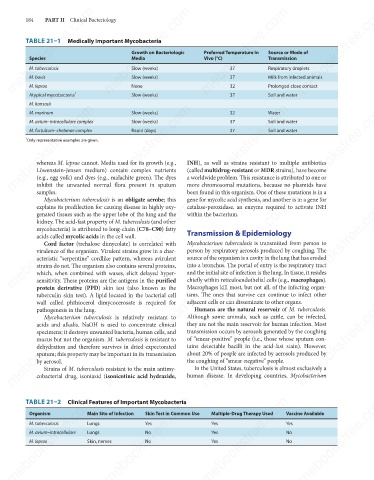
TABLE 21–1 Medically Important Mycobacteria
Growth on Bacteriologic
Media
Vivo (°C)
Species
Transmission
Respiratory droplets
Slow (weeks)
37
M. tuberculosis
M. bovis
Slow (weeks)
37
Milk from infected animals
Prolonged close contact
32
None
M. leprae
1
Soil and water
37
Slow (weeks)
Atypical mycobacteria
M. kansasii
mebooksfree.com mebooksfree.com mebooksfree.com INH), as well as strains resistant to multiple antibiotics mebooksfree.com
mebooksfree.com
mebooksfree.com
32
Slow (weeks)
M. marinum
Water
Slow (weeks)
M. avium–intracellulare complex
Soil and water
37
Soil and water
Rapid (days)
M. fortuitum–chelonae complex
37
1
Only representative examples are given.
whereas M. leprae cannot. Media used for its growth (e.g.,
(called multidrug-resistant or MDR strains), have become
Löwenstein-Jensen medium) contain complex nutrients
(e.g., egg yolk) and dyes (e.g., malachite green). The dyes
more chromosomal mutations, because no plasmids have
inhibit the unwanted normal flora present in sputum
samples.
been found in this organism. One of these mutations is in a
Mycobacterium tuberculosis is an obligate aerobe; this a worldwide problem. This resistance is attributed to one or
gene for mycolic acid synthesis, and another is in a gene for
mebooksfree.com
mebooksfree.com mebooksfree.com mebooksfree.com Transmission & Epidemiology mebooksfree.com mebooksfree.com
explains its predilection for causing disease in highly oxy-
catalase-peroxidase, an enzyme required to activate INH
within the bacterium.
genated tissues such as the upper lobe of the lung and the
kidney. The acid-fast property of M. tuberculosis (and other
mycobacteria) is attributed to long-chain (C78–C90) fatty
acids called mycolic acids in the cell wall.
Mycobacterium tuberculosis is transmitted from person to
Cord factor (trehalose dimycolate) is correlated with
person by respiratory aerosols produced by coughing. The
virulence of the organism. Virulent strains grow in a char-
source of the organism is a cavity in the lung that has eroded
acteristic “serpentine” cordlike pattern, whereas avirulent
into a bronchus. The portal of entry is the respiratory tract
strains do not. The organism also contains several proteins,
which, when combined with waxes, elicit delayed hyper-
chiefly within reticuloendothelial cells (e.g., macrophages).
sensitivity. These proteins are the antigens in the purified
Macrophages kill most, but not all, of the infecting organ-
protein derivative (PPD) skin test (also known as the
isms. The ones that survive can continue to infect other
tuberculin skin test). A lipid located in the bacterial cell and the initial site of infection is the lung. In tissue, it resides
mebooksfree.com
mebooksfree.com
mebooksfree.com mebooksfree.com mebooksfree.com they are not the main reservoir for human infection. Most mebooksfree.com
adjacent cells or can disseminate to other organs.
wall called phthiocerol dimycocerosate is required for
Humans are the natural reservoir of M. tuberculosis.
pathogenesis in the lung.
Although some animals, such as cattle, can be infected,
Mycobacterium tuberculosis is relatively resistant to
acids and alkalis. NaOH is used to concentrate clinical
transmission occurs by aerosols generated by the coughing
specimens; it destroys unwanted bacteria, human cells, and
of “smear-positive” people (i.e., those whose sputum con-
mucus but not the organism. M. tuberculosis is resistant to
tains detectable bacilli in the acid-fast stain). However,
dehydration and therefore survives in dried expectorated
about 20% of people are infected by aerosols produced by
sputum; this property may be important in its transmission
the coughing of “smear-negative” people.
by aerosol.
In the United States, tuberculosis is almost exclusively a
Strains of M. tuberculosis resistant to the main antimy-
human disease. In developing countries, Mycobacterium
cobacterial drug, isoniazid (isonicotinic acid hydrazide,
mebooksfree.com mebooksfree.com Main Site of Infection Skin Test in Common Use mebooksfree.com Vaccine Available mebooksfree.com
mebooksfree.com
mebooksfree.com
TABLE 21–2 Clinical Features of Important Mycobacteria
Organism
Multiple-Drug Therapy Used
Yes
Yes
Lungs
M. tuberculosis
Yes
No
M. avium–intracellulare
No
Lungs
Yes
Yes
Skin, nerves
No
No
M. leprae
mebooksfree.com mebooksfree.com mebooksfree.com mebooksfree.com mebooksfree.com mebooksfree.com

