


Page 198 - Review of Medical Microbiology and Immunology ( PDFDrive )
P. 198
mebooksfree.com


                                                                                                                                           mebooksfree.com
            mebooksfree.com
                        a boost to the immune system. mebooksfree.com
                                                                            mebooksfree.com
 mebooksfree.com  mebooksfree.com           mebooksfree.com                 mebooksfree.com                 mebooksfree.com                mebooksfree.com
                                                                                                            mebooksfree.com
                                                                                              CHAPTER 21  Mycobacteria
                                                                                                                        187
                        time. People with PPD reactions of 15 mm or more are
                        assumed to be infected with M. tuberculosis even if they
                        have received the BCG vaccine. A positive skin test reverts
                        to negative in about 5% to 10% of people. Reversion to
                        negative is more common in the United States now than
                        many years ago because now a person is less likely to be
                        exposed to the organism and therefore less likely to receive

                          The skin test itself does not induce a positive response in
 mebooksfree.com  mebooksfree.com           mebooksfree.com                 mebooksfree.com                 mebooksfree.com                mebooksfree.com
                        a person who has not been exposed to the organism. It can,
                        however, “boost” a weak or negative response in a person
                        who has been exposed to produce a positive reaction. The
                        clinical implications of this “booster effect” are beyond the
                        scope of this book.
                          Tuberculin reactivity is mediated by the cellular arm of
                        the immune system; it can be transferred by CD4-positive
                        T cells but not by serum. Infection with measles virus can
                        suppress cell-mediated immunity, resulting in a loss of
                        tuberculin skin test reactivity and, in some instances, reac-
                        tivation of dormant organisms and clinical disease.
                          A gene called Nramp determines natural resistance to
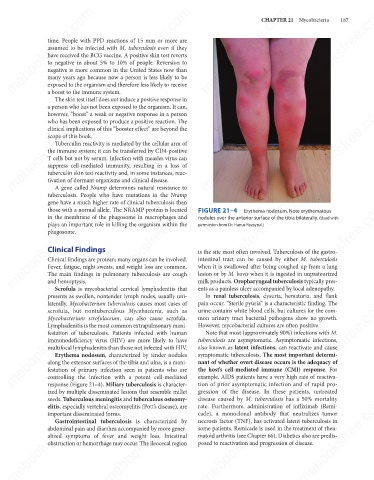
                        tuberculosis. People who have mutations in the  Nramp   FIGURE 21–4   Erythema nodosum. Note erythematous
                        gene have a much higher rate of clinical tuberculosis than
 mebooksfree.com  mebooksfree.com           mebooksfree.com              permission from Dr. Hanus Rozsypal.)  mebooksfree.com             mebooksfree.com
                                                                            mebooksfree.com
                        those with a normal allele. The NRAMP protein is located
                        in the membrane of the phagosome in macrophages and
                                                                         nodules over the anterior surface of the tibia bilaterally. (Used with
                        plays an important role in killing the organism within the
                        phagosome.
                        Clinical Findings
                                                                         is the site most often involved. Tuberculosis of the gastro-
                        Clinical findings are protean; many organs can be involved.
                                                                         intestinal tract can be caused by either  M. tuberculosis
                        Fever, fatigue, night sweats, and weight loss are common.
                                                                         when it is swallowed after being coughed up from a lung
                        The main findings in pulmonary tuberculosis are cough
                                                                         milk products. Oropharyngeal tuberculosis typically pres-
                        and hemoptysis.
                                                                         ents as a painless ulcer accompanied by local adenopathy.
                          Scrofula is mycobacterial cervical lymphadenitis that
                        presents as swollen, nontender lymph nodes, usually uni-  lesion or by M. bovis when it is ingested in unpasteurized
                                                                           In  renal tuberculosis, dysuria, hematuria, and flank
                                                                                                            mebooksfree.com
                                                                            mebooksfree.com
 mebooksfree.com  mebooksfree.com           mebooksfree.com              However, mycobacterial cultures are often positive.               mebooksfree.com
                        laterally. Mycobacterium tuberculosis causes most cases of
                                                                         pain occur. “Sterile pyuria” is a characteristic finding. The
                                                                         urine contains white blood cells, but cultures for the com-
                        scrofula, but nontuberculous  Mycobacteria, such as
                                                                         mon urinary tract bacterial pathogens show no growth.
                        Mycobacterium scrofulaceum, can also cause scrofula.
                        Lymphadenitis is the most common extrapulmonary mani-
                                                                           Note that most (approximately 90%) infections with M.
                        festation of tuberculosis. Patients infected with human
                        immunodeficiency virus (HIV) are more likely to have
                                                                         tuberculosis are asymptomatic. Asymptomatic infections,
                                                                         also known as latent infections, can reactivate and cause
                        multifocal lymphadenitis than those not infected with HIV.
                                                                         symptomatic tuberculosis. The most important determi-
                          Erythema nodosum, characterized by tender nodules
                        along the extensor surfaces of the tibia and ulna, is a mani-
                                                                         nant of whether overt disease occurs is the adequacy of
                        festation  of  primary  infection  seen  in  patients  who  are
                                                                         example, AIDS patients have a very high rate of reactiva-
                        controlling the infection with a potent cell-mediated
                                                                         tion of prior asymptomatic infection and of rapid pro-
                        response (Figure 21–4). Miliary tuberculosis is character-
                                                                         gression of the disease. In these patients, untreated
                        ized by multiple disseminated lesions that resemble millet   the host’s cell-mediated immune (CMI) response. For
                                                                                                            mebooksfree.com
                        seeds. Tuberculous meningitis and tuberculous osteomy-
                                                                            mebooksfree.com
                                                                         disease caused by  M. tuberculosis has a 50% mortality
 mebooksfree.com  mebooksfree.com           mebooksfree.com              necrosis factor (TNF), has activated latent tuberculosis in       mebooksfree.com
                        elitis, especially vertebral osteomyelitis (Pott’s disease), are
                                                                         rate.  Furthermore, administration of infliximab (Remi-
                        important disseminated forms.
                                                                         cade), a monoclonal antibody that neutralizes tumor
                          Gastrointestinal tuberculosis is characterized by
                                                                         some patients. Remicade is used in the treatment of rheu-
                        abdominal pain and diarrhea accompanied by more gener-
                                                                         matoid arthritis (see Chapter 66). Diabetics also are predis-
                        alized symptoms of fever and weight loss. Intestinal
                        obstruction or hemorrhage may occur. The ileocecal region
                                                                         posed to reactivation and progression of disease.
 mebooksfree.com  mebooksfree.com           mebooksfree.com                 mebooksfree.com                 mebooksfree.com                mebooksfree.com

