


Page 201 - Review of Medical Microbiology and Immunology ( PDFDrive )
P. 201
mebooksfree.com
mebooksfree.com
mebooksfree.com
mebooksfree.com
mebooksfree.com
mebooksfree.com mebooksfree.com mebooksfree.com Dark mebooksfree.com mebooksfree.com mebooksfree.com
mebooksfree.com
190
PART II Clinical Bacteriology
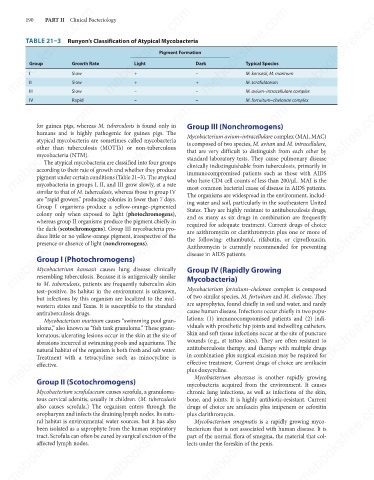
TABLE 21–3 Runyon’s Classification of Atypical Mycobacteria
Pigment Formation
Typical Species
Growth Rate
Group
Light
M. kansasii, M. marinum
+
I
Slow
–
II
M. avium–intracellulare complex
–
–
Slow
III
IV Slow + + M. scrofulaceum
–
Rapid
–
M. fortuitum–chelonae complex
mebooksfree.com
mebooksfree.com mebooksfree.com mebooksfree.com Group III (Nonchromogens) mebooksfree.com mebooksfree.com
for guinea pigs, whereas M. tuberculosis is found only in
humans and is highly pathogenic for guinea pigs. The
Mycobacterium avium–intracellulare complex (MAI, MAC)
atypical mycobacteria are sometimes called mycobacteria
is composed of two species, M. avium and M. intracellulare,
other than tuberculosis (MOTTs) or non-tuberculous
that are very difficult to distinguish from each other by
mycobacteria (NTM).
standard laboratory tests. They cause pulmonary disease
The atypical mycobacteria are classified into four groups
clinically indistinguishable from tuberculosis, primarily in
according to their rate of growth and whether they produce
immunocompromised patients such as those with AIDS
pigment under certain conditions (Table 21–3). The atypical
mycobacteria in groups I, II, and III grow slowly, at a rate
most common bacterial cause of disease in AIDS patients.
similar to that of M. tuberculosis, whereas those in group IV
The organisms are widespread in the environment, includ-
are “rapid growers,” producing colonies in fewer than 7 days. who have CD4 cell counts of less than 200/μL. MAI is the
ing water and soil, particularly in the southeastern United
mebooksfree.com
mebooksfree.com mebooksfree.com mebooksfree.com required for adequate treatment. Current drugs of choice mebooksfree.com
mebooksfree.com
Group I organisms produce a yellow-orange–pigmented
States. They are highly resistant to antituberculosis drugs,
colony only when exposed to light (photochromogens),
and as many as six drugs in combination are frequently
whereas group II organisms produce the pigment chiefly in
the dark (scotochromogens). Group III mycobacteria pro-
are azithromycin or clarithromycin plus one or more of
duce little or no yellow-orange pigment, irrespective of the
the following: ethambutol, rifabutin, or ciprofloxacin.
presence or absence of light (nonchromogens).
Azithromycin is currently recommended for preventing
disease in AIDS patients.
Group I (Photochromogens)
Mycobacterium kansasii causes lung disease clinically
Group IV (Rapidly Growing
resembling tuberculosis. Because it is antigenically similar
Mycobacteria)
to M. tuberculosis, patients are frequently tuberculin skin
Mycobacterium fortuitum–chelonae complex is composed
test–positive. Its habitat in the environment is unknown,
but infections by this organism are localized to the mid-
mebooksfree.com
mebooksfree.com
mebooksfree.com mebooksfree.com mebooksfree.com of two similar species, M. fortuitum and M. chelonae. They mebooksfree.com
are saprophytes, found chiefly in soil and water, and rarely
western states and Texas. It is susceptible to the standard
cause human disease. Infections occur chiefly in two popu-
antituberculosis drugs.
lations: (1) immunocompromised patients and (2) indi-
Mycobacterium marinum causes “swimming pool gran-
viduals with prosthetic hip joints and indwelling catheters.
uloma,” also known as “fish tank granuloma.” These granu-
Skin and soft tissue infections occur at the site of puncture
lomatous, ulcerating lesions occur in the skin at the site of
wounds (e.g., at tattoo sites). They are often resistant to
abrasions incurred at swimming pools and aquariums. The
antituberculosis therapy, and therapy with multiple drugs
natural habitat of the organism is both fresh and salt water.
in combination plus surgical excision may be required for
Treatment with a tetracycline such as minocycline is
effective treatment. Current drugs of choice are amikacin
effective.
Mycobacterium abscessus is another rapidly growing
Group II (Scotochromogens)
mycobacteria acquired from the environment. It causes
Mycobacterium scrofulaceum causes scrofula, a granuloma- plus doxycycline.
chronic lung infections, as well as infections of the skin,
mebooksfree.com mebooksfree.com mebooksfree.com bacterium that is not associated with human disease. It is mebooksfree.com
mebooksfree.com
mebooksfree.com
tous cervical adenitis, usually in children. (M. tuberculosis
bone, and joints. It is highly antibiotic-resistant. Current
also causes scrofula.) The organism enters through the
drugs of choice are amikacin plus imipenem or cefoxitin
oropharynx and infects the draining lymph nodes. Its natu-
plus clarithromycin.
ral habitat is environmental water sources, but it has also
Mycobacterium smegmatis is a rapidly growing myco-
been isolated as a saprophyte from the human respiratory
tract. Scrofula can often be cured by surgical excision of the
part of the normal flora of smegma, the material that col-
affected lymph nodes.
lects under the foreskin of the penis.
mebooksfree.com mebooksfree.com mebooksfree.com mebooksfree.com mebooksfree.com mebooksfree.com

