Page 202 - Review of Medical Microbiology and Immunology ( PDFDrive )
P. 202
mebooksfree.com
                                                                                                            mebooksfree.com
 mebooksfree.com

            mebooksfree.com
                                                                                                            mebooksfree.com
                                                                            mebooksfree.com
                                                                                                                                           mebooksfree.com
                                            mebooksfree.com
 mebooksfree.com  mebooksfree.com           mebooksfree.com              rosy, the CMI response to the organism limits its growth,   191   mebooksfree.com
                                                                                              CHAPTER 21  Mycobacteria
                        MYCOBACTERIUM LEPRAE
                                                                           (1) In tuberculoid (also known as paucibacillary) lep-
                        Disease
                                                                         very few acid-fast bacilli are seen, and granulomas contain-
                                                                         ing giant cells form. The nerve damage seems likely to be
                        This organism causes leprosy (Hansen’s disease).
                                                                         caused by cell-mediated immunity as there are few organ-
                        Important Properties
                                                                           The CMI response consists primarily of CD4-positive
                        Mycobacterium leprae has not been grown in the laboratory,
                                                                         cells and a Th-1 profile of cytokines, namely, interferon-γ,
                        either on artificial media or in cell culture. It can be grown   isms and the CMI response is strong.
                                                                         interleukin-2, and interleukin-12. It is the CMI response
                        in experimental animals, such as mice and armadillos. Humans
                                                                                                            mebooksfree.com
                                                                            mebooksfree.com
 mebooksfree.com  mebooksfree.com           mebooksfree.com              extract of M. leprae is injected intradermally, and indura-       mebooksfree.com
                                                                         that causes the nerve damage seen in tuberculoid leprosy.
                        are the natural hosts, although the armadillo appears to be a
                                                                           The lepromin skin test result is positive. The lepromin
                        reservoir for human infection in the Mississippi Delta
                                                                         skin test is similar to the tuberculin test (see earlier). An
                        region where these animals are common. In view of this,
                        leprosy can be thought of as a zoonotic disease, at least in
                                                                         tion is observed 48 hours later in those in whom a CMI
                        certain southern states, such as Louisiana and Texas.
                                                                         response against the organism exists.
                          The  optimal  temperature  for  growth  (30°C)  is  lower
                                                                           (2) In lepromatous (also known as multibacillary) lep-
                        than body temperature; therefore, M. leprae grows prefer-
                                                                         rosy, the cell-mediated response to the organism is poor,
                        entially in the skin and superficial nerves. It grows very
                                                                         the skin and mucous membrane lesions contain large num-
                        slowly, with a doubling time of 14 days. This makes it the
                                                                         bers of organisms, foamy histiocytes rather than granulo-
                        slowest-growing human bacterial pathogen. One conse-
                                                                         mas are found, and the lepromin skin test result is negative.
                        quence of this is that antibiotic therapy must be continued
                                                                         The nerve damage seems likely to be caused by direct con-
                        for a long time, usually several years.
                                                                         tact as there are many organisms and the CMI response is
                                                                            mebooksfree.com
 mebooksfree.com  mebooksfree.com           mebooksfree.com              poor.                              mebooksfree.com                mebooksfree.com
                        Transmission
                                                                           There is evidence that people with lepromatous leprosy
                        Infection is acquired by prolonged contact with patients
                                                                         produce interferon-β (antiviral interferon) in response to
                        with lepromatous leprosy, who discharge M. leprae in large
                                                                         M. leprae infection, whereas people with tuberculoid lep-
                        numbers in nasal secretions and from skin lesions. In the
                                                                         rosy produce interferon-γ. Interferon-β inhibits the synthe-
                        United States, leprosy occurs primarily in Texas, Louisiana,
                                                                         sis of interferon-γ thereby reducing the CMI response
                        California, and Hawaii. Most cases are found in immigrants
                                                                         needed to contain the infection.
                        from Mexico, the Philippines, Southeast Asia, and India.
                                                                           Note that in lepromatous leprosy, only the cell-mediated
                        The disease occurs worldwide, with most cases in the tropi-
                                                                         response to M. leprae is defective (i.e., the patient is anergic
                        cal areas of Asia and Africa. The armadillo is unlikely to be
                                                                         to M. leprae). The cell-mediated response to other organ-
                        an important reservoir because it is not found in many
                                                                         isms is unaffected, and the humoral response to M. leprae
                        areas of the world where leprosy is endemic.
                                                                         is intact. However, these antibodies are not protective. The
                                                                         T-cell response consists primarily of Th-2 cells.
                        Pathogenesis
 mebooksfree.com  mebooksfree.com           mebooksfree.com              Clinical Findings                  mebooksfree.com                mebooksfree.com
                                                                            mebooksfree.com
                        The organism replicates intracellularly, typically within
                        skin histiocytes, endothelial cells, and the Schwann cells of
                                                                         The incubation period averages several years, and the onset
                        nerves. The nerve damage in leprosy is the result of two
                                                                         of the disease is gradual. In tuberculoid leprosy, hypopig-
                        processes: damage caused by direct contact with the bacte-
                                                                         mented  macular  or  plaquelike skin  lesions,  thickened
                        rium and damage caused by CMI attack on the nerves.
                                                                         superficial nerves, and significant anesthesia of the skin
                          There are two distinct forms of leprosy—tuberculoid
                                                                         lesions occur (Figure 21–5). In lepromatous leprosy, mul-
                        and  lepromatous—with several intermediate forms
                                                                         tiple nodular skin lesions occur, resulting in the typical
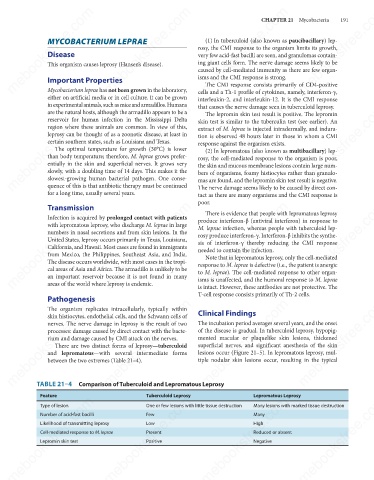
                        between the two extremes (Table 21–4).
                    TABLE 21–4  Comparison of Tuberculoid and Lepromatous Leprosy
                     Feature
                                                        Tuberculoid Leprosy
                                                                                           Lepromatous Leprosy
 mebooksfree.com  mebooksfree.com           mebooksfree.com                 mebooksfree.com                 mebooksfree.com                mebooksfree.com
                                                                                           Many lesions with marked tissue destruction
                                                        One or few lesions with little tissue destruction
                     Type of lesion
                                                                                           Many
                                                        Few
                     Number of acid-fast bacilli
                                                                                           High
                     Likelihood of transmitting leprosy
                                                        Low
                     Cell-mediated response to M. leprae
                                                        Present
                                                                                           Reduced or absent
                                                        Positive
                     Lepromin skin test
                                                                                           Negative
 mebooksfree.com  mebooksfree.com           mebooksfree.com                 mebooksfree.com                 mebooksfree.com                mebooksfree.com
   197   198   199   200   201   202   203   204   205   206   207