


Page 256 - Review of Medical Microbiology and Immunology ( PDFDrive )
P. 256
mebooksfree.com
mebooksfree.com
mebooksfree.com
mebooksfree.com
mebooksfree.com
mebooksfree.com
mebooksfree.com
mebooksfree.com mebooksfree.com mebooksfree.com different, complementary proteins. If it cannot, the two 245 mebooksfree.com
mebooksfree.com
CHAPTER 30 Genetics & Gene Therapy
INTERACTIONS BETWEEN VIRUSES
mutations are in the same gene, and both proteins are non-
When two genetically distinct viruses infect a cell, three
functional. By performing many of these paired tests with
different phenomena can ensue.
different mutants, it is possible to determine functional
domains of complementation groups that correspond to
(1) Recombination is the exchange of genes between
two chromosomes that is based on crossing over within
effects of recombination.
regions of significant base sequence homology. Recombi-
(3) In phenotypic mixing, the genome of virus type A
nation can be readily demonstrated for viruses with double-
can be coated with the surface proteins of virus type B
stranded DNA as the genetic material and has been used to genes. Appropriate controls are needed to obviate the
mebooksfree.com
mebooksfree.com
(Figure 30–2). This phenotypically mixed virus can infect
mebooksfree.com mebooksfree.com mebooksfree.com encoded solely by its type A genetic material. An interest- mebooksfree.com
determine their genetic map. However, recombination by
cells as determined by its type B protein coat. However, the
RNA viruses occurs at a very low frequency, if at all. Reas-
progeny virus from this infection has a type A coat; it is
sortment is the term used when viruses with segmented
genomes, such as influenza virus, exchange segments. This
ing example of phenotypic mixing is that of pseudotypes,
usually results in a much higher frequency of gene exchange
which consist of the nucleocapsid of one virus and the
than does recombination. Reassortment of influenza virus
envelope of another. Pseudotypes composed of the nucleo-
RNA segments is involved in the major antigenic changes
capsid of vesicular stomatitis virus (a rhabdovirus) and the
in the virus that are the basis for recurrent influenza
envelope of human immunodeficiency virus (HIV; a retro-
epidemics.
virus) are currently being used to study the immune
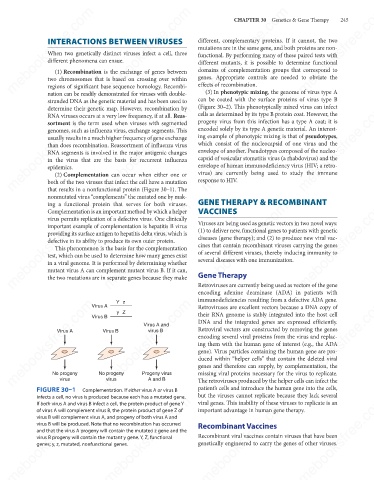
(2) Complementation can occur when either one or
both of the two viruses that infect the cell have a mutation
that results in a nonfunctional protein (Figure 30–1). The
nonmutated virus “complements” the mutated one by mak- response to HIV.
GENE THERAPY & RECOMBINANT
mebooksfree.com
mebooksfree.com mebooksfree.com mebooksfree.com Viruses are being used as genetic vectors in two novel ways: mebooksfree.com
ing a functional protein that serves for both viruses.
mebooksfree.com
VACCINES
Complementation is an important method by which a helper
virus permits replication of a defective virus. One clinically
important example of complementation is hepatitis B virus
(1) to deliver new, functional genes to patients with genetic
providing its surface antigen to hepatitis delta virus, which is
diseases (gene therapy); and (2) to produce new viral vac-
defective in its ability to produce its own outer protein.
cines that contain recombinant viruses carrying the genes
This phenomenon is the basis for the complementation
of several different viruses, thereby inducing immunity to
test, which can be used to determine how many genes exist
several diseases with one immunization.
in a viral genome. It is performed by determining whether
mutant virus A can complement mutant virus B. If it can,
Gene Therapy
the two mutations are in separate genes because they make
Retroviruses are currently being used as vectors of the gene
encoding adenine deaminase (ADA) in patients with
immunodeficiencies resulting from a defective ADA gene.
mebooksfree.com
mebooksfree.com mebooksfree.com Virus B Virus A and DNA and the integrated genes are expressed efficiently. mebooksfree.com
mebooksfree.com
mebooksfree.com
Yz
Virus A
Retroviruses are excellent vectors because a DNA copy of
yZZ
their RNA genome is stably integrated into the host cell
Virus B
Retroviral vectors are constructed by removing the genes
virus B
Virus A
encoding several viral proteins from the virus and replac-
ing them with the human gene of interest (e.g., the ADA
gene). Virus particles containing the human gene are pro-
duced within “helper cells” that contain the deleted viral
genes and therefore can supply, by complementation, the
No progeny
No progeny
Progeny virus
The retroviruses produced by the helper cells can infect the
virus
A and B
virus
patient’s cells and introduce the human gene into the cells,
FIGURE 30–1 Complementation. If either virus A or virus B missing viral proteins necessary for the virus to replicate.
but the viruses cannot replicate because they lack several
infects a cell, no virus is produced because each has a mutated gene.
mebooksfree.com
mebooksfree.com mebooksfree.com mebooksfree.com Recombinant Vaccines mebooksfree.com mebooksfree.com
viral genes. This inability of these viruses to replicate is an
If both virus A and virus B infect a cell, the protein product of gene Y
important advantage in human gene therapy.
of virus A will complement virus B, the protein product of gene Z of
virus B will complement virus A, and progeny of both virus A and
virus B will be produced. Note that no recombination has occurred
and that the virus A progeny will contain the mutated z gene and the
Recombinant viral vaccines contain viruses that have been
virus B progeny will contain the mutant y gene. Y, Z, functional
genetically engineered to carry the genes of other viruses.
genes; y, z, mutated, nonfunctional genes.
mebooksfree.com mebooksfree.com mebooksfree.com mebooksfree.com mebooksfree.com mebooksfree.com

