


Page 251 - Review of Medical Microbiology and Immunology ( PDFDrive )
P. 251
mebooksfree.com
                                                                                                            mebooksfree.com
 mebooksfree.com

                                                                                                            mebooksfree.com
            mebooksfree.com
                                            mebooksfree.com
 mebooksfree.com  mebooksfree.com           mebooksfree.com          synthesis of sufficient repressor, replication and lysis of the       mebooksfree.com
                                                                            mebooksfree.com
                                                                                                                                           mebooksfree.com
                       PART III  Basic Virology
                 240
                                                 Viral antigens
                                                 on cell membrane
                                                                     cell result. One correlate of the lysogenic state is that the
                                                                     repressor can also prevent the replication of additional
                                                                     lambda phages that infect subsequently. This is called
                     Nucleocapsid
                                                                     “immunity” and is specifically directed against lambda
                                                       Budding
                      Protein coat
                                                       virion
                         (capsid)
                                                                     in lambda DNA; other phages are not affected.
                                                                        The  next important step in the lysogenic cycle is the
                          Nucleic                      Envelope      phage because the repressor binds only to the operator sites
                                                                     integration  of  the  viral  DNA  into  the  cell  DNA.  This
                          acid core              Mature virion       occurs by the matching of a specific attachment site on the
                                                                                                            mebooksfree.com
                                                                            mebooksfree.com
 mebooksfree.com  mebooksfree.com           mebooksfree.com          mediated by a phage-encoded recombination enzyme. The                 mebooksfree.com
                                                                     lambda DNA to a homologous site on the E. coli DNA and
                                                                     the integration (breakage and rejoining) of the two DNAs
                 FIGURE 29–5
                                Budding. Most enveloped viruses derive their
                                                                     integrated viral DNA is called a prophage. Most lysogenic
                 lipoprotein envelope from the cell membrane. The matrix protein
                                                                     phages integrate at one or a few specific sites, but some,
                 mediates the interaction between the viral nucleocapsid and the
                                                                     such as the Mu (or mutator) phage, can integrate their
                 viral envelope. (Reproduced with permission from Mims CA. The Pathogenesis of
                 Infectious Disease. 3rd ed, Academic Press. Copyright 1987 Elsevier.)
                                                                        λ Bacteriophage
                                                                        infects E. coli
                                                                            mebooksfree.com
 mebooksfree.com  mebooksfree.com     Synthesis mebooksfree.com         Bacterial chromosome                mebooksfree.com                mebooksfree.com


                                                                          Lysogenic cycle
                                               Lytic cycle
                                                                 Choice
                                                                                    Prophage

                                                                                      λ-Phage DNA
                                      of many
                                                                                      integrates into
                                      progeny
                                                                                      E. coli DNA
                                      λ phage
                                                                                      and no progeny
                                                                                      phage are made
                                                                                      at this time
 mebooksfree.com  mebooksfree.com     λ phage mebooksfree.com               mebooksfree.com                 mebooksfree.com                mebooksfree.com
                                                                                UV irradiation
                                      Release of
                                      and lysis
                                                                                      λ-Phage DNA
                                      of E. coli
                                                                                      excised from
                                                                                      integrated state
                                                                                      and λ phage
                                                                                      synthesized


                                                                                      Release of
                                                                                      λ phage
 mebooksfree.com  mebooksfree.com           mebooksfree.com                 mebooksfree.com                 mebooksfree.com                mebooksfree.com
                                                                                      and lysis
                                                                                      of E. coli
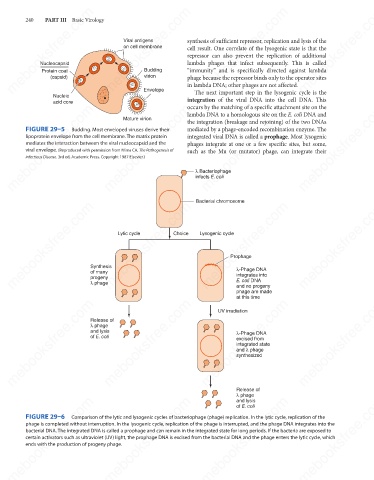
                 FIGURE 29–6
                                Comparison of the lytic and lysogenic cycles of bacteriophage (phage) replication. In the lytic cycle, replication of the
                 phage is completed without interruption. In the lysogenic cycle, replication of the phage is interrupted, and the phage DNA integrates into the
                 bacterial DNA. The integrated DNA is called a prophage and can remain in the integrated state for long periods. If the bacteria are exposed to
                 certain activators such as ultraviolet (UV) light, the prophage DNA is excised from the bacterial DNA and the phage enters the lytic cycle, which
                 ends with the production of progeny phage.


 mebooksfree.com  mebooksfree.com           mebooksfree.com                 mebooksfree.com                 mebooksfree.com                mebooksfree.com

