


Page 253 - Review of Medical Microbiology and Immunology ( PDFDrive )
P. 253
mebooksfree.com
mebooksfree.com
mebooksfree.com
mebooksfree.com
mebooksfree.com
mebooksfree.com mebooksfree.com c-III N mebooksfree.com RM O R P R mebooksfree.com mebooksfree.com mebooksfree.com
mebooksfree.com
PART III Basic Virology
242
DNA replication and
Integration
c-I
O
P
c-II
cro
P
genes
capsid protein genes
L
L
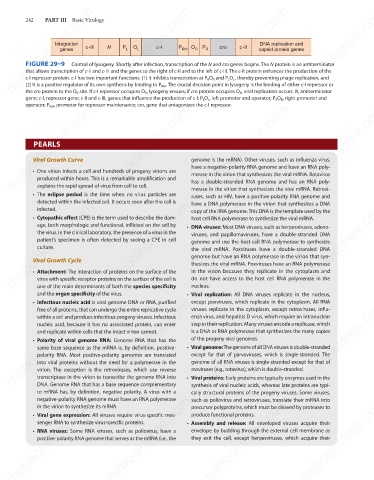
FIGURE 29–9
Control of lysogeny. Shortly after infection, transcription of the N and cro genes begins. The N protein is an antiterminator
that allows transcription of c-II and c-III and the genes to the right of c-II and to the left of c-III. The c-II protein enhances the production of the
c-I repressor protein. c-I has two important functions: (1) It inhibits transcription at P R O R and P L O L , thereby preventing phage replication, and
(2) It is a positive regulator of its own synthesis by binding to P RM . The crucial decision point in lysogeny is the binding of either c-I repressor or
the cro protein to the O R site. If c-I repressor occupies O R , lysogeny ensues; if cro protein occupies O R , viral replication occurs. N, antiterminator
gene; c-I, repressor gene; c-II and c-III, genes that influence the production of c-I; P L O L , left promoter and operator; P R O R , right promoter and
operator; P RM , promoter for repressor maintenance; cro, gene that antagonizes the c-I repressor.
mebooksfree.com
mebooksfree.com mebooksfree.com mebooksfree.com genome is the mRNA). Other viruses, such as influenza virus, mebooksfree.com
mebooksfree.com
PEARLS
Viral Growth Curve
have a negative-polarity RNA genome and have an RNA poly-
• One virion infects a cell and hundreds of progeny virions are
produced within hours. This is a remarkable amplification and
has a double-stranded RNA genome and has an RNA poly-
explains the rapid spread of virus from cell to cell.
merase in the virion that synthesizes the viral mRNA. Retrovi-
• The eclipse period is the time when no virus particles are merase in the virion that synthesizes the viral mRNA. Rotavirus
ruses, such as HIV, have a positive-polarity RNA genome and
detected within the infected cell. It occurs soon after the cell is
mebooksfree.com mebooksfree.com mebooksfree.com • DNA viruses: Most DNA viruses, such as herpesviruses, adeno- mebooksfree.com
mebooksfree.com
mebooksfree.com
have a DNA polymerase in the virion that synthesizes a DNA
infected.
copy of the RNA genome. This DNA is the template used by the
• Cytopathic effect (CPE) is the term used to describe the dam-
host cell RNA polymerase to synthesize the viral mRNA.
age, both morphologic and functional, inflicted on the cell by
the virus. In the clinical laboratory, the presence of a virus in the
viruses, and papillomaviruses, have a double-stranded DNA
patient’s specimen is often detected by seeing a CPE in cell
genome and use the host cell RNA polymerase to synthesize
culture.
the viral mRNA. Poxviruses have a double-stranded DNA
genome but have an RNA polymerase in the virion that syn-
Viral Growth Cycle
thesizes the viral mRNA. Poxviruses have an RNA polymerase
• Attachment: The interaction of proteins on the surface of the
in the virion because they replicate in the cytoplasm and
virus with specific receptor proteins on the surface of the cell is
do not have access to the host cell RNA polymerase in the
one of the main determinants of both the species specificity
nucleus.
and the organ specificity of the virus. • Viral replication: All DNA viruses replicate in the nucleus,
mebooksfree.com
mebooksfree.com mebooksfree.com mebooksfree.com • Viral genome: The genome of all DNA viruses is double-stranded mebooksfree.com
mebooksfree.com
• Infectious nucleic acid is viral genome DNA or RNA, purified
except poxviruses, which replicate in the cytoplasm. All RNA
viruses replicate in the cytoplasm, except retroviruses, influ-
free of all proteins, that can undergo the entire replicative cycle
enza virus, and hepatitis D virus, which require an intranuclear
within a cell and produce infectious progeny viruses. Infectious
nucleic acid, because it has no associated protein, can enter
step in their replication. Many viruses encode a replicase, which
is a DNA or RNA polymerase that synthesizes the many copies
and replicate within cells that the intact virion cannot.
of the progeny viral genomes.
• Polarity of viral genome RNA: Genome RNA that has the
same base sequence as the mRNA is, by definition, positive-
polarity RNA. Most positive-polarity genomes are translated
except for that of parvoviruses, which is single-stranded. The
into viral proteins without the need for a polymerase in the
genome of all RNA viruses is single-stranded except for that of
virion. The exception is the retroviruses, which use reverse
reoviruses (e.g., rotavirus), which is double-stranded.
transcriptase in the virion to transcribe the genome RNA into
DNA. Genome RNA that has a base sequence complementary
synthesis of viral nucleic acids, whereas late proteins are typi-
to mRNA has, by definition, negative polarity. A virus with a • Viral proteins: Early proteins are typically enzymes used in the
cally structural proteins of the progeny viruses. Some viruses,
mebooksfree.com
mebooksfree.com
mebooksfree.com mebooksfree.com mebooksfree.com • Assembly and release: All enveloped viruses acquire their mebooksfree.com
negative-polarity RNA genome must have an RNA polymerase
such as poliovirus and retroviruses, translate their mRNA into
in the virion to synthesize its mRNA.
precursor polyproteins, which must be cleaved by proteases to
• Viral gene expression: All viruses require virus-specific mes-
produce functional proteins.
senger RNA to synthesize virus-specific proteins.
• RNA viruses: Some RNA viruses, such as poliovirus, have a
envelope by budding through the external cell membrane as
they exit the cell, except herpesviruses, which acquire their
positive-polarity RNA genome that serves as the mRNA (i.e., the
mebooksfree.com mebooksfree.com mebooksfree.com mebooksfree.com mebooksfree.com mebooksfree.com

