


Page 26 - Review of Medical Microbiology and Immunology ( PDFDrive )
P. 26
mebooksfree.com
 mebooksfree.com


                    Growth mebooksfree.com
            mebooksfree.com
                                                                                                            mebooksfree.com
                                                                            mebooksfree.com
 mebooksfree.com  mebooksfree.com           mebooksfree.com                 mebooksfree.com         C   H 3          E   R                 mebooksfree.com
                                                                                                                                           mebooksfree.com
                                                                                                           A
                                                                                                               P
                                                                                                                  T


 mebooksfree.com  mebooksfree.com           mebooksfree.com              Iron Metabolism                    mebooksfree.com                mebooksfree.com
                                                                            mebooksfree.com
                       CHAPTER  C ONTENT S


                       Growth Cycle
                       Obligate Intracellular Growth
                                                                         Pearls
                       Aerobic & Anaerobic Growth
                                                                         Self-Assessment Questions
                                                                         Practice Questions: USMLE & Course Examinations
                       Fermentation of Sugars


                        GROWTH CYCLE                                                          c
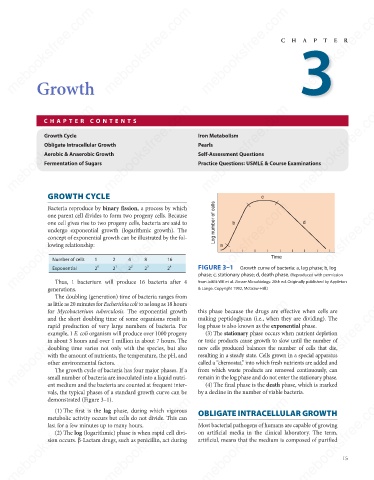
 mebooksfree.com  mebooksfree.com      1 2 0 mebooksfree.com             FIGURE 3–1  b  Growth curve of bacteria: a, lag phase; b, log     mebooksfree.com
                                                                            mebooksfree.com
                                                                                                            mebooksfree.com
                                                                              Log number of cells
                        Bacteria reproduce by binary fission, a process by which
                        one parent cell divides to form two progeny cells. Because
                        one cell gives rise to two progeny cells, bacteria are said to
                                                                                                           d
                        undergo  exponential  growth  (logarithmic  growth).  The
                        concept of exponential growth can be illustrated by the fol-
                        lowing relationship:
                                                                                a
                                                                                                 Time
                                                       8
                                                  4
                                             2
                         Number of cells
                                                               16
                                                                4
                                              1
                                                   2
                                                        3
                                                       2
                                                  2
                                                               2
                         Exponential
                                             2
                          Thus,  1 bacterium  will produce 16  bacteria after  4
                                                                         from Joklik WK et al. Zinsser Microbiology. 20th ed. Originally published by Appleton
                        generations.
                                                                         & Lange. Copyright 1992, McGraw-Hill.)
                          The doubling (generation) time of bacteria ranges from   phase; c, stationary phase; d, death phase. (Reproduced with permission
                                                                                                            mebooksfree.com
                                                                            mebooksfree.com
 mebooksfree.com  mebooksfree.com           mebooksfree.com              log phase is also known as the exponential phase.                 mebooksfree.com
                        as little as 20 minutes for Escherichia coli to as long as 18 hours
                                                                         this phase because the drugs are effective when cells are
                        for  Mycobacterium tuberculosis.  The  exponential  growth
                                                                         making peptidoglycan (i.e., when they are dividing). The
                        and the short doubling time of some organisms result in
                        rapid production of very large numbers of bacteria. For
                        example, 1 E. coli organism will produce over 1000 progeny
                                                                           (3) The stationary phase occurs when nutrient depletion
                        in about 3 hours and over 1 million in about 7 hours. The
                                                                         or toxic products cause growth to slow until the number of
                                                                         new cells produced balances the number of cells that die,
                        doubling time varies not only with the species, but also
                                                                         resulting in a steady state. Cells grown in a special apparatus
                        with the amount of nutrients, the temperature, the pH, and
                        other environmental factors.
                                                                         called a “chemostat,” into which fresh nutrients are added and
                          The growth cycle of bacteria has four major phases. If a
                        small number of bacteria are inoculated into a liquid nutri-
                                                                         remain in the log phase and do not enter the stationary phase.
                        ent medium and the bacteria are counted at frequent inter-
                                                                           (4) The final phase is the death phase, which is marked
                                                                         by a decline in the number of viable bacteria.
                        vals, the typical phases of a standard growth curve can be   from  which  waste products  are  removed  continuously,  can
                                                                                                            mebooksfree.com
 mebooksfree.com  mebooksfree.com           mebooksfree.com              Most bacterial pathogens of humans are capable of growing   15    mebooksfree.com
                                                                            mebooksfree.com
                        demonstrated (Figure 3–1).
                          (1) The first is  the  lag phase,  during which vigorous
                                                                         OBLIGATE INTRACELLULAR GROWTH
                        metabolic activity occurs but cells do not divide. This can
                        last for a few minutes up to many hours.
                          (2) The log (logarithmic) phase is when rapid cell divi-
                                                                         on artificial media in the clinical laboratory. The term,
                        sion occurs. β-Lactam drugs, such as penicillin, act during
                                                                         artificial, means that the medium is composed of purified
 mebooksfree.com  mebooksfree.com           mebooksfree.com                 mebooksfree.com                 mebooksfree.com                mebooksfree.com

