


Page 21 - Review of Medical Microbiology and Immunology ( PDFDrive )
P. 21
mebooksfree.com
mebooksfree.com
mebooksfree.com
mebooksfree.com
mebooksfree.com
mebooksfree.com
mebooksfree.com mebooksfree.com mebooksfree.com importance of bacteriocins is that they may be useful in mebooksfree.com
mebooksfree.com
mebooksfree.com
PART I Basic Bacteriology
10
9
2 × 10 and contains about 2000 genes. (By contrast, human
DNA has approximately 100,000 genes.) Because the nucle-
treating infections caused by antibiotic-resistant bacteria.
oid contains no nuclear membrane, no nucleolus, no
(2) Nitrogen fixation enzymes in Rhizobium in the root
nodules of legumes.
mitotic spindle, and no histones, there is little resemblance
to the eukaryotic nucleus. One major difference between
(3) Tumors caused by Agrobacterium in plants.
(4) Several antibiotics produced by Streptomyces.
bacterial DNA and eukaryotic DNA is that bacterial DNA
has no introns, whereas eukaryotic DNA does.
(5) A variety of degradative enzymes that are produced
mental hazards such as oil spills and toxic chemical waste
Plasmids by Pseudomonas and are capable of cleaning up environ-
mebooksfree.com
sites.
mebooksfree.com
mebooksfree.com mebooksfree.com mebooksfree.com Transposons are pieces of DNA that move readily from one mebooksfree.com
Plasmids are extrachromosomal, double-stranded, circular
DNA molecules that are capable of replicating indepen-
Transposons
dently of the bacterial chromosome. Although plasmids are
usually extrachromosomal, they can be integrated into the
bacterial chromosome. Plasmids occur in both gram-posi-
site to another either within or between the DNAs of bac-
tive and gram-negative bacteria, and several different types
teria, plasmids, and bacteriophages. Because of their
of plasmids can exist in one cell:
unusual ability to move, they are nicknamed “jumping
genes.” Some transposons move by replicating their DNA
(1) Transmissible plasmids can be transferred from cell
and inserting the new copy into another site (replicative
to cell by conjugation (see Chapter 4 for a discussion of
conjugation). They are large (MW 40–100 million), since
without replicating and then inserted into the new site
they contain about a dozen genes responsible for synthesis
(direct transposition). Transposons can code for drug-
of the sex pilus and for the enzymes required for transfer.
resistant enzymes, toxins, or a variety of metabolic enzymes
They are usually present in a few (1–3) copies per cell. transposition), whereas others are excised from the site
mebooksfree.com
tetanus toxin of Clostridium tetani. mebooksfree.com
mebooksfree.com mebooksfree.com On each end is a short DNA sequence of inverted repeats, mebooksfree.com
mebooksfree.com
and can either cause mutations in the gene into which they
(2) Nontransmissible plasmids are small (MW 3–20
insert or alter the expression of nearby genes.
million), since they do not contain the transfer genes; they
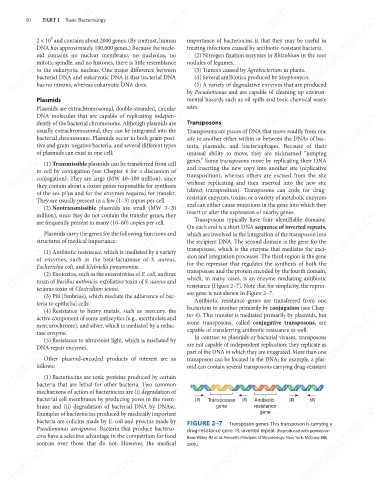
Transposons typically have four identifiable domains.
are frequently present in many (10–60) copies per cell.
Plasmids carry the genes for the following functions and
which are involved in the integration of the transposon into
structures of medical importance:
the recipient DNA. The second domain is the gene for the
transposase, which is the enzyme that mediates the exci-
(1) Antibiotic resistance, which is mediated by a variety
sion and integration processes. The third region is the gene
of enzymes, such as the beta-lactamase of S. aureus,
for the repressor that regulates the synthesis of both the
Escherichia coli, and Klebsiella pneumoniae.
transposase and the protein encoded by the fourth domain,
(2) Exotoxins, such as the enterotoxins of E. coli, anthrax
toxin of Bacillus anthracis, exfoliative toxin of S. aureus and
resistance (Figure 2–7). Note that for simplicity, the repres-
sor gene is not shown in Figure 2–7.
(3) Pili (fimbriae), which mediate the adherence of bac- which, in many cases, is an enzyme mediating antibiotic
Antibiotic resistance genes are transferred from one
mebooksfree.com
mebooksfree.com mebooksfree.com mebooksfree.com some transposons, called conjugative transposons, are mebooksfree.com
mebooksfree.com
teria to epithelial cells.
bacterium to another primarily by conjugation (see Chap-
(4) Resistance to heavy metals, such as mercury, the
ter 4). This transfer is mediated primarily by plasmids, but
active component of some antiseptics (e.g., merthiolate and
mercurochrome), and silver, which is mediated by a reduc-
capable of transferring antibiotic resistance as well.
tase enzyme.
In contrast to plasmids or bacterial viruses, transposons
(5) Resistance to ultraviolet light, which is mediated by
are not capable of independent replication; they replicate as
DNA repair enzymes.
part of the DNA in which they are integrated. More than one
Other plasmid-encoded products of interest are as
transposon can be located in the DNA; for example, a plas-
follows:
mid can contain several transposons carrying drug-resistant
(1) Bacteriocins are toxic proteins produced by certain
bacteria that are lethal for other bacteria. Two common
mechanisms of action of bacteriocins are (i) degradation of IR Transposase IR Antibiotic- IR IR
mebooksfree.com
bacterial cell membranes by producing pores in the mem-
mebooksfree.com mebooksfree.com mebooksfree.com FIGURE 2–7 Transposon genes. This transposon is carrying a mebooksfree.com
mebooksfree.com
brane and (ii) degradation of bacterial DNA by DNAse.
resistance
gene
gene
Examples of bacteriocins produced by medically important
bacteria are colicins made by E. coli and pyocins made by
Pseudomonas aeruginosa. Bacteria that produce bacterio-
drug-resistance gene. IR, inverted repeat. (Reproduced with permission
cins have a selective advantage in the competition for food
from Willey JM et al. Prescott’s Principles of Microbiology. New York: McGraw-Hill,
sources over those that do not. However, the medical
2009.)
mebooksfree.com mebooksfree.com mebooksfree.com mebooksfree.com mebooksfree.com mebooksfree.com

