


Page 23 - Review of Medical Microbiology and Immunology ( PDFDrive )
P. 23
mebooksfree.com
                                            mebooksfree.com
 mebooksfree.com

            mebooksfree.com
                                                                            mebooksfree.com
                                            mebooksfree.com
 mebooksfree.com  mebooksfree.com        Nucleoid         DNA              Peptidoglycan        Keratin coat mebooksfree.com               mebooksfree.com
                                                                                                            mebooksfree.com
                                                                                                                                           mebooksfree.com
                      PART I  Basic Bacteriology
                 12
                                   Plasma membrane
                                                           Septum
                           Cell wall

                                                                                                  Free spore
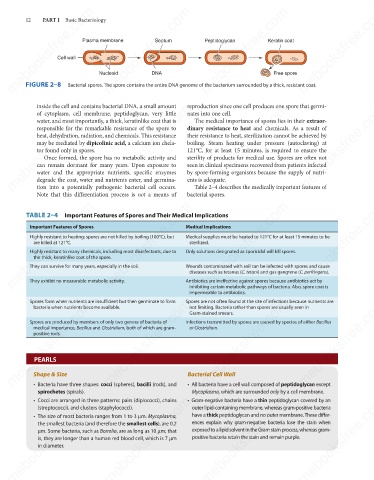
                 FIGURE 2–8
                              Bacterial spores. The spore contains the entire DNA genome of the bacterium surrounded by a thick, resistant coat.

                    inside the cell and contains bacterial DNA, a small amount
                                                                                                            mebooksfree.com
 mebooksfree.com  mebooksfree.com           mebooksfree.com          reproduction since one cell produces one spore that germi-            mebooksfree.com
                                                                            mebooksfree.com
                    of cytoplasm, cell membrane, peptidoglycan, very little
                                                                     nates into one cell.
                    water, and most importantly, a thick, keratinlike coat that is
                                                                        The medical importance of spores lies in their extraor-
                    responsible for the remarkable resistance of the spore to
                                                                     dinary resistance to heat and chemicals. As a result of
                    heat, dehydration, radiation, and chemicals. This resistance
                                                                     their resistance to heat, sterilization cannot be achieved by
                    may be mediated by dipicolinic acid, a calcium ion chela-
                                                                     boiling. Steam heating under pressure (autoclaving) at
                    tor found only in spores.
                                                                     121°C, for at least 15 minutes, is required to ensure the
                       Once formed, the spore has no metabolic activity and
                                                                     sterility of products for medical use. Spores are often not
                                                                     seen in clinical specimens recovered from patients infected
                    can remain dormant for many years. Upon exposure to
                    water and the appropriate nutrients, specific enzymes
                                                                     ents is adequate.
                    degrade the coat, water and nutrients enter, and germina-
                    tion into a potentially pathogenic bacterial cell occurs.
                                                                        Table 2–4 describes the medically important features of
                                                                     bacterial spores.
                    Note that this differentiation process is  not a means of   by spore-forming organisms because the supply of nutri-
                                                                            mebooksfree.com
 mebooksfree.com  mebooksfree.com           mebooksfree.com          Medical Implications                   mebooksfree.com                mebooksfree.com
                 TABLE 2–4  Important Features of Spores and Their Medical Implications
                  Important Features of Spores
                                                                     Medical supplies must be heated to 121°C for at least 15 minutes to be
                  Highly resistant to heating; spores are not killed by boiling (100°C), but
                   are killed at 121°C.
                                                                      sterilized.
                                                                     Only solutions designated as sporicidal will kill spores.
                  Highly resistant to many chemicals, including most disinfectants, due to
                   the thick, keratinlike coat of the spore.
                                                                     Wounds contaminated with soil can be infected with spores and cause
                  They can survive for many years, especially in the soil.
                                                                      diseases such as tetanus (C. tetani) and gas gangrene (C. perfringens).
                  They exhibit no measurable metabolic activity.
                                                                     Antibiotics are ineffective against spores because antibiotics act by
                                                                      inhibiting certain metabolic pathways of bacteria. Also, spore coat is
                                                                      impermeable to antibiotics.
                                                                                                            mebooksfree.com
 mebooksfree.com  mebooksfree.com           mebooksfree.com          Infections transmitted by spores are caused by species of either Bacillus   mebooksfree.com
                                                                            mebooksfree.com
                                                                     Spores are not often found at the site of infections because nutrients are
                  Spores form when nutrients are insufficient but then germinate to form
                   bacteria when nutrients become available.
                                                                      not limiting. Bacteria rather than spores are usually seen in
                                                                      Gram-stained smears.
                  Spores are produced by members of only two genera of bacteria of
                   medical importance, Bacillus and Clostridium, both of which are gram-
                                                                      or Clostridium.
                   positive rods.
                   PEARLS
                   Shape & Size
                   •  Bacteria have three shapes: cocci (spheres), bacilli (rods), and
                                                                      •  All bacteria have a cell wall composed of peptidoglycan except
                                                                       Mycoplasma, which are surrounded only by a cell membrane.
                     spirochetes (spirals).                           Bacterial Cell Wall
                                                                                                            mebooksfree.com
                                                                            mebooksfree.com
 mebooksfree.com  mebooksfree.com           mebooksfree.com            ences explain why gram-negative bacteria lose the stain when        mebooksfree.com
                                                                      •  Gram-negative bacteria have a thin peptidoglycan covered by an
                   •  Cocci are arranged in three patterns: pairs (diplococci), chains
                                                                       outer lipid-containing membrane, whereas gram-positive bacteria
                     (streptococci), and clusters (staphylococci).
                                                                       have a thick peptidoglycan and no outer membrane. These differ-
                   •  The size of most bacteria ranges from 1 to 3 μm. Mycoplasma,
                     the smallest bacteria (and therefore the smallest cells), are 0.2
                                                                       exposed to a lipid solvent in the Gram stain process, whereas gram-
                     μm. Some bacteria, such as Borrelia, are as long as 10 μm; that
                                                                       positive bacteria retain the stain and remain purple.
                     is, they are longer than a human red blood cell, which is 7 μm
                     in diameter.

 mebooksfree.com  mebooksfree.com           mebooksfree.com                 mebooksfree.com                 mebooksfree.com                mebooksfree.com

