


Page 31 - Review of Medical Microbiology and Immunology ( PDFDrive )
P. 31
mebooksfree.com
 mebooksfree.com


                                            mebooksfree.com
            mebooksfree.com
                                                                                                            mebooksfree.com
 mebooksfree.com  mebooksfree.com       Expression                   2      mebooksfree.com                 mebooksfree.com                mebooksfree.com
                                                                            mebooksfree.com
                                                                                                                                           mebooksfree.com
                 20
                      PART I  Basic Bacteriology
                                          locus
                                            1
                                                                             3
                                                                                              N
                                                                                      4
                                          mRNA

                                                                       rearrangement
                                         Protein 1                     Programmed
                                                                       moves gene 2 into
                                        (antigen 1)
                                                                       the expression locus
                                            mebooksfree.com
 mebooksfree.com  mebooksfree.com         mRNA                       2      mebooksfree.com                 mebooksfree.com                mebooksfree.com
                                        Expression
                                          locus
                                                                                              N
                                                                                      4
                                            2
                                                                             3


                                         Protein 2
                                        (antigen 2)
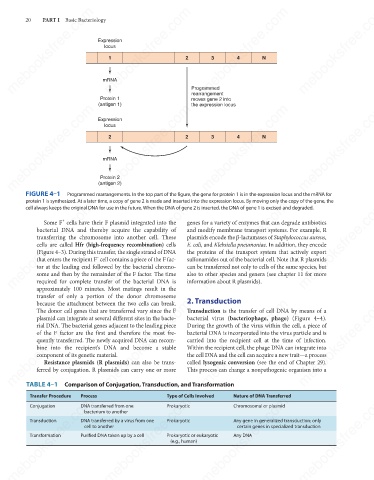
                 FIGURE 4–1   Programmed rearrangements. In the top part of the figure, the gene for protein 1 is in the expression locus and the mRNA for
                 protein 1 is synthesized. At a later time, a copy of gene 2 is made and inserted into the expression locus. By moving only the copy of the gene, the
                                                                            mebooksfree.com
 mebooksfree.com  mebooksfree.com       –   mebooksfree.com          genes for a variety of enzymes that can degrade antibiotics           mebooksfree.com
                                                                                                            mebooksfree.com
                 cell always keeps the original DNA for use in the future. When the DNA of gene 2 is inserted, the DNA of gene 1 is excised and degraded.
                             +
                       Some F  cells have their F plasmid integrated into the
                    bacterial DNA and thereby acquire the capability of
                                                                     and modify membrane transport systems. For example, R
                    transferring the chromosome into another cell. These
                                                                     plasmids encode the β-lactamases of Staphylococcus aureus,
                                                                     E. coli, and Klebsiella pneumoniae. In addition, they encode
                    cells  are called  Hfr (high-frequency recombination) cells
                                                                     the proteins of the transport system that actively export
                    (Figure 4–3). During this transfer, the single strand of DNA
                    that enters the recipient F  cell contains a piece of the F fac-
                                                                     sulfonamides out of the bacterial cell. Note that R plasmids
                                                                     can be transferred not only to cells of the same species, but
                    tor at the leading end followed by the bacterial chromo-
                    some and then by the remainder of the F factor. The time
                                                                     information about R plasmids).
                    required for complete  transfer  of the  bacterial DNA  is
                    approximately 100 minutes. Most matings result in the
                    transfer  of  only  a  portion  of  the  donor  chromosome   also to other species and genera (see chapter 11 for more
                                                                     2. Transduction
 mebooksfree.com  mebooksfree.com           mebooksfree.com          During the growth of the virus within the cell, a piece of            mebooksfree.com
                                                                            mebooksfree.com
                                                                                                            mebooksfree.com
                    because the attachment between the two cells can break.
                    The donor cell genes that are transferred vary since the F
                                                                     Transduction is the transfer of cell DNA by means of a
                                                                     bacterial virus (bacteriophage, phage) (Figure 4–4).
                    plasmid can integrate at several different sites in the bacte-
                    rial DNA. The bacterial genes adjacent to the leading piece
                    of the F factor are the first and therefore the most fre-
                                                                     bacterial DNA is incorporated into the virus particle and is
                                                                     carried  into  the  recipient  cell  at  the  time of infection.
                    quently transferred. The newly acquired DNA can recom-
                    bine  into  the recipient’s  DNA  and  become  a  stable
                                                                     Within the recipient cell, the phage DNA can integrate into
                    component of its genetic material.
                                                                     the cell DNA and the cell can acquire a new trait—a process
                                                                     called lysogenic conversion (see the end of Chapter 29).
                       Resistance plasmids (R plasmids) can also be trans-
                                                                     This process can change a nonpathogenic organism into a
                    ferred by conjugation. R plasmids can carry one or more
                 TABLE 4–1  Comparison of Conjugation, Transduction, and Transformation
                                                                                     Nature of DNA Transferred
                  Transfer Procedure
                                                               Type of Cells Involved
                                   Process
 mebooksfree.com  mebooksfree.com           mebooksfree.com                 mebooksfree.com                 mebooksfree.com                mebooksfree.com
                                   DNA transferred from one
                                                                                     Chromosomal or plasmid
                                                               Prokaryotic
                  Conjugation
                                    bacterium to another
                                                               Prokaryotic
                                   DNA transferred by a virus from one
                                                                                     Any gene in generalized transduction; only
                  Transduction
                                    cell to another
                                                                                      certain genes in specialized transduction
                                   Purified DNA taken up by a cell
                                                                                     Any DNA
                  Transformation
                                                               Prokaryotic or eukaryotic
                                                                (e.g., human)
 mebooksfree.com  mebooksfree.com           mebooksfree.com                 mebooksfree.com                 mebooksfree.com                mebooksfree.com

