


Page 268 - Review of Medical Microbiology and Immunology ( PDFDrive )
P. 268
mebooksfree.com
mebooksfree.com
mebooksfree.com
mebooksfree.com
mebooksfree.com
mebooksfree.com
mebooksfree.com
mebooksfree.com mebooksfree.com mebooksfree.com host defenses is by having multiple antigenic types (also 257 mebooksfree.com
mebooksfree.com
CHAPTER 32 Pathogenesis
Another important way by which viruses evade our
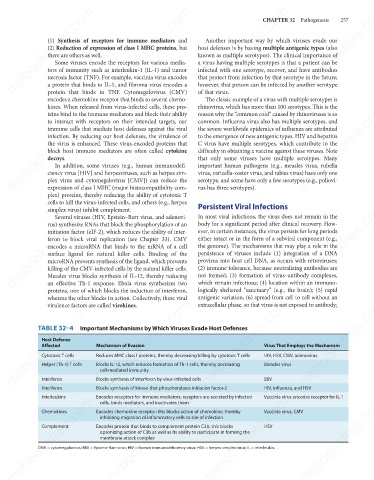
(1) Synthesis of receptors for immune mediators and
(2) Reduction of expression of class I MHC proteins, but
known as multiple serotypes). The clinical importance of
there are others as well.
Some viruses encode the receptors for various media-
a virus having multiple serotypes is that a patient can be
tors of immunity such as interleukin-1 (IL-1) and tumor
infected with one serotype, recover, and have antibodies
necrosis factor (TNF). For example, vaccinia virus encodes
a protein that binds to IL-1, and fibroma virus encodes a
however, that person can be infected by another serotype
protein that binds to TNF. Cytomegalovirus (CMV)
of that virus.
The classic example of a virus with multiple serotypes is
encodes a chemokine receptor that binds to several chemo- that protect from infection by that serotype in the future;
mebooksfree.com mebooksfree.com mebooksfree.com the severe worldwide epidemics of influenza are attributed mebooksfree.com
rhinovirus, which has more than 100 serotypes. This is the
kines. When released from virus-infected cells, these pro-
mebooksfree.com
mebooksfree.com
reason why the “common cold” caused by rhinoviruses is so
teins bind to the immune mediators and block their ability
to interact with receptors on their intended targets, our
common. Influenza virus also has multiple serotypes, and
immune cells that mediate host defenses against the viral
to the emergence of new antigenic types. HIV and hepatitis
infection. By reducing our host defenses, the virulence of
the virus is enhanced. These virus-encoded proteins that
C virus have multiple serotypes, which contribute to the
block host immune mediators are often called cytokine
difficulty in obtaining a vaccine against these viruses. Note
that only some viruses have multiple serotypes. Many
decoys.
important human pathogens (e.g., measles virus, rubella
In addition, some viruses (e.g., human immunodefi-
ciency virus [HIV] and herpesviruses, such as herpes sim-
plex virus and cytomegalovirus [CMV]) can reduce the
serotype, and some have only a few serotypes (e.g., poliovi-
expression of class I MHC (major histocompatibility com-
rus has three serotypes).
plex) proteins, thereby reducing the ability of cytotoxic T virus, varicella-zoster virus, and rabies virus) have only one
cells to kill the virus-infected cells, and others (e.g., herpes
mebooksfree.com
mebooksfree.com
mebooksfree.com mebooksfree.com mebooksfree.com body for a significant period after clinical recovery. How- mebooksfree.com
Persistent Viral Infections
simplex virus) inhibit complement.
In most viral infections, the virus does not remain in the
Several viruses (HIV, Epstein–Barr virus, and adenovi-
rus) synthesize RNAs that block the phosphorylation of an
ever, in certain instances, the virus persists for long periods
initiation factor (eIF-2), which reduces the ability of inter-
either intact or in the form of a subviral component (e.g.,
feron to block viral replication (see Chapter 33). CMV
the genome). The mechanisms that may play a role in the
encodes a microRNA that binds to the mRNA of a cell
persistence of viruses include (1) integration of a DNA
surface ligand for natural killer cells. Binding of the
provirus into host cell DNA, as occurs with retroviruses;
microRNA prevents synthesis of the ligand, which prevents
(2) immune tolerance, because neutralizing antibodies are
killing of the CMV-infected cells by the natural killer cells.
Measles virus blocks synthesis of IL-12, thereby reducing
which remain infectious; (4) location within an immuno-
an effective Th-1 response. Ebola virus synthesizes two
logically sheltered “sanctuary” (e.g., the brain); (5) rapid
proteins, one of which blocks the induction of interferon,
antigenic variation; (6) spread from cell to cell without an
whereas the other blocks its action. Collectively, these viral not formed; (3) formation of virus–antibody complexes,
mebooksfree.com mebooksfree.com Mechanism of Evasion mebooksfree.com mebooksfree.com mebooksfree.com
mebooksfree.com
extracellular phase, so that virus is not exposed to antibody;
virulence factors are called virokines.
TABLE 32–4 Important Mechanisms by Which Viruses Evade Host Defenses
Host Defense
Affected
Virus That Employs the Mechanism
Cytotoxic T cells
HIV, HSV, CMV, adenovirus
Reduces MHC class I proteins, thereby decreasing killing by cytotoxic T cells
Helper (Th-1) T cells
Blocks IL-12, which reduces formation of Th-1 cells, thereby decreasing
Measles virus
cell-mediated immunity
EBV
Blocks synthesis of interferon by virus-infected cells
Interferon
Blocks synthesis of kinase that phosphorylates initiation factor-2
HIV, influenza, and HSV
Interferon
Interleukins
mebooksfree.com
mebooksfree.com
mebooksfree.com mebooksfree.com Encodes receptors for immune mediators; receptors are secreted by infected Vaccinia virus encodes receptor for IL-1 mebooksfree.com
mebooksfree.com
cells, binds mediators, and inactivates them
Encodes chemokine receptor; this blocks action of chemokine, thereby
Vaccinia virus, CMV
Chemokines
inhibiting migration of inflammatory cells to site of infection
HSV
Encodes protein that binds to complement protein C3b; this blocks
Complement
opsonizing action of C3b as well as its ability to participate in forming the
membrane attack complex
CMV = cytomegalovirus; EBV = Epstein–Barr virus; HIV = human immunodeficiency virus; HSV = herpes simplex virus; IL = interleukin.
mebooksfree.com mebooksfree.com mebooksfree.com mebooksfree.com mebooksfree.com mebooksfree.com

