


Page 291 - Review of Medical Microbiology and Immunology ( PDFDrive )
P. 291
mebooksfree.com
mebooksfree.com
mebooksfree.com
mebooksfree.com
mebooksfree.com
mebooksfree.com
mebooksfree.com mebooksfree.com mebooksfree.com mebooksfree.com H A P T E R mebooksfree.com
mebooksfree.com
36
C
Viral Vaccines
mebooksfree.com
mebooksfree.com mebooksfree.com mebooksfree.com Herd Immunity mebooksfree.com mebooksfree.com
CHAPTER C ONTENT S
Introduction
Active Immunity
Pearls
(Killed, Subunit, and Live, Attenuated Vaccines)
Self-Assessment Questions
Practice Questions: USMLE & Course Examinations
Passive Immunity
mebooksfree.com
mebooksfree.com
mebooksfree.com mebooksfree.com mebooksfree.com replication, no viral epitopes are presented in association mebooksfree.com
INTRODUCTION
with class I MHC proteins, and the cytotoxic T-cell response
Because few drugs are useful against viral infections, pre-
is not activated (see Chapter 58). Although live vaccines
vention of infection by the use of vaccines is very impor-
stimulate a long-lasting response, booster doses are now
tant. Prevention of viral diseases can be achieved by the use
recommended with measles and polio vaccines.
of vaccines that induce active immunity or by the adminis-
One unique form of a live, attenuated viral vaccine is the
tration of preformed antibody that provides passive
influenza vaccine that contains a temperature-sensitive
immunity.
mutant of the virus as the immunogen. The temperature-
sensitive mutant will replicate in the cooler air passages of
the nose, where it induces IgA-based immunity, whereas it
ACTIVE IMMUNITY
will not replicate in the warmer lung tissue and therefore
will not cause disease.
There are two types of vaccines that induce active immu-
nity: those that contain live virus whose pathogenicity has
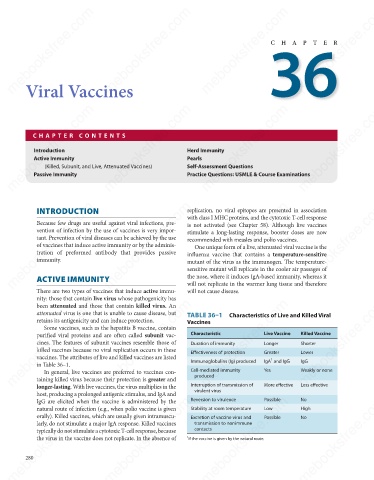
mebooksfree.com mebooksfree.com mebooksfree.com TABLE 36–1 Characteristics of Live and Killed Viral mebooksfree.com
mebooksfree.com
More effective mebooksfree.com
been attenuated and those that contain killed virus. An
attenuated virus is one that is unable to cause disease, but
retains its antigenicity and can induce protection.
Vaccines
Some vaccines, such as the hepatitis B vaccine, contain
Killed Vaccine
Characteristic
Live Vaccine
purified viral proteins and are often called subunit vac-
cines. The features of subunit vaccines resemble those of
Longer
Shorter
Duration of immunity
killed vaccines because no viral replication occurs in these
Lower
Greater
Effectiveness of protection
vaccines. The attributes of live and killed vaccines are listed
1
IgG
IgA and IgG
Immunoglobulins (Ig) produced
in Table 36–1.
In general, live vaccines are preferred to vaccines con-
produced
taining killed virus because their protection is greater and
Less effective
Interruption of transmission of
longer-lasting. With live vaccines, the virus multiplies in the
virulent virus
host, producing a prolonged antigenic stimulus, and IgA and Cell-mediated immunity Yes Weakly or none
mebooksfree.com
mebooksfree.com
mebooksfree.com mebooksfree.com mebooksfree.com 1 If the vaccine is given by the natural route. Possible No mebooksfree.com
Reversion to virulence
No
Possible
IgG are elicited when the vaccine is administered by the
natural route of infection (e.g., when polio vaccine is given
High
Low
Stability at room temperature
orally). Killed vaccines, which are usually given intramuscu-
Excretion of vaccine virus and
larly, do not stimulate a major IgA response. Killed vaccines
transmission to nonimmune
contacts
typically do not stimulate a cytotoxic T-cell response, because
the virus in the vaccine does not replicate. In the absence of
280
mebooksfree.com mebooksfree.com mebooksfree.com mebooksfree.com mebooksfree.com mebooksfree.com

