Page 33 - Review of Medical Microbiology and Immunology ( PDFDrive )
P. 33
mebooksfree.com
 mebooksfree.com


                                            mebooksfree.com
            mebooksfree.com
                                                                            mebooksfree.com
                                                                                                            mebooksfree.com
                                                                                                                                           mebooksfree.com
 mebooksfree.com  mebooksfree.com           mebooksfree.com                 mebooksfree.com           Transduced                           mebooksfree.com
                      PART I  Basic Bacteriology
                 22
                                Bacteriophage
                                                  Progeny
                                                                   Progeny
                                                                                     Transduced
                                                   phage
                                   Phage
                                                                    phage
                                                                                      bacterial
                                                    DNA
                                   DNA
                                                                                       DNA
                                                                                                       bacterial
                                                                                                        DNA
                                                                                                        Host
                                                                                       Host
                                  Bacterial
                                                                                                        DNA
                                                                                       DNA
                                    DNA
                                                  Fragmented
                                                  bacterial DNA                       bacterial       bacterial
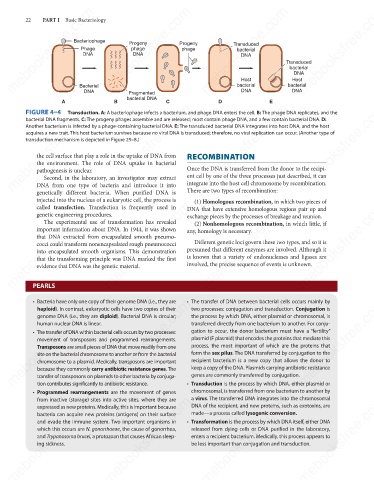
                            A  Transduction. A: A bacteriophage infects a bacterium, and phage DNA enters the cell. B: The phage DNA replicates, and the
                                                                                                E
                                                                                D
                                              B
                                                               C
                                                                            mebooksfree.com
 mebooksfree.com  mebooksfree.com           mebooksfree.com          RECOMBINATION                          mebooksfree.com                mebooksfree.com
                 FIGURE 4–4
                 bacterial DNA fragments. C: The progeny phages assemble and are released; most contain phage DNA, and a few contain bacterial DNA. D:
                 Another bacterium is infected by a phage-containing bacterial DNA. E: The transduced bacterial DNA integrates into host DNA, and the host
                 acquires a new trait. This host bacterium survives because no viral DNA is transduced; therefore, no viral replication can occur. (Another type of
                 transduction mechanism is depicted in Figure 29–8.)
                    the cell surface that play a role in the uptake of DNA from
                    the  environment. The role of DNA  uptake  in bacterial
                                                                     Once the DNA is transferred from the donor to the recipi-
                    pathogenesis is unclear.
                       Second, in the laboratory, an investigator may extract
                                                                     integrate into the host cell chromosome by recombination.
                    DNA from one type of bacteria and introduce it into
                                                                     There are two types of recombination:
                    genetically  different  bacteria. When  purified  DNA  is
                    injected into the nucleus of a eukaryotic cell, the process is   ent cell by one of the three processes just described, it can
                                                                        (1) Homologous recombination, in which two pieces of
 mebooksfree.com  mebooksfree.com           mebooksfree.com          any, homology is necessary.            mebooksfree.com                mebooksfree.com
                                                                            mebooksfree.com
                    called  transfection. Transfection is frequently used in
                                                                     DNA that have extensive homologous regions pair up and
                    genetic engineering procedures.
                                                                     exchange pieces by the processes of breakage and reunion.
                       The experimental use of transformation has revealed
                                                                        (2) Nonhomologous recombination, in which little, if
                    important information about DNA. In 1944, it was shown
                    that DNA extracted from encapsulated smooth pneumo-
                                                                        Different genetic loci govern these two types, and so it is
                    cocci could transform nonencapsulated rough pneumococci
                                                                     presumed that different enzymes are involved. Although it
                    into encapsulated smooth organisms. This demonstration
                                                                     is known that a variety of endonucleases and ligases are
                    that the transforming principle was DNA marked the first
                                                                     involved, the precise sequence of events is unknown.
                    evidence that DNA was the genetic material.
                   PEARLS
                                                                                                            mebooksfree.com
 mebooksfree.com  mebooksfree.com           mebooksfree.com          •  The transfer of DNA between bacterial cells occurs mainly by       mebooksfree.com
                                                                            mebooksfree.com
                   •  Bacteria have only one copy of their genome DNA (i.e., they are
                    haploid). In contrast, eukaryotic cells have two copies of their
                                                                       two processes: conjugation and transduction. Conjugation is
                    genome DNA (i.e., they are diploid). Bacterial DNA is circular;
                                                                       the process by which DNA, either plasmid or chromosomal, is
                    human nuclear DNA is linear.
                                                                       transferred directly from one bacterium to another. For conju-
                                                                       gation to occur, the donor bacterium must have a “fertility”
                   •  The transfer of DNA within bacterial cells occurs by two processes:
                                                                       plasmid (F plasmid) that encodes the proteins that mediate this
                    movement of transposons and programmed rearrangements.
                                                                       process, the most important of which are the proteins that
                    Transposons are small pieces of DNA that move readily from one
                                                                       form the sex pilus. The DNA transferred by conjugation to the
                    site on the bacterial chromosome to another or from the bacterial
                                                                       recipient bacterium is a new copy that allows the donor to
                    chromosome to a plasmid. Medically, transposons are important
                                                                       keep a copy of the DNA. Plasmids carrying antibiotic resistance
                    because they commonly carry antibiotic resistance genes. The
                                                                       genes are commonly transferred by conjugation.
                    transfer of transposons on plasmids to other bacteria by conjuga-
                    tion contributes significantly to antibiotic resistance.
                                                                       chromosomal, is transferred from one bacterium to another by
                   •  Programmed rearrangements are the movement of genes   •  Transduction is the process by which DNA, either plasmid or
                                                                            mebooksfree.com
 mebooksfree.com  mebooksfree.com           mebooksfree.com          •  Transformation is the process by which DNA itself, either DNA      mebooksfree.com
                                                                                                            mebooksfree.com
                                                                       a virus. The transferred DNA integrates into the chromosomal
                    from inactive (storage) sites into active sites, where they are
                                                                       DNA of the recipient, and new proteins, such as exotoxins, are
                    expressed as new proteins. Medically, this is important because
                                                                       made—a process called lysogenic conversion.
                    bacteria can acquire new proteins (antigens) on their surface
                    and evade the immune system. Two important organisms in
                                                                       released from dying cells or DNA purified in the laboratory,
                    which this occurs are N. gonorrhoeae, the cause of gonorrhea,
                    and Trypanosoma brucei, a protozoan that causes African sleep-
                                                                       enters a recipient bacterium. Medically, this process appears to
                                                                       be less important than conjugation and transduction.
                    ing sickness.
 mebooksfree.com  mebooksfree.com           mebooksfree.com                 mebooksfree.com                 mebooksfree.com                mebooksfree.com
   28   29   30   31   32   33   34   35   36   37   38