


Page 318 - Review of Medical Microbiology and Immunology ( PDFDrive )
P. 318
mebooksfree.com


                                                                                                            mebooksfree.com
                                                                            mebooksfree.com
            mebooksfree.com
                                                                                                                                           mebooksfree.com
 mebooksfree.com  mebooksfree.com           mebooksfree.com                 mebooksfree.com                 mebooksfree.com                mebooksfree.com
                                            mebooksfree.com
                                                                                   CHAPTER 38  DNA Nonenveloped Viruses
                                                                                                                        307
                          Genital warts are among the  most common sexually
                        transmitted diseases. Skin warts are more common in
                        children  and  young  adults  and  tend  to  regress  in  older
                        adults. HPV transmitted from an infected mother to the
                        neonate during childbirth causes warts in the mouth and in
                        the respiratory tract, especially on the larynx, of the infant.
                        Many species of animals are infected with their own types
                        of papillomaviruses, but these viruses are not an important
                        source of human infection.                       FIGURE 38–3    Papillomas (warts) on finger—note dry, raised
                                                                            mebooksfree.com
 mebooksfree.com  mebooksfree.com           mebooksfree.com              matology. 6th ed. New York: McGraw-Hill, 2009. Copyright © 2009 by The McGraw-  mebooksfree.com
                                                                                                            mebooksfree.com
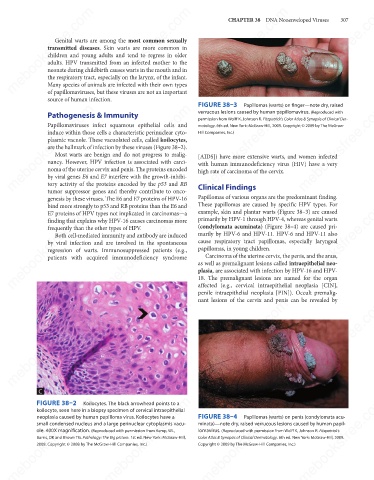
                        Pathogenesis & Immunity
                                                                         verrucous lesions caused by human papillomavirus. (Reproduced with
                                                                         permission from Wolff K, Johnson R. Fitzpatrick’s Color Atlas & Synopsis of Clinical Der-
                        Papillomaviruses  infect  squamous  epithelial  cells  and
                        induce within those cells a characteristic perinuclear cyto-
                                                                         Hill Companies, Inc.)
                        plasmic vacuole. These vacuolated cells, called koilocytes,
                        are the hallmark of infection by these viruses (Figure 38–2).
                          Most warts are benign and do not progress to malig-
                                                                         [AIDS]) have more extensive warts, and women infected
                        nancy. However, HPV infection is associated with carci-
                                                                         with human immunodeficiency virus (HIV) have a very
                        noma of the uterine cervix and penis. The proteins encoded
                                                                         high rate of carcinoma of the cervix.
                        by viral genes E6 and E7 interfere with the growth-inhibi-
                        tory activity of the proteins encoded by the  p53 and  RB
                        tumor suppressor genes and thereby contribute to onco-
                                                                         Papillomas of various organs are the predominant finding.
                        genesis by these viruses. The E6 and E7 proteins of HPV-16   Clinical Findings
 mebooksfree.com  mebooksfree.com           mebooksfree.com              (condylomata acuminata) (Figure 38–4) are caused pri-             mebooksfree.com
                                                                                                            mebooksfree.com
                                                                            mebooksfree.com
                                                                         These papillomas are caused by  specific HPV types. For
                        bind more strongly to p53 and RB proteins than the E6 and
                                                                         example, skin and plantar warts (Figure 38–3) are caused
                        E7 proteins of HPV types not implicated in carcinomas—a
                                                                         primarily by HPV-1 through HPV-4, whereas genital warts
                        finding that explains why HPV-16 causes carcinomas more
                        frequently than the other types of HPV.
                                                                         marily by HPV-6 and HPV-11. HPV-6 and HPV-11 also
                          Both cell-mediated immunity and antibody are induced
                                                                         cause respiratory tract papillomas, especially laryngeal
                        by viral infection and are involved in the spontaneous
                                                                         papillomas, in young children.
                        regression of warts. Immunosuppressed patients (e.g.,
                                                                           Carcinoma of the uterine cervix, the penis, and the anus,
                        patients with acquired immunodeficiency syndrome
                                                                         as well as premalignant lesions called intraepithelial neo-
                                                                         plasia, are associated with infection by HPV-16 and HPV-
                                                                         18. The premalignant lesions are named for the organ
                                                                         affected (e.g., cervical intraepithelial neoplasia [CIN],
                                                                         penile intraepithelial neoplasia [PIN]). Occult premalig-
                                                                         nant lesions of the cervix and penis can be revealed by
 mebooksfree.com  mebooksfree.com           mebooksfree.com                 mebooksfree.com                 mebooksfree.com                mebooksfree.com


                                                                                                            mebooksfree.com
 mebooksfree.com  mebooksfree.com           mebooksfree.com              FIGURE 38–4    Papillomas (warts) on penis (condylomata acu-      mebooksfree.com
                                                                            mebooksfree.com
                    FIGURE 38–2
                                   Koilocytes. The black arrowhead points to a
                    koilocyte, seen here in a biopsy specimen of cervical intraepithelial
                    neoplasia caused by human papilloma virus. Koilocytes have a
                    small condensed nucleus and a large perinuclear cytoplasmis vacu-
                                                                         minata)—note dry, raised verrucous lesions caused by human papil-
                                                                         lomavirus. (Reproduced with permission from Wolff K, Johnson R. Fitzpatrick’s
                    ole. 400X magnification. (Reproduced with permission from Kemp, WL,
                                                                         Color Atlas & Synopsis of Clinical Dermatology. 6th ed. New York: McGraw-Hill, 2009.
                    Burns, DK and Brown TG. Pathology: The Big picture. 1st ed. New York: McGraw-Hill,
                                                                         Copyright © 2009 by The McGraw-Hill Companies, Inc.)
                    2008. Copyright © 2008 by The McGraw-Hill Companies, Inc.)


 mebooksfree.com  mebooksfree.com           mebooksfree.com                 mebooksfree.com                 mebooksfree.com                mebooksfree.com

