


Page 398 - Review of Medical Microbiology and Immunology ( PDFDrive )
P. 398
mebooksfree.com
                                                                            mebooksfree.com
 mebooksfree.com

            mebooksfree.com
                                                                                                            mebooksfree.com
                                                                                                                                           mebooksfree.com
 mebooksfree.com  mebooksfree.com           mebooksfree.com              indinavir, nelfinavir, ritonavir, saquinavir, tipranavir, and a   387  mebooksfree.com
                                                                            mebooksfree.com
                                            mebooksfree.com
                                                                               CHAPTER 45  Human Immunodeficiency Virus
                        prolonging life, improving quality of life, and reducing viral
                        load but does not cure the chronic HIV infection (i.e., rep-
                                                                         combination of lopinavir and ritonavir). Protease inhibitors
                                                                         when combined with nucleoside analogues are very effec-
                        lication of HIV within CD4-positive cells continues indefi-
                        nitely). Discontinuation of HAART almost always results in
                                                                         tive in inhibiting viral replication and increasing CD4 cell
                                                                         counts and are commonly used in HAART regimens. Lopi-
                        viremia (a return of the viral load to its pretreatment set
                        point) and a fall in the CD4 count.
                                                                         navir inhibits the degradation of lopinavir thereby
                                                                         increasing the concentration of lopinavir. A briefer way of
                        Nucleoside/Nucleotide Reverse Transcriptase
                                                                         saying that is ritonavir “boosts” lopinavir.
                        Inhibitors (NRTIs)                               navir and ritonavir are given in combination because rito-
 mebooksfree.com  mebooksfree.com           mebooksfree.com              bination of two protease inhibitors, namely, ritonavir and        mebooksfree.com
                                                                            mebooksfree.com
                                                                           Mutants of HIV resistant to protease inhibitors can be a
                                                                                                            mebooksfree.com
                        Table 45–3 describes six nucleoside reverse transcriptase
                                                                         significant clinical problem. Resistance to one  protease
                        inhibitors (abacavir, didanosine, emtricitabine, lamivudine,
                                                                         inhibitor often conveys resistance to all; however, the com-
                        stavudine, and zidovudine) and a single nucleotide reverse
                        transcriptase inhibitor (tenofovir). These drugs are charac-
                                                                         lopinavir (Kaletra), is effective against both mutant and
                        terized by not having a 3′ hydroxyl group on the ribose ring
                                                                         nonmutant strains of HIV. Also, darunavir is effective
                        and therefore are chain-terminating drugs. They inhibit
                                                                         against many strains of HIV that are resistant to other pro-
                        HIV replication by interfering with proviral DNA synthesis
                                                                         tease inhibitors. Mutants of HIV resistant to both protease
                        by reverse transcriptase. They cannot cure an infected cell
                                                                         inhibitors and reverse transcriptase inhibitors have been
                        of an already integrated copy of proviral DNA. Additional
                                                                         recovered from patients.
                        information on these “nucleoside analogue” drugs and the
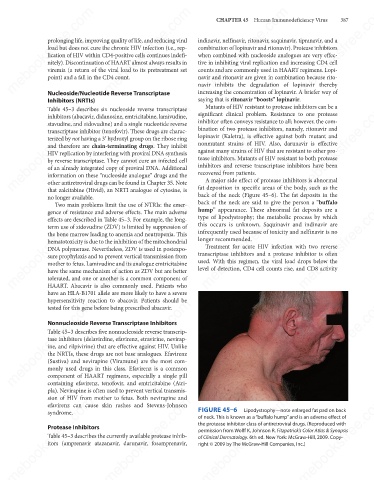
                                                                           A major side effect of protease inhibitors is abnormal
                        other antiretroviral drugs can be found in Chapter 35. Note
                        that zalcitabine (Hivid), an NRTI analogue of cytosine, is
                                                                         back of the neck (Figure 45–6). The fat deposits in the
                        no longer available.                             fat deposition in specific areas of the body, such as the
                                                                         back of the neck are said to give the person a “buffalo
                                                                            mebooksfree.com
 mebooksfree.com  mebooksfree.com           mebooksfree.com              this occurs is unknown. Saquinavir and indinavir are              mebooksfree.com
                                                                                                            mebooksfree.com
                          Two main problems limit the use of NTRIs: the emer-
                                                                         hump” appearance. These abnormal fat deposits are a
                        gence of resistance and adverse effects. The main adverse
                                                                         type of lipodystrophy; the metabolic process by which
                        effects are described in Table 45–3. For example, the long-
                        term use of zidovudine (ZDV) is limited by suppression of
                                                                         infrequently used because of toxicity and nelfinavir is no
                        the bone marrow leading to anemia and neutropenia. This
                                                                         longer recommended.
                        hematotoxicity is due to the inhibition of the mitochondrial
                                                                           Treatment for acute HIV infection with two reverse
                        DNA polymerase. Nevertheless, ZDV is used in postexpo-
                                                                         transcriptase inhibitors and a protease inhibitor is often
                        sure prophylaxis and to prevent vertical transmission from
                                                                         used. With this regimen, the viral load drops below the
                        mother to fetus. Lamivudine and its analogue emtricitabine
                                                                         level of detection, CD4 cell counts rise, and CD8 activity
                        have the same mechanism of action as ZDV but are better
                        tolerated, and one or another is a common component of
                        HAART. Abacavir is also commonly used. Patients who
                        have an HLA-B1701 allele are more likely to have a severe
                        hypersensitivity reaction to abacavir. Patients should be
 mebooksfree.com  mebooksfree.com           mebooksfree.com                 mebooksfree.com                 mebooksfree.com                mebooksfree.com
                        tested for this gene before being prescribed abacavir.
                        Nonnucleoside Reverse Transcriptase Inhibitors
                        Table 45–3 describes five nonnucleoside reverse transcrip-
                        tase inhibitors (delavirdine, efavirenz, etravirine, nevirap-
                        ine, and rilpivirine) that are effective against HIV. Unlike
                        the NRTIs, these drugs are not base analogues. Efavirenz
                        (Sustiva) and nevirapine (Viramune) are the most com-
                        monly used drugs in this class. Efavirenz is a common
                        component of HAART regimens, especially a single pill
                        containing efavirenz, tenofovir, and emtricitabine (Atri-
                        pla). Nevirapine is often used to prevent vertical transmis-  FIGURE 45–6   Lipodystrophy—note enlarged fat pad on back
                        sion of HIV from mother to fetus. Both nevirapine and
                                                                            mebooksfree.com
                                                                                                            mebooksfree.com
 mebooksfree.com  mebooksfree.com           mebooksfree.com              of neck. This is known as a “buffalo hump” and is an adverse effect of   mebooksfree.com
                        efavirenz can cause skin rashes and Stevens-Johnson
                        syndrome.
                                                                         the protease inhibitor class of antiretroviral drugs. (Reproduced with
                        Protease Inhibitors
                                                                         permission from Wolff K, Johnson R. Fitzpatrick’s Color Atlas & Synopsis
                        Table 45–3 describes the currently available protease inhib-
                                                                         of Clinical Dermatology. 6th ed. New York: McGraw-Hill, 2009. Copy-
                        itors  (amprenavir  atazanavir,  darunavir,  fosamprenavir,
                                                                         right © 2009 by The McGraw-Hill Companies, Inc.)
 mebooksfree.com  mebooksfree.com           mebooksfree.com                 mebooksfree.com                 mebooksfree.com                mebooksfree.com

