


Page 411 - Review of Medical Microbiology and Immunology ( PDFDrive )
P. 411
mebooksfree.com
mebooksfree.com
mebooksfree.com
mebooksfree.com
mebooksfree.com
mebooksfree.com
mebooksfree.com
mebooksfree.com
mebooksfree.com
mebooksfree.com mebooksfree.com Name of Drug Mechanism of Action Important Adverse Reactions mebooksfree.com
PART V Mycology
400
TABLE 47–3 Mechanism of Action and Adverse Effects of Antifungal Drugs
Usage
Renal toxicity, fever, and chills; moni-
Amphotericin B
Binds to ergosterol and disrupts
Systemic use (intravenous, oral)
tor kidney function; use test dose;
fungal cell membranes
liposomal preparation reduces
toxicity
Azoles such as fluconazole,
ketoconazole, itraconazole,
chrome P450; this decreases synthe-
sis of gonadal steroids resulting in
voriconazole, posaconazole Inhibits ergosterol synthesis Ketoconazole inhibits human cyto-
mebooksfree.com
mebooksfree.com
mebooksfree.com mebooksfree.com Flucytosine (FC) Inhibits DNA synthesis; FC con- Bone marrow toxicity mebooksfree.com mebooksfree.com
gynecomastia
Well-tolerated
Inhibits synthesis of d-glucan, a
Echinocandins such as caspo-
component of fungal cell wall
fungin, micafungin
verted to fluorouracil, which
inhibits thymidine synthetase
Liver toxicity
Disrupts mitotic spindle by bind-
Griseofulvin
ing to tubulin
Topical use (skin only); too toxic
Well-tolerated on skin
Inhibits ergosterol synthesis
Azoles such as clotrimazole,
miconazole
for systemic use
Inhibits ergosterol synthesis
Well-tolerated on skin
Tolnaftate
Nystatin
Binds to ergosterol and disrupts
Terbinafine Inhibits ergosterol synthesis Well-tolerated on skin
Well-tolerated on skin
mebooksfree.com
fungal cell membranes
mebooksfree.com
mebooksfree.com mebooksfree.com mebooksfree.com and the various azoles, exploit the presence of ergosterol mebooksfree.com
The most effective antifungal drugs, amphotericin B
a significant rise in the antibody titer must be observed to
confirm a diagnosis. The complement fixation test is most
in fungal cell membranes that is not found in bacterial or
frequently used in suspected cases of coccidioidomycosis,
human cell membranes. Amphotericin B (Fungizone)
histoplasmosis, and blastomycosis. In cryptococcal menin-
disrupts fungal cell membranes at the site of ergosterol
gitis, the presence of the polysaccharide capsular antigens
and azole drugs inhibit the synthesis of ergosterol, which
of C. neoformans in the spinal fluid can be detected by the
latex agglutination test.
is an essential component of fungal membranes. Another
antifungal drug, caspofungin (Cancidas), inhibits the
synthesis of β-glucan, which is found in fungal cell walls
ANTIFUNGAL THERAPY
but not in bacterial cell walls. Human cells do not have a
The drugs used to treat bacterial diseases have no effect on
mebooksfree.com mebooksfree.com mebooksfree.com cell wall. mebooksfree.com mebooksfree.com mebooksfree.com
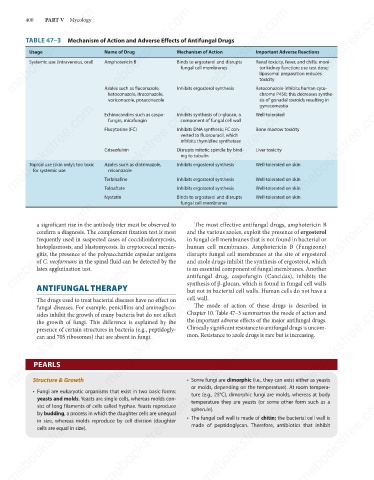
The mode of action of these drugs is described in
fungal diseases. For example, penicillins and aminoglyco-
Chapter 10. Table 47–3 summarizes the mode of action and
sides inhibit the growth of many bacteria but do not affect
the important adverse effects of the major antifungal drugs.
the growth of fungi. This difference is explained by the
Clinically significant resistance to antifungal drugs is uncom-
presence of certain structures in bacteria (e.g., peptidogly-
mon. Resistance to azole drugs is rare but is increasing.
can and 70S ribosomes) that are absent in fungi.
PEARLS
Structure & Growth
or molds, depending on the temperature). At room tempera-
• Fungi are eukaryotic organisms that exist in two basic forms: • Some fungi are dimorphic (i.e., they can exist either as yeasts
ture (e.g., 25°C), dimorphic fungi are molds, whereas at body
mebooksfree.com
mebooksfree.com mebooksfree.com mebooksfree.com • The fungal cell wall is made of chitin; the bacterial cell wall is mebooksfree.com
mebooksfree.com
yeasts and molds. Yeasts are single cells, whereas molds con-
temperature they are yeasts (or some other form such as a
sist of long filaments of cells called hyphae. Yeasts reproduce
spherule).
by budding, a process in which the daughter cells are unequal
in size, whereas molds reproduce by cell division (daughter
made of peptidoglycan. Therefore, antibiotics that inhibit
cells are equal in size).
mebooksfree.com mebooksfree.com mebooksfree.com mebooksfree.com mebooksfree.com mebooksfree.com

