Page 415 - Review of Medical Microbiology and Immunology ( PDFDrive )
P. 415
mebooksfree.com
                                                                                                            mebooksfree.com
 mebooksfree.com

            mebooksfree.com
                                            mebooksfree.com
                                                                                                            mebooksfree.com
                                                                            mebooksfree.com
                                                                                                                                           mebooksfree.com
 mebooksfree.com  mebooksfree.com           mebooksfree.com            Important Clinical Findings  Laboratory Diagnosis                   mebooksfree.com
                 404
                       PART V  Mycology
                 TABLE 48–2  Important Features of Skin and Subcutaneous Fungal Diseases
                                Forms in Tissue Seen
                                                  Mode of Transmission
                  Genus
                                by Microscopy
                                Hyphae
                                                                                                   Potassium hydroxide (KOH)
                                                                       Tinea capitis, tinea pedis, etc.,
                                                  Human to human
                  Trichophyton,
                                                                        “ringworm” Ring of inflammatory,
                                                                                                    prep shows septate
                   Epidermophyton
                                                                        pruritic vesicles with a healing
                                                                                                    hyphae culture on Sab-
                                                                        center
                                                                                                    ouraud’s agar
                  Microsporum
                                                  Animal to human as well as
                                Hyphae
                                                   human to human      Tinea capitis, tinea pedis, etc.,   KOH prep shows septate
                                                                        “ringworm” Ring of inflammatory,
                                                                                                    hyphae culture on Sab-
                                                                            mebooksfree.com
                                                                                                            mebooksfree.com
 mebooksfree.com  mebooksfree.com           mebooksfree.com          contain hyphae. Patients with tinea infections show positive          mebooksfree.com
                                                                                                    ouraud’s agar
                                                                        pruritic vesicles with a healing center
                                                  Human to human
                                                                       Scaly plaques on trunk; often
                                Hyphae and yeasts
                                                                                                   KOH prep shows mixture of
                  Malassezia
                                                                        hypopigmented; often nonpruritic
                                                                                                    hyphae and yeasts
                                Yeasts
                                                                                                   KOH prep shows cigar-
                                                  Penetrating lesion in gar-
                                                                       Pustule or ulcer on hands often with
                  Sporothrix
                                                   den implants fungal
                                                                                                    shaped yeasts culture at
                                                                        nodules on arms
                                                                                                    20°C shows hyphae with
                                                   spores, e.g., rose thorn
                                                                                                    daisy-like conidia
                    CUTANEOUS MYCOSES
                    Dermatophytoses
                                                                        Scrapings of skin or nail placed in 10% potassium
                                                                     hydroxide (KOH) on a glass slide show septate hyphae
                    Dermatophytoses are caused by fungi (dermatophytes)
                                                                     under microscopy. Cultures on Sabouraud’s agar at room
                    that infect only superficial keratinized structures (skin,   skin tests with fungal extracts (e.g., trichophytin).
 mebooksfree.com  mebooksfree.com           mebooksfree.com          exposed to ultraviolet light from a Wood’s lamp. mebooksfree.com      mebooksfree.com
                                                                            mebooksfree.com
                                                                     temperature develop typical hyphae and  conidia. Tinea
                    hair, and nails), not deeper tissues. The most important
                                                                     capitis lesions caused by  Microsporum species can be
                    dermatophytes are classified in three genera: Trichophyton,
                                                                     detected by seeing fluorescence when the lesions are
                    Epidermophyton, and Microsporum. They are spread from
                    infected  persons  by direct  contact.  Microsporum  is  also
                                                                        Treatment involves local antifungal creams, such as (ter-
                    spread from animals such as dogs and cats. This indicates
                                                                     binafine  (Lamisil),  undecylenic  acid  (Desenex),  micon-
                    that to prevent reinfection, the animal must be treated also.
                                                                     azole (Micatin), or tolnaftate (Tinactin). Oral griseofulvin
                       Dermatophytoses (tinea, ringworm) are chronic infec-
                                                                     (Fulvicin) or oral itraconazole (Sporanox) can also be used.
                    tions often located in the warm, humid areas of the body
                                                                     Tinea unguium can be treated with efinaconazole solution
                                             1
                    (e.g., athlete’s foot and jock itch).  Typical ringworm lesions
                    have an inflamed circular border containing papules and
                                                                     skin dry and cool.
                    vesicles surrounding a clear area of relatively normal skin.
                    The lesions are typically pruritic. Broken hairs and dam-
                    aged nails are often seen. The disease is typically named for   applied topically to the nails. Prevention centers on keeping
 mebooksfree.com  mebooksfree.com           mebooksfree.com                 mebooksfree.com                 mebooksfree.com                mebooksfree.com
                    the affected body part (i.e., tinea capitis [head], tinea cor-
                    poris [body], tinea cruris [groin], and tinea pedis [foot])
                    (Figure 48–1). Tinea unguium, also called onychomycosis,
                    is  a disease of  the nails, especially toe  nails. The nails
                    become thickened, broken, and discolored.
                       Trichophyton tonsurans is the most common cause of out-
                    breaks of tinea capitis in children and is the main cause of
                    endothrix (inside the hair) infections. Trichophyton rubrum is
                    also a very common cause of tinea capitis.  Trichophyton
                    schoenleinii is the cause of favus, a form of tinea capitis in
                    which crusts are seen on the scalp. Trichophyton species also
                    cause an inflammatory pustular lesion on the scalp called a
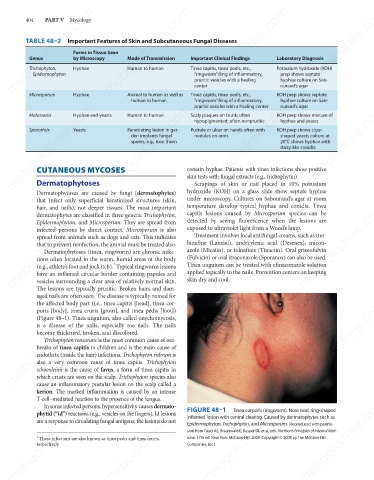
                    kerion.  The  marked  inflammation  is  caused  by  an  intense   FIGURE 48–1   Tinea corporis (ringworm). Note oval, ring-shaped
                                                                                                            mebooksfree.com
                    T-cell–mediated reaction to the presence of the fungus.
                                                                            mebooksfree.com
 mebooksfree.com  mebooksfree.com           mebooksfree.com          inflamed lesion with central clearing. Caused by dermatophytes such as   mebooksfree.com
                       In some infected persons, hypersensitivity causes dermato-
                    phytid (“id”) reactions (e.g., vesicles on the fingers). Id lesions
                    are a response to circulating fungal antigens; the lesions do not
                                                                     Epidermophyton, Trichophyton, and Microsporum. (Reproduced with permis-
                                                                     sion from Fauci AS, Braunwald E, Kasper DL et al, eds. Harrison’s Principles of Internal Med-
                    1
                                                                     icine. 17th ed. New York: McGraw-Hill, 2008. Copyright © 2008 by The McGraw-Hill
                      These infections are also known as tinea pedis and tinea cruris,
                    respectively.
                                                                     Companies, Inc.)
 mebooksfree.com  mebooksfree.com           mebooksfree.com                 mebooksfree.com                 mebooksfree.com                mebooksfree.com
   410   411   412   413   414   415   416   417   418   419   420