


Page 490 - Review of Medical Microbiology and Immunology ( PDFDrive )
P. 490
mebooksfree.com


            mebooksfree.com
                                                                                                                                           mebooksfree.com
                                                                            mebooksfree.com
                                            mebooksfree.com
                                                                                                            mebooksfree.com
 mebooksfree.com  mebooksfree.com           mebooksfree.com                 mebooksfree.com                 mebooksfree.com                mebooksfree.com
                                                                                                                        479
                                                                                               CHAPTER 56  Nematodes


 mebooksfree.com  mebooksfree.com           mebooksfree.com                 mebooksfree.com                 mebooksfree.com                mebooksfree.com


 mebooksfree.com  mebooksfree.com           mebooksfree.com                 mebooksfree.com                 mebooksfree.com                mebooksfree.com


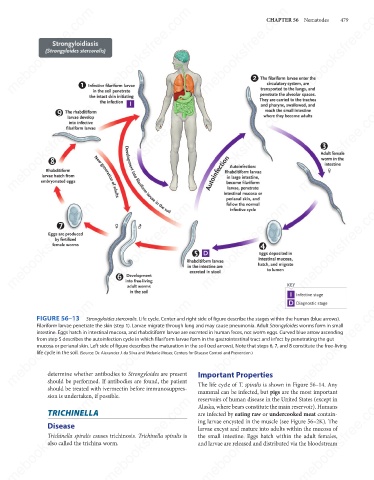
 mebooksfree.com  mebooksfree.com   Strongyloides stercoralis. Life cycle. Center and right side of figure describe the stages within the human (blue arrows).   mebooksfree.com
                                                                                                            mebooksfree.com
                                                                            mebooksfree.com
                                            mebooksfree.com
                    FIGURE 56–13
                    Filariform larvae penetrate the skin (step 1). Larvae migrate through lung and may cause pneumonia. Adult Strongyloides worms form in small
                    intestine. Eggs hatch in intestinal mucosa, and rhabditiform larvae are excreted in human feces, not worm eggs. Curved blue arrow ascending
                    from step 5 describes the autoinfection cycle in which filariform larvae form in the gastrointestinal tract and infect by penetrating the gut
                    mucosa or perianal skin. Left side of figure describes the maturation in the soil (red arrows). Note that steps 6, 7, and 8 constitute the free-living
                    life cycle in the soil. (Source: Dr. Alexander J. da Silva and Melanie Moser, Centers for Disease Control and Prevention.)


                        determine whether antibodies to Strongyloides are present
                                                                         Important Properties
                        should be performed. If antibodies are found, the patient
                                                                         The life cycle of T. spiralis is shown in Figure 56–14. Any
                        should be treated with ivermectin before immunosuppres-
                                                                         mammal can be infected, but pigs are the most important
                        sion is undertaken, if possible.
                                                                                                            mebooksfree.com
                                                                            mebooksfree.com
 mebooksfree.com  mebooksfree.com           mebooksfree.com              reservoirs of human disease in the United States (except in       mebooksfree.com
                                                                         Alaska, where bears constitute the main reservoir). Humans
                        TRICHINELLA
                                                                         are infected by eating raw or undercooked meat contain-
                                                                         ing larvae encysted in the muscle (see Figure 56–2K). The
                        Disease
                                                                         larvae excyst and mature into adults within the mucosa of
                        Trichinella spiralis causes trichinosis. Trichinella spiralis is
                                                                         the small intestine. Eggs hatch within the adult females,
                        also called the trichina worm.
                                                                         and larvae are released and distributed via the bloodstream


 mebooksfree.com  mebooksfree.com           mebooksfree.com                 mebooksfree.com                 mebooksfree.com                mebooksfree.com

