


Page 487 - Review of Medical Microbiology and Immunology ( PDFDrive )
P. 487
mebooksfree.com
 mebooksfree.com


                                                                                                            mebooksfree.com
                                            mebooksfree.com
            mebooksfree.com
 mebooksfree.com  mebooksfree.com           mebooksfree.com          Laboratory Diagnosis                   mebooksfree.com                mebooksfree.com
                                                                            mebooksfree.com
                                                                                                                                           mebooksfree.com
                       PART VI  Parasitology
                 476
                                                                     Diagnosis is made microscopically by observing the eggs in
                                                                     the stools (see Figures 56–3D and 56–12). Occult blood in
                                                                     the stools is frequent. Eosinophilia is typical.

                                                                     Treatment

                                                                     The drug of choice is either albendazole, mebendazole, or
                                                                     pyrantel pamoate.
 mebooksfree.com  mebooksfree.com           mebooksfree.com          Disposing of sewage properly and wearing shoes are effec-             mebooksfree.com
                                                                            mebooksfree.com
                                                                                                            mebooksfree.com
                                                                     Prevention

                                                                     tive means of prevention.
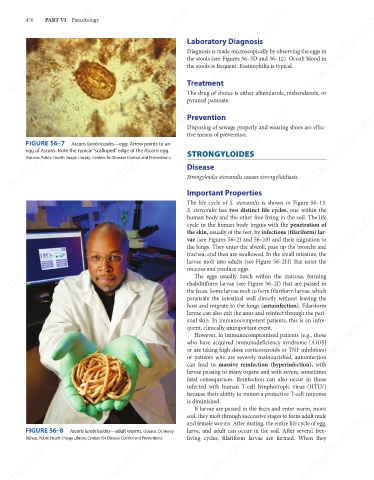
                 FIGURE 56–7
                                Ascaris lumbricoides—egg. Arrow points to an
                 egg of Ascaris. Note the typical “scalloped” edge of the Ascaris egg.
                                                                     STRONGYLOIDES
                 (Source: Public Health Image Library, Centers for Disease Control and Prevention.)
                                                                     Disease
                                                                     Strongyloides stercoralis causes strongyloidiasis.

                                                                     Important Properties
 mebooksfree.com  mebooksfree.com           mebooksfree.com          The life cycle of  S. stercoralis is shown in Figure 56–13.           mebooksfree.com
                                                                                                            mebooksfree.com
                                                                            mebooksfree.com
                                                                     S. stercoralis has  two distinct life cycles, one within the
                                                                     human body and the other free-living in the soil. The life
                                                                     cycle in the human body begins with the penetration of
                                                                     the skin, usually of the feet, by infectious (filariform) lar-
                                                                     vae (see Figures 56–2I and 56–10) and their migration to
                                                                     the lungs. They enter the alveoli, pass up the bronchi and
                                                                     trachea, and then are swallowed. In the small intestine, the
                                                                     larvae molt into adults (see Figure 56–2H) that enter the
                                                                     mucosa and produce eggs.
                                                                        The eggs usually hatch within the mucosa, forming
                                                                     rhabditiform larvae (see Figure 56–2J) that are passed in
                                                                     the feces. Some larvae molt to form filariform larvae, which
                                                                                                            mebooksfree.com
 mebooksfree.com  mebooksfree.com           mebooksfree.com          penetrate the intestinal wall directly without leaving the            mebooksfree.com
                                                                            mebooksfree.com
                                                                     host and migrate to the lungs (autoinfection). Filariform
                                                                     larvae can also exit the anus and reinfect through the peri-
                                                                     anal skin. In immunocompetent patients, this is an infre-
                                                                     quent, clinically unimportant event.
                                                                        However, in immunocompromised patients (e.g., those
                                                                     who  have  acquired  immunodeficiency  syndrome  [AIDS]
                                                                     or are taking high-dose corticosteroids or TNF inhibitors)
                                                                     or patients who are severely malnourished, autoinfection
                                                                     can lead to  massive reinfection (hyperinfection), with
                                                                     larvae passing to many organs and with severe, sometimes
                                                                     fatal consequences. Reinfection can also occur in those
                                                                     infected with human T-cell lymphotropic virus (HTLV)
                                                                     because their ability to mount a protective T-cell response
                                                                            mebooksfree.com
                                                                                                            mebooksfree.com
 mebooksfree.com  mebooksfree.com           mebooksfree.com          and female worms. After mating, the entire life cycle of egg,         mebooksfree.com
                                                                     is diminished.
                                                                        If larvae are passed in the feces and enter warm, moist
                                                                     soil, they molt through successive stages to form adult male
                 FIGURE 56–8
                                                                     larva, and adult can occur in the soil. After several free-
                               Ascaris lumbricoides—adult worms. (Source: Dr. Henry
                                                                     living cycles, filariform larvae are formed. When they
                 Bishop, Public Health Image Library, Centers for Disease Control and Prevention.)


 mebooksfree.com  mebooksfree.com           mebooksfree.com                 mebooksfree.com                 mebooksfree.com                mebooksfree.com

