


Page 486 - Review of Medical Microbiology and Immunology ( PDFDrive )
P. 486
mebooksfree.com
 mebooksfree.com


            mebooksfree.com
                                                                            mebooksfree.com
                                            mebooksfree.com
                                                                                                            mebooksfree.com
                                                                                                                                           mebooksfree.com
 mebooksfree.com  mebooksfree.com           Circulation  Lungs        Trachea mebooksfree.com               mebooksfree.com                mebooksfree.com
                                                                                                                        475
                                                                                               CHAPTER 56  Nematodes
                              Ascariasis
                          (Ascaris lumbricoides)

                                                                                      Pharynx


                                                                                              Swallowed
                                            mebooksfree.com
 mebooksfree.com  mebooksfree.com    Ingested  Larvae hatch          Human  mebooksfree.com                 mebooksfree.com                mebooksfree.com


                                            in intestine

                                                                                     Adults in lumen
                                                                                     of small intestine


                                                                                          Eggs in feces

                                            Embryonated egg
                                           with 2nd stage larva
                                            (infective stage)                           (Diagnostic stage)  Fertilized
                                                                                                       1-cell
 mebooksfree.com  mebooksfree.com           mebooksfree.com                 mebooksfree.com                 mebooksfree.com                mebooksfree.com


                                                             External Environment


                                                                                                            mebooksfree.com
 mebooksfree.com  mebooksfree.com           mebooksfree.com              the blood loss. “Ground itch,” a pruritic papule or vesicle,      mebooksfree.com
                                                                            mebooksfree.com
                                                                                         2-cell
                                                  Advanced
                                                                                         stage
                                                  cleavage
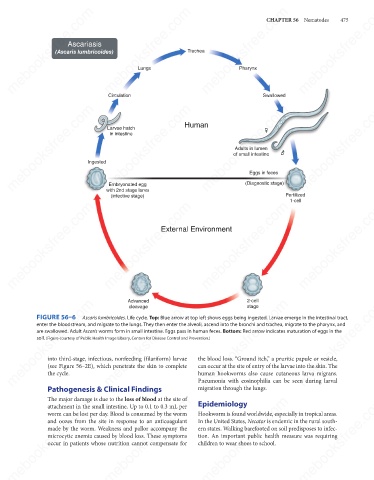
                    FIGURE 56–6
                                   Ascaris lumbricoides. Life cycle. Top: Blue arrow at top left shows eggs being ingested. Larvae emerge in the intestinal tract,
                    enter the bloodstream, and migrate to the lungs. They then enter the alveoli, ascend into the bronchi and trachea, migrate to the pharynx, and
                    are swallowed. Adult Ascaris worms form in small intestine. Eggs pass in human feces. Bottom: Red arrow indicates maturation of eggs in the
                    soil. (Figure courtesy of Public Health Image Library, Centers for Disease Control and Prevention.)
                        into third-stage, infectious, nonfeeding (filariform) larvae
                        (see Figure 56–2E), which penetrate the skin to complete
                                                                         can occur at the site of entry of the larvae into the skin. The
                        the cycle.
                                                                         Pneumonia with eosinophilia can be seen during larval
                                                                         migration through the lungs.
                        Pathogenesis & Clinical Findings                 human hookworms also cause cutaneous larva migrans.
                        The major damage is due to the loss of blood at the site of
                                                                                                            mebooksfree.com
 mebooksfree.com  mebooksfree.com           mebooksfree.com              In the United States, Necator is endemic in the rural south-      mebooksfree.com
                                                                            mebooksfree.com
                                                                         Epidemiology
                        attachment in the small intestine. Up to 0.1 to 0.3 mL per
                        worm can be lost per day. Blood is consumed by the worm
                                                                         Hookworm is found worldwide, especially in tropical areas.
                        and oozes from the site in response to an anticoagulant
                                                                         ern states. Walking barefooted on soil predisposes to infec-
                        made by the worm. Weakness and pallor accompany the
                        microcytic anemia caused by blood loss. These symptoms
                                                                         tion.  An  important  public  health  measure  was  requiring
                                                                         children to wear shoes to school.
                        occur in patients whose nutrition cannot compensate for


 mebooksfree.com  mebooksfree.com           mebooksfree.com                 mebooksfree.com                 mebooksfree.com                mebooksfree.com

