


Page 488 - Review of Medical Microbiology and Immunology ( PDFDrive )
P. 488
mebooksfree.com
                                                                                                            mebooksfree.com
 mebooksfree.com

            mebooksfree.com
                                            mebooksfree.com
                                                                            mebooksfree.com
 mebooksfree.com  mebooksfree.com           mebooksfree.com            Swallowed    small intestine  CHAPTER 56  Nematodes  477            mebooksfree.com
                                                                                                            mebooksfree.com
                                                                                                                                           mebooksfree.com
                           Hookworm infection
                           (Ancylostoma duodenale,
                             Necator americanus)
                                                            y r a
                                                          h
                                                         P
                                                                                        c
                                                                                         h
                                                                                             o t   d
                                                                                          e
                                                             n
                                                              x
                                                                                       a t t A
                                                 Trachea
 mebooksfree.com  mebooksfree.com    Penetrates skin                   Human                (Diagnostic stage) mebooksfree.com             mebooksfree.com
                                            mebooksfree.com
                                                                            mebooksfree.com
                                            Lungs
                                        Circulation


                                                                                              Eggs in feces

                                             Filariform larva
                                             (Infective stage)
 mebooksfree.com  mebooksfree.com           mebooksfree.com                 mebooksfree.com                 mebooksfree.com                mebooksfree.com


                                                               External Environment


                                                                                             Rhabditiform larva
                                                                                                 hatches


                                                                            mebooksfree.com
                        cycle within humans. mebooksfree.com
 mebooksfree.com  mebooksfree.com                                 Rhabditiform larva in soil                mebooksfree.com                mebooksfree.com


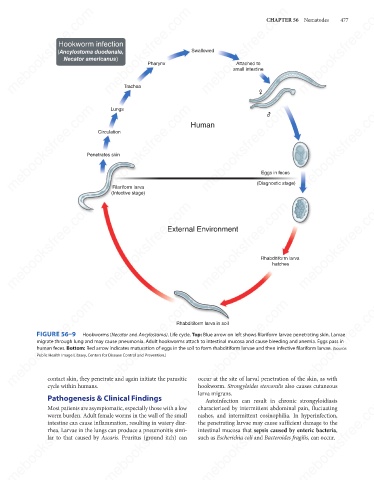
                    FIGURE 56–9
                                   Hookworms (Necator and Ancylostoma). Life cycle. Top: Blue arrow on left shows filariform larvae penetrating skin. Larvae
                    migrate through lung and may cause pneumonia. Adult hookworms attach to intestinal mucosa and cause bleeding and anemia. Eggs pass in
                    human feces. Bottom: Red arrow indicates maturation of eggs in the soil to form rhabditiform larvae and then infective filariform larvae. (Source:
                    Public Health Image Library, Centers for Disease Control and Prevention.)


                        contact skin, they penetrate and again initiate the parasitic
                                                                         occur at the site of larval penetration of the skin, as with
                                                                         hookworm. Strongyloides stercoralis also causes cutaneous
                                                                         larva migrans.
                        Pathogenesis & Clinical Findings
 mebooksfree.com  mebooksfree.com           mebooksfree.com              the penetrating larvae may cause sufficient damage to the         mebooksfree.com
                                                                            mebooksfree.com
                                                                                                            mebooksfree.com
                                                                           Autoinfection can result in chronic strongyloidiasis
                        Most patients are asymptomatic, especially those with a low
                                                                         characterized by intermittent abdominal pain, fluctuating
                                                                         rashes, and intermittent eosinophilia. In hyperinfection,
                        worm burden. Adult female worms in the wall of the small
                        intestine can cause inflammation, resulting in watery diar-
                                                                         intestinal mucosa that sepsis caused by enteric bacteria,
                        rhea. Larvae in the lungs can produce a pneumonitis simi-
                        lar  to  that  caused  by  Ascaris.  Pruritus  (ground  itch)  can
                                                                         such as Escherichia coli and Bacteroides fragilis, can occur.


 mebooksfree.com  mebooksfree.com           mebooksfree.com                 mebooksfree.com                 mebooksfree.com                mebooksfree.com

