


Page 525 - Review of Medical Microbiology and Immunology ( PDFDrive )
P. 525
mebooksfree.com
mebooksfree.com
mebooksfree.com
mebooksfree.com
mebooksfree.com
mebooksfree.com
mebooksfree.com
mebooksfree.com mebooksfree.com mebooksfree.com globulin classes, such as IgG and IgA, to occur. mebooksfree.com mebooksfree.com
PART VII Immunology
514
costimulatory interactions, which occur between surface
are also found in the gut-associated lymphoid tissue
(GALT) such as Peyer’s patches.
proteins on the T and B cells, are as follows: (1) CD28 on the
T cell must interact with B7 on the B cell, and (2) CD40L on
Clonal Selection
the T cell must interact with CD40 on the B cell. The CD28-
B7 interaction is required for activation of the T cell to pro-
How do antibodies arise? Does the antigen “instruct” the B
duce interleukins, and the CD40L-CD40 interaction is
cell to make an antibody, or does the antigen “select” a B
cell endowed with the preexisting capacity to make the
antibody?
Hyper-IgM syndrome is caused by a mutation in the
It appears that the latter alternative (i.e., clonal selec- required for class switching from IgM to other immuno-
gene encoding CD40L. Patients have very high IgM levels
mebooksfree.com
mebooksfree.com mebooksfree.com mebooksfree.com infections (see Chapter 68). mebooksfree.com mebooksfree.com
tion) accounts for antibody formation. Each individual has
and very little IgG, IgA, and IgE because they cannot “class-
7
a large pool of B lymphocytes (about 10 ). Each immuno-
switch.” This syndrome is characterized by severe pyogenic
logically responsive B cell bears a surface receptor (either
IgM or IgD) that can react with one antigen (or closely
related group of antigens). It is estimated that there are at
Effector Functions of B Cells/Plasma Cells
least 10 million different specificities. An antigen interacts
The end result of the activation process is the production of
with the B lymphocyte that shows the best “fit” with its
immunoglobulin surface receptor. After the antigen binds,
many plasma cells that produce large amounts of immuno-
the B cell is stimulated to proliferate and form a clone of
globulins specific for the epitope. Plasma cells secrete thou-
cells. These selected B cells soon become plasma cells and
then die. Some activated B cells form memory cells, which
secrete antibody specific for the antigen. Plasma cells syn-
thesize the immunoglobulins with the same antigenic
can remain quiescent for long periods but are capable of
being activated rapidly upon reexposure to antigen. Most
specificity (i.e., they have the same heavy chain and the sands of antibody molecules per second for a few days and
mebooksfree.com mebooksfree.com mebooksfree.com memory B cells. The presence of these cells explains the mebooksfree.com
mebooksfree.com
mebooksfree.com
same light chain) as those carried by the selected B cell.
memory B cells have surface IgG that serves as the antigen
Antigenic specificity does not change when heavy chain
receptor, but some have IgM. Memory T cells secrete
class switching occurs (see Chapter 59).
interleukins that enhance antibody production by the
Note that clonal selection also occurs with T cells. The
antigen interacts with a specific receptor located on the
rapid appearance of antibody in the secondary response
(see Chapter 60).
surface of either a CD4-positive or a CD8-positive T cell.
This “selects” this cell and activates it to expand into a clone
of cells with the same specificity.
ANTIGEN-PRESENTING CELLS
Activation of B Cells
In the following example, the B cell is the APC. Multivalent
Macrophages have three main functions: phagocytosis, anti-
antigen binds to surface IgM (or IgD) and cross-links adja-
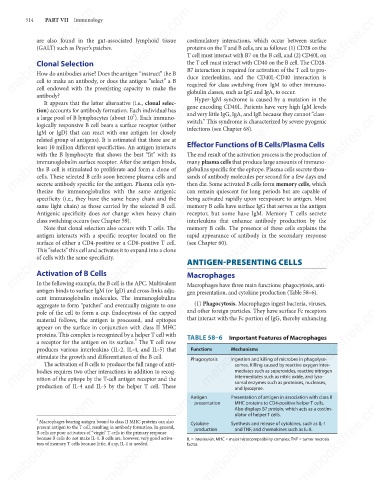
gen presentation, and cytokine production (Table 58–6).
cent immunoglobulin molecules. The immunoglobulins Macrophages
mebooksfree.com mebooksfree.com mebooksfree.com TABLE 58–6 Important Features of Macrophages mebooksfree.com
mebooksfree.com
mebooksfree.com
(1) Phagocytosis. Macrophages ingest bacteria, viruses,
aggregate to form “patches” and eventually migrate to one
and other foreign particles. They have surface Fc receptors
pole of the cell to form a cap. Endocytosis of the capped
that interact with the Fc portion of IgG, thereby enhancing
material follows, the antigen is processed, and epitopes
appear on the surface in conjunction with class II MHC
proteins. This complex is recognized by a helper T cell with
5
a receptor for the antigen on its surface. The T cell now
produces various interleukins (IL-2, IL-4, and IL-5) that
Functions
Mechanisms
stimulate the growth and differentiation of the B cell.
Ingestion and killing of microbes in phagolyso-
Phagocytosis
The activation of B cells to produce the full range of anti-
somes. Killing caused by reactive oxygen inter-
bodies requires two other interactions in addition to recog-
mediates such as superoxides, reactive nitrogen
intermediates such as nitric oxide, and lyso-
nition of the epitope by the T-cell antigen receptor and the
somal enzymes such as proteases, nucleases,
production of IL-4 and IL-5 by the helper T cell. These
and lysozyme.
Presentation of antigen in association with class II
Antigen
mebooksfree.com mebooksfree.com mebooksfree.com IL = interleukin; MHC = major histocompatibility complex; TNF = tumor necrosis mebooksfree.com
mebooksfree.com
mebooksfree.com
presentation
MHC proteins to CD4-positive helper T cells.
Also displays B7 protein, which acts as a costim-
ulator of helper T cells.
5
Macrophages bearing antigen bound to class II MHC proteins can also
Synthesis and release of cytokines, such as IL-1
Cytokine
present antigen to the T cell, resulting in antibody formation. In general,
and TNF, and chemokines such as IL-8.
production
B cells are poor activators of “virgin” T cells in the primary response
because B cells do not make IL-1. B cells are, however, very good activa-
tors of memory T cells because little, if any, IL-1 is needed.
factor.
mebooksfree.com mebooksfree.com mebooksfree.com mebooksfree.com mebooksfree.com mebooksfree.com

