


Page 523 - Review of Medical Microbiology and Immunology ( PDFDrive )
P. 523
mebooksfree.com
 mebooksfree.com


                                   Activated mebooksfree.com
            mebooksfree.com
                                                                            mebooksfree.com
 mebooksfree.com  mebooksfree.com       B 1 mebooksfree.com                Memory             B7    B 1     mebooksfree.com                mebooksfree.com
                                                                                                                                           mebooksfree.com
                                                                                                            mebooksfree.com
                       PART VII  Immunology
                 512
                            Antigen
                                                               B
                                                                3'
                                                                             B
                                                     2
                                                    B
                               0
                              B
                                                                                                       CD40
                                                                                              Activated
                                    T cell   Interleukins  0    B 3       PC              B CD28 T cell  CD40L
 mebooksfree.com  mebooksfree.com           mebooksfree.com                 mebooksfree.com             1   mebooksfree.com                mebooksfree.com
                           A
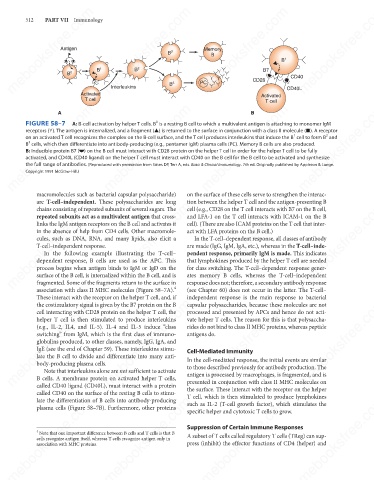
                 FIGURE 58–7
                                A: B-cell activation by helper T cells. B  is a resting B cell to which a multivalent antigen is attaching to monomer IgM
                 receptors (Y). The antigen is internalized, and a fragment (▲) is returned to the surface in conjunction with a class II molecule (■). A receptor
                                                                                                                   2
                 on an activated T cell recognizes the complex on the B-cell surface, and the T cell produces interleukins that induce the B  cell to form B  and
                  3
                 B  cells, which then differentiate into antibody-producing (e.g., pentamer IgM) plasma cells (PC). Memory B cells are also produced.
                 B: Inducible protein B7 ( ) on the B cell must interact with CD28 protein on the helper T cell in order for the helper T cell to be fully
                                  ◗
                 activated, and CD40L (CD40 ligand) on the helper T cell must interact with CD40 on the B cell for the B cell to be activated and synthesize
                 the full range of antibodies. (Reproduced with permission from Stites DP, Terr A, eds. Basic & Clinical Immunology. 7th ed. Originally published by Appleton & Lange.
                 Copyright 1991 McGraw-Hill.)

                    macromolecules such as bacterial capsular polysaccharide)   on the surface of these cells serve to strengthen the interac-
                                                                     tion between the helper T cell and the antigen-presenting B
                    are  T-cell–independent. These polysaccharides are long
 mebooksfree.com  mebooksfree.com           mebooksfree.com          cell). (There are also ICAM proteins on the T cell that inter-        mebooksfree.com
                                                                            mebooksfree.com
                                                                                                            mebooksfree.com
                                                                     cell (e.g., CD28 on the T cell interacts with B7 on the B cell,
                    chains consisting of repeated subunits of several sugars. The
                                                                     and LFA-1 on the T cell interacts with ICAM-1 on the B
                    repeated subunits act as a multivalent antigen that cross-
                    links the IgM antigen receptors on the B cell and activates it
                    in the absence of help from CD4 cells. Other macromole-
                                                                     act with LFA proteins on the B cell.)
                                                                        In the T-cell–dependent response, all classes of antibody
                    cules, such as DNA, RNA, and many lipids, also elicit a
                    T-cell–independent response.
                                                                     are made (IgG, IgM, IgA, etc.), whereas in the T-cell–inde-
                                                                     pendent response, primarily IgM is made. This indicates
                       In the following example illustrating the T-cell–
                    dependent response, B cells are used as the APC. This
                                                                     that lymphokines produced by the helper T cell are needed
                    process begins when antigen binds to IgM or IgD on the
                                                                     for class switching. The T-cell–dependent response gener-
                    surface of the B cell, is internalized within the B cell, and is
                                                                     response does not; therefore, a secondary antibody response
                    fragmented. Some of the fragments return to the surface in
                                                                 4
                                                                     (see Chapter 60) does not occur in the latter. The T-cell–
                    association with class II MHC molecules (Figure 58–7A).
                                                                     independent response is the main response to bacterial
                    These interact with the receptor on the helper T cell, and, if   ates memory B cells, whereas the T-cell–independent
 mebooksfree.com  mebooksfree.com           mebooksfree.com          rides do not bind to class II MHC proteins, whereas peptide           mebooksfree.com
                                                                            mebooksfree.com
                                                                                                            mebooksfree.com
                                                                     capsular polysaccharides, because these molecules are not
                    the costimulatory signal is given by the B7 protein on the B
                    cell interacting with CD28 protein on the helper T cell, the
                                                                     processed and presented by APCs and hence do not acti-
                    helper T cell is then stimulated to produce interleukins
                                                                     vate helper T cells. The reason for this is that polysaccha-
                    (e.g., IL-2, IL4, and IL-5). IL-4 and IL-5 induce “class
                                                                     antigens do.
                    switching” from IgM, which is the first class of immuno-
                    globulins produced, to other classes, namely, IgG, IgA, and
                    IgE (see the end of Chapter 59). These interleukins stimu-
                                                                     Cell-Mediated Immunity
                    late the B cell to divide and differentiate into many anti-
                                                                     In the cell-mediated response, the initial events are similar
                    body-producing plasma cells.
                                                                     to those described previously for antibody production. The
                       Note that interleukins alone are not sufficient to activate
                    B cells. A membrane protein on activated helper T cells,
                                                                     presented in conjunction with class II MHC molecules on
                    called CD40 ligand (CD40L), must interact with a protein
                                                                     the surface. These interact with the receptor on the helper
                    called CD40 on the surface of the resting B cells to stimu-  antigen is processed by macrophages, is fragmented, and is
                                                                     T cell, which is then stimulated to produce lymphokines
                                                                            mebooksfree.com
 mebooksfree.com  mebooksfree.com           mebooksfree.com          Suppression of Certain Immune Responses mebooksfree.com               mebooksfree.com
                    late the differentiation of B cells into antibody-producing
                                                                     such as IL-2 (T-cell growth factor), which stimulates the
                    plasma cells (Figure 58–7B). Furthermore, other proteins
                                                                     specific helper and cytotoxic T cells to grow.
                    4
                      Note that one important difference between B cells and T cells is that B
                                                                     A subset of T cells called regulatory T cells (TReg) can sup-
                    cells recognize antigen itself, whereas T cells recognize antigen only in
                                                                     press (inhibit) the effector functions of CD4 (helper) and
                    association with MHC proteins.
 mebooksfree.com  mebooksfree.com           mebooksfree.com                 mebooksfree.com                 mebooksfree.com                mebooksfree.com

