


Page 67 - Review of Medical Microbiology and Immunology ( PDFDrive )
P. 67
mebooksfree.com
mebooksfree.com
mebooksfree.com
mebooksfree.com
mebooksfree.com
mebooksfree.com
mebooksfree.com mebooksfree.com mebooksfree.com lactoferrin, which chelates iron from the bacteria; lyso- mebooksfree.com
mebooksfree.com
mebooksfree.com
PART I Basic Bacteriology
56
important microbicidal agent. In degranulation, the two
types of granules in the cytoplasm of the neutrophil fuse
zyme, which degrades peptidoglycan in the bacterial cell
wall; cationic proteins, which damage bacterial mem-
with the phagosome, emptying their contents in the pro-
cess. These granules are lysosomes that contain a variety of
branes; and low pH.
enzymes essential to the killing and degradation that occur
Macrophages also migrate, engulf, and kill bacteria by
using essentially the same processes as PMNs do, but there
within the phagolysosome.
(1) The larger lysosomal granules, which constitute
(1) Macrophages do not possess myeloperoxidase and
about 15% of the total, contain the important enzyme
so cannot make hypochlorite ion; however, they do pro-
myeloperoxidase as well as lysozyme and several other are several differences:
mebooksfree.com
mebooksfree.com mebooksfree.com mebooksfree.com brucellosis, and toxoplasmosis are preferentially ingested mebooksfree.com
mebooksfree.com
degradative enzymes. (Myeloperoxidase, which is green,
duce hydrogen peroxide and superoxide by respiratory
burst.
makes a major contribution to the color of pus.)
(2) Certain organisms such as the agents of tuberculosis,
(2) The smaller granules, which make up the remaining
85%, contain lactoferrin and additional degradative enzymes
such as proteases, nucleases, and lipases. Lysosomal granules
by macrophages rather than PMNs and may remain viable
and multiply within these cells; granulomas formed during
can empty into the extracellular space as well as into the
phagosome. Outside the cell, the degradative enzymes can
these infections contain many of these macrophages.
attack structures too large to be phagocytized, such as fungal
(3) Macrophages secrete plasminogen activator, an
mycelia, as well as extracellular bacteria.
enzyme that converts the proenzyme plasminogen to the
The actual killing of the microorganisms occurs by a
variety of mechanisms, which fall into two categories: oxy-
gen-dependent and oxygen-independent. The most impor- active enzyme plasmin, which dissolves the fibrin clot.
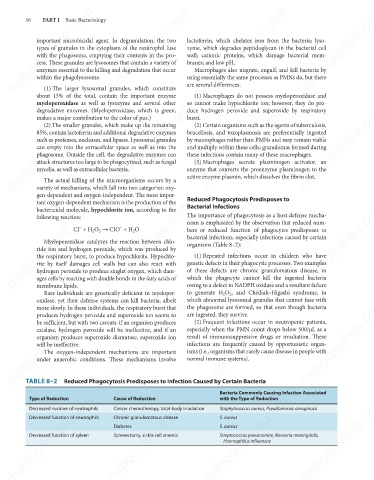
Reduced Phagocytosis Predisposes to
tant oxygen-dependent mechanism is the production of the
mebooksfree.com
mebooksfree.com
mebooksfree.com mebooksfree.com 2 2 mebooksfree.com nism is emphasized by the observation that reduced num- mebooksfree.com
Bacterial Infections
bactericidal molecule, hypochlorite ion, according to the
The importance of phagocytosis as a host defense mecha-
following reaction:
−
−
CI + H O → CIO + H O
bers or reduced function of phagocytes predisposes to
2
bacterial infections, especially infections caused by certain
Myeloperoxidase catalyzes the reaction between chlo-
organisms (Table 8–2):
ride ion and hydrogen peroxide, which was produced by
(1) Repeated infections occur in children who have
the respiratory burst, to produce hypochlorite. Hypochlo-
genetic defects in their phagocytic processes. Two examples
rite by itself damages cell walls but can also react with
hydrogen peroxide to produce singlet oxygen, which dam-
which the phagocyte cannot kill the ingested bacteria
ages cells by reacting with double bonds in the fatty acids of
owing to a defect in NADPH oxidase and a resultant failure
membrane lipids.
to generate H O , and Chédiak–Higashi syndrome, in
Rare individuals are genetically deficient in myeloper- of these defects are chronic granulomatous disease, in
2
2
which abnormal lysosomal granules that cannot fuse with
oxidase, yet their defense systems can kill bacteria, albeit
mebooksfree.com mebooksfree.com mebooksfree.com especially when the PMN count drops below 500/μL as a mebooksfree.com
mebooksfree.com
mebooksfree.com
the phagosome are formed, so that even though bacteria
more slowly. In these individuals, the respiratory burst that
are ingested, they survive.
produces hydrogen peroxide and superoxide ion seems to
(2) Frequent infections occur in neutropenic patients,
be sufficient, but with two caveats: if an organism produces
catalase, hydrogen peroxide will be ineffective, and if an
result of immunosuppressive drugs or irradiation. These
organism produces superoxide dismutase, superoxide ion
infections are frequently caused by opportunistic organ-
will be ineffective.
isms (i.e., organisms that rarely cause disease in people with
The oxygen-independent mechanisms are important
normal immune systems).
under anaerobic conditions. These mechanisms involve
TABLE 8–2 Reduced Phagocytosis Predisposes to Infection Caused by Certain Bacteria
Bacteria Commonly Causing Infection Associated
mebooksfree.com mebooksfree.com mebooksfree.com mebooksfree.com mebooksfree.com mebooksfree.com
with the Type of Reduction
Cause of Reduction
Type of Reduction
Cancer chemotherapy, total-body irradiation
Decreased number of neutrophils
Staphylococcus aureus, Pseudomonas aeruginosa
Chronic granulomatous disease
Decreased function of neutrophils
S. aureus
Diabetes
S. aureus
Streptococcus pneumoniae, Neisseria meningitidis,
Splenectomy, sickle cell anemia
Decreased function of spleen
Haemophilus influenzae
mebooksfree.com mebooksfree.com mebooksfree.com mebooksfree.com mebooksfree.com mebooksfree.com

