


Page 69 - Review of Medical Microbiology and Immunology ( PDFDrive )
P. 69
mebooksfree.com
 mebooksfree.com


                                            mebooksfree.com
            mebooksfree.com
                                                                            mebooksfree.com
 mebooksfree.com  mebooksfree.com           mebooksfree.com               Important Examples                mebooksfree.com                mebooksfree.com
                                                                                                                                           mebooksfree.com
                                                                                                            mebooksfree.com
                      PART I  Basic Bacteriology
                 58
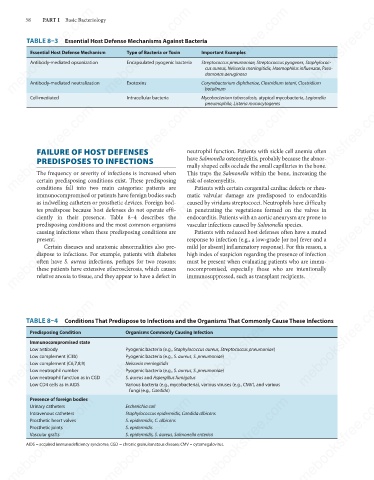
                 TABLE 8–3  Essential Host Defense Mechanisms Against Bacteria
                  Essential Host Defense Mechanism
                                                  Type of Bacteria or Toxin
                                                  Encapsulated pyogenic bacteria
                                                                          Streptococcus pneumoniae, Streptococcus pyogenes, Staphylococ-
                  Antibody-mediated opsonization
                                                                           cus aureus, Neisseria meningitidis, Haemophilus influenzae, Pseu-
                                                                           domonas aeruginosa
                  Antibody-mediated neutralization
                                                                           botulinum
                                                                          Mycobacterium tuberculosis, atypical mycobacteria, Legionella
                  Cell-mediated                   Exotoxins               Corynebacterium diphtheriae, Clostridium tetani, Clostridium
                                                  Intracellular bacteria
                                                                           pneumophila, Listeria monocytogenes
                                                                                                            mebooksfree.com
 mebooksfree.com  mebooksfree.com           mebooksfree.com          neutrophil function. Patients with sickle cell anemia often           mebooksfree.com
                                                                            mebooksfree.com


                    FAILURE OF HOST DEFENSES
                                                                     have Salmonella osteomyelitis, probably because the abnor-
                    PREDISPOSES TO INFECTIONS
                                                                     mally shaped cells occlude the small capillaries in the bone.
                    The frequency or severity of infections is increased when
                    certain predisposing conditions exist. These predisposing
                                                                     risk of osteomyelitis.
                    conditions fall into two main categories: patients are
                                                                        Patients with certain congenital cardiac defects or rheu-
                                                                     matic valvular damage are predisposed to endocarditis
                    immunocompromised or patients have foreign bodies such   This traps the Salmonella within the bone, increasing the
                                                                     caused by viridans streptococci. Neutrophils have difficulty
                    as indwelling catheters or prosthetic devices. Foreign bod-
 mebooksfree.com  mebooksfree.com           mebooksfree.com          vascular infections caused by Salmonella species. mebooksfree.com     mebooksfree.com
                                                                            mebooksfree.com
                                                                     in penetrating the vegetations formed on the valves in
                    ies predispose because host defenses do not operate effi-
                    ciently in their presence. Table 8–4 describes the
                                                                     endocarditis. Patients with an aortic aneurysm are prone to
                    predisposing conditions and the most common organisms
                    causing infections when these predisposing conditions are
                                                                        Patients with reduced host defenses often have a muted
                                                                     response to infection (e.g., a low-grade [or no] fever and a
                    present.
                                                                     mild [or absent] inflammatory response). For this reason, a
                       Certain diseases and anatomic abnormalities also pre-
                    dispose to infections. For example, patients with diabetes
                                                                     high index of suspicion regarding the presence of infection
                    often have  S. aureus infections, perhaps for two reasons:
                                                                     must be present when evaluating patients who are immu-
                                                                     nocompromised, especially those who are intentionally
                    these patients have extensive atherosclerosis, which causes
                    relative anoxia to tissue, and they appear to have a defect in
                                                                     immunosuppressed, such as transplant recipients.
 mebooksfree.com  mebooksfree.com           mebooksfree.com                 mebooksfree.com                 mebooksfree.com                mebooksfree.com
                 TABLE 8–4  Conditions That Predispose to Infections and the Organisms That Commonly Cause These Infections
                  Predisposing Condition
                                                 Organisms Commonly Causing Infection
                  Immunocompromised state
                                                 Pyogenic bacteria (e.g., Staphylococcus aureus, Streptococcus pneumoniae)
                  Low antibody
                                                 Pyogenic bacteria (e.g., S. aureus, S. pneumoniae)
                  Low complement (C3b)
                                                 Neisseria meningitidis
                  Low complement (C6,7,8,9)
                                                 Pyogenic bacteria (e.g., S. aureus, S. pneumoniae)
                  Low neutrophil number
                  Low neutrophil function as in CGD
                                                 S. aureus and Aspergillus fumigatus
                                                 Various bacteria (e.g., mycobacteria), various viruses (e.g., CMV), and various
                  Low CD4 cells as in AIDS
                                                   fungi (e.g., Candida)
 mebooksfree.com  mebooksfree.com           mebooksfree.com                 mebooksfree.com                 mebooksfree.com                mebooksfree.com
                  Presence of foreign bodies
                  Urinary catheters
                                                 Escherichia coli
                                                 Staphylococcus epidermidis, Candida albicans
                  Intravenous catheters
                                                 S. epidermidis, C. albicans
                  Prosthetic heart valves
                                                 S. epidermidis
                  Prosthetic joints
                                                 S. epidermidis, S. aureus, Salmonella enterica
                  Vascular grafts
                 AIDS = acquired immunodeficiency syndrome; CGD = chronic granulomatous disease; CMV = cytomegalovirus.


 mebooksfree.com  mebooksfree.com           mebooksfree.com                 mebooksfree.com                 mebooksfree.com                mebooksfree.com

