


Page 81 - Review of Medical Microbiology and Immunology ( PDFDrive )
P. 81
mebooksfree.com
                                                                            mebooksfree.com
 mebooksfree.com

                                                                            mebooksfree.com
            mebooksfree.com
                                                                                                                                           mebooksfree.com
 mebooksfree.com  mebooksfree.com        Role of Antimicrobial Drug Stewardship in Mitigating These Problems  mebooksfree.com              mebooksfree.com
                                                                                                            mebooksfree.com
                                            mebooksfree.com
                      PART I  Basic Bacteriology
                 70
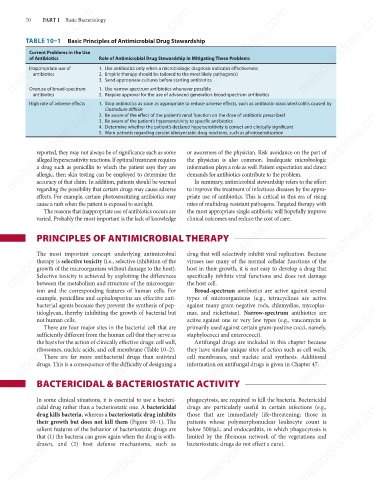
                 TABLE 10–1  Basic Principles of Antimicrobial Drug Stewardship
                  Current Problems in the Use
                  of Antibiotics
                                         1.  Use antibiotics only when a microbiologic diagnosis indicates effectiveness
                  Inappropriate use of
                                         2.  Empiric therapy should be tailored to the most likely pathogen(s)
                   antibiotics
                                         3.  Send appropriate cultures before starting antibiotics
                  Overuse of broad-spectrum
                                         1.  Use narrow-spectrum antibiotics whenever possible
                                         2.  Require approval for the use of advanced generation broad-spectrum antibiotics
                   antibiotics
                  High rate of adverse effects
                                                                                                            mebooksfree.com
                                            mebooksfree.com
                                                                            mebooksfree.com
 mebooksfree.com  mebooksfree.com        1.   Stop antibiotics as soon as appropriate to reduce adverse effects, such as antibiotic-associated colitis caused by   mebooksfree.com
                                           Clostridium difficile
                                         2.  Be aware of the effect of the patient’s renal function on the dose of antibiotic prescribed
                                         3.  Be aware of the patient’s hypersensitivity to specific antibiotics
                                         4.  Determine whether the patient’s declared hypersensitivity is correct and clinically significant
                                         5.  Warn patients regarding certain idiosyncratic drug reactions, such as photosensitization
                    reported, they may not always be of significance such as some
                                                                     or awareness of the physician. Risk avoidance on the part of
                    alleged hypersensitivity reactions. If optimal treatment requires
                                                                     the physician is also common. Inadequate microbiologic
                                                                     information plays a role as well. Patient expectation and direct
                    a drug such as penicillin to which the patient says they are
                    allergic, then skin testing can be employed to determine the
                                                                        In summary, antimicrobial stewardship refers to the effort
                    accuracy of that claim. In addition, patients should be warned
                    regarding the possibility that certain drugs may cause adverse
                                                                     to improve the treatment of infectious diseases by the appro-
                    effects. For example, certain photosensitizing antibiotics may   demands for antibiotics contribute to the problem.
                                                                     priate use of antibiotics. This is critical in this era of rising
                                                                     rates of multidrug-resistant pathogens. Targeted therapy with
                                                                                                            mebooksfree.com
 mebooksfree.com  mebooksfree.com           mebooksfree.com          drug that will selectively inhibit viral replication. Because         mebooksfree.com
                    cause a rash when the patient is exposed to sunlight.
                                                                            mebooksfree.com
                                                                     the most appropriate single antibiotic will hopefully improve
                       The reasons that inappropriate use of antibiotics occurs are
                    varied. Probably the most important is the lack of knowledge
                                                                     clinical outcomes and reduce the cost of care.
                    PRINCIPLES OF ANTIMICROBIAL THERAPY
                    The most important concept underlying antimicrobial
                    therapy is selective toxicity (i.e., selective inhibition of the
                                                                     viruses use many of the normal cellular functions of the
                    growth of the microorganism without damage to the host).
                                                                     host in their growth, it is not easy to develop a drug that
                    Selective toxicity is achieved by exploiting the differences
                                                                     the host cell.
                    between the metabolism and structure of the microorgan-
                                                                        Broad-spectrum  antibiotics  are  active  against  several
                    ism and the corresponding features of human cells. For
                                                                     types of microorganisms (e.g., tetracyclines are active
                    example, penicillins and cephalosporins are effective anti-  specifically inhibits viral functions and does not damage
 mebooksfree.com  mebooksfree.com           mebooksfree.com          primarily used against certain gram-positive cocci, namely,           mebooksfree.com
                                                                            mebooksfree.com
                                                                                                            mebooksfree.com
                                                                     against many gram-negative rods, chlamydiae, mycoplas-
                    bacterial agents because they prevent the synthesis of pep-
                    tidoglycan, thereby inhibiting the growth of bacterial but
                                                                     mas, and rickettsiae).  Narrow-spectrum antibiotics are
                                                                     active against one or very few types (e.g., vancomycin is
                    not human cells.
                       There are four major sites in the bacterial cell that are
                    sufficiently different from the human cell that they serve as
                                                                     staphylococci and enterococci).
                                                                        Antifungal drugs are included in this chapter because
                    the basis for the action of clinically effective drugs: cell wall,
                                                                     they have similar unique sites of action such as cell walls,
                    ribosomes, nucleic acids, and cell membrane (Table 10–2).
                                                                     cell  membranes,  and nucleic  acid synthesis. Additional
                       There are far more antibacterial drugs than antiviral
                                                                     information on antifungal drugs is given in Chapter 47.
                    drugs. This is a consequence of the difficulty of designing a
                    BACTERICIDAL & BACTERIOSTATIC ACTIVITY
                                                                            mebooksfree.com
                                                                                                            mebooksfree.com
 mebooksfree.com  mebooksfree.com           mebooksfree.com          phagocytosis, are required to kill the bacteria. Bactericidal         mebooksfree.com
                    In some clinical situations, it is essential to use a bacteri-
                                                                     drugs are particularly useful in certain infections (e.g.,
                    cidal drug rather than a bacteriostatic one. A bactericidal
                    drug kills bacteria, whereas a bacteriostatic drug inhibits
                                                                     those that are immediately life-threatening; those in
                                                                     patients whose polymorphonuclear leukocyte count is
                    their growth but does not kill them (Figure 10–1). The
                                                                     below 500/μL; and endocarditis, in which phagocytosis is
                    salient features of the behavior of bacteriostatic drugs are
                                                                     limited by the fibrinous network of the vegetations and
                    that (1) the bacteria can grow again when the drug is with-
                                                                     bacteriostatic drugs do not effect a cure).
                    drawn, and (2) host defense mechanisms, such as
 mebooksfree.com  mebooksfree.com           mebooksfree.com                 mebooksfree.com                 mebooksfree.com                mebooksfree.com

