


Page 83 - Review of Medical Microbiology and Immunology ( PDFDrive )
P. 83
mebooksfree.com
mebooksfree.com
mebooksfree.com
mebooksfree.com
mebooksfree.com
mebooksfree.com
mebooksfree.com
mebooksfree.com
mebooksfree.com mebooksfree.com mebooksfree.com conjugated to benzathine. This form is metabolized very mebooksfree.com
PART I Basic Bacteriology
72
the bacterial cell. If the osmotic pressure of the medium is
(3) Benzathine penicillin G, in which penicillin G is
raised about threefold (e.g., by the addition of sufficient
KCl), rupture will not occur and the organism can survive
slowly and is often called a “depot” preparation.
as a protoplast. Exposure of the bacterial cell to lysozyme,
Benzylpenicillin is one of the most widely used and
which is present in human tears, results in degradation of
effective antibiotics. However, it has four disadvantages,
the peptidoglycan and osmotic rupture similar to that
caused by penicillin.
cal modification of the side chain. The three disadvantages
Penicillin is bactericidal, but it kills cells only when
are (1) limited effectiveness against many gram-negative
they are growing. When cells are growing, new peptido- three of which have been successfully overcome by chemi-
rods, (2) hydrolysis by gastric acids, so that it cannot be
mebooksfree.com
glycan is being synthesized, and transpeptidation occurs.
mebooksfree.com mebooksfree.com mebooksfree.com rods is due to the inability of the drug to penetrate the outer mebooksfree.com
mebooksfree.com
taken orally, and (3) inactivation by β-lactamases. The lim-
However, in nongrowing cells, no new cross-linkages are
ited effectiveness of penicillin G against gram-negative
required, and penicillin is inactive. Penicillins are therefore
more active during the log phase of bacterial cell growth
membrane of the organism. The fourth disadvantage com-
than during the stationary phase (see Chapter 3 for the
mon to all penicillins that has not been overcome is hyper-
bacterial cell growth cycle).
sensitivity, especially anaphylaxis, in some recipients of the
Penicillins (and cephalosporins) are called β-lactam
drug.
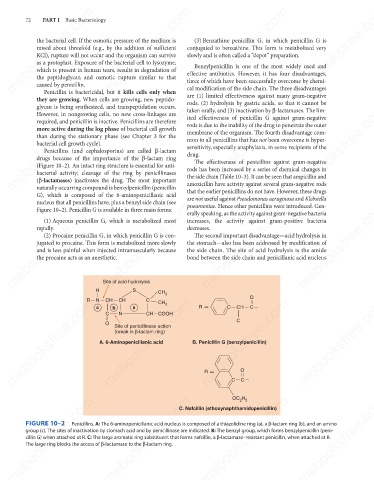
drugs because of the importance of the β-lactam ring
The effectiveness of penicillins against gram-negative
(Figure 10–2). An intact ring structure is essential for anti-
rods has been increased by a series of chemical changes in
bacterial activity; cleavage of the ring by penicillinases
(β-lactamases) inactivates the drug. The most important
amoxicillin have activity against several gram-negative rods
naturally occurring compound is benzylpenicillin (penicillin
that the earlier penicillins do not have. However, these drugs
G), which is composed of the 6-aminopenicillanic acid the side chain (Table 10–3). It can be seen that ampicillin and
are not useful against Pseudomonas aeruginosa and Klebsiella
nucleus that all penicillins have, plus a benzyl side chain (see
mebooksfree.com
mebooksfree.com mebooksfree.com H Site of acid hydrolysis CH 3 increases, the activity against gram-positive bacteria mebooksfree.com
mebooksfree.com
mebooksfree.com
pneumoniae. Hence other penicillins were introduced. Gen-
Figure 10–2). Penicillin G is available in three main forms:
erally speaking, as the activity against gram-negative bacteria
(1) Aqueous penicillin G, which is metabolized most
rapidly.
decreases.
(2) Procaine penicillin G, in which penicillin G is con-
The second important disadvantage—acid hydrolysis in
jugated to procaine. This form is metabolized more slowly
the stomach—also has been addressed by modification of
the side chain. The site of acid hydrolysis is the amide
and is less painful when injected intramuscularly because
the procaine acts as an anesthetic.
bond between the side chain and penicillanic acid nucleus
S
O
mebooksfree.com
CH
C
CH
mebooksfree.com mebooksfree.com R N A. 6-Aminopenicillanic acid 3 B. Penicillin G (benzylpenicillin) mebooksfree.com mebooksfree.com
mebooksfree.com
CH
R
CH
C
C
c
a
b
N
COOH
CH
C
C
O
Site of penicillinase action
(break in β-lactam ring)
O
R
C
C
mebooksfree.com mebooksfree.com mebooksfree.com mebooksfree.com mebooksfree.com mebooksfree.com
OC H
2 5
C. Nafcillin (ethoxynaphthamidopenicillin)
FIGURE 10–2
Penicillins. A: The 6-aminopenicillanic acid nucleus is composed of a thiazolidine ring (a), a β-lactam ring (b), and an amino
group (c). The sites of inactivation by stomach acid and by penicillinase are indicated. B: The benzyl group, which forms benzylpenicillin (peni-
cillin G) when attached at R. C: The large aromatic ring substituent that forms nafcillin, a β-lactamase–resistant penicillin, when attached at R.
The large ring blocks the access of β-lactamase to the β-lactam ring.
mebooksfree.com mebooksfree.com mebooksfree.com mebooksfree.com mebooksfree.com mebooksfree.com

