


Page 84 - Review of Medical Microbiology and Immunology ( PDFDrive )
P. 84
mebooksfree.com
mebooksfree.com
mebooksfree.com
mebooksfree.com
mebooksfree.com
mebooksfree.com
mebooksfree.com mebooksfree.com mebooksfree.com CHAPTER 10 Antimicrobial Drugs: Mechanism of Action 73 mebooksfree.com
mebooksfree.com
mebooksfree.com
TABLE 10–3 Activity of Selected Penicillins
1
Clinically Useful Activity
Drug
Gram-positive cocci, gram-positive rods, Neisseria, spirochetes such as Treponema pallidum, and many anaerobes
Penicillin G
(except Bacteroides fragilis) but none of the gram-negative rods listed below
Ampicillin or amoxicillin
not Pseudomonas aeruginosa
Ticarcillin
P. aeruginosa, especially when used in synergistic combination with an aminoglycoside
Similar to ticarcillin but with greater activity against P. aeruginosa and Klebsiella pneumoniae
Piperacillin Certain gram-negative rods, such as Haemophilus influenzae, Escherichia coli, Proteus, Salmonella, and Shigella but
mebooksfree.com
mebooksfree.com
mebooksfree.com mebooksfree.com mebooksfree.com inhibit the cross-linking of peptidoglycan). The structures, mebooksfree.com
Penicillinase-producing Staphylococcus aureus
Nafcillin or dicloxacillin
1
The spectrum of activity is intentionally incomplete. It is simplified for the beginning student to illustrate the expanded coverage of gram-negative organisms with successive
generations and does not cover all possible clinical uses.
(see Figure 10–2). Minor modifications of the side chain in
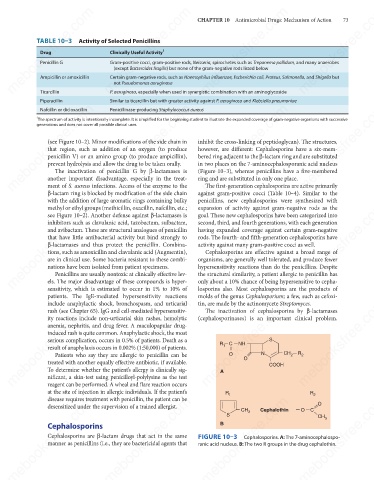
however, are different: Cephalosporins have a six-mem-
that region, such as addition of an oxygen (to produce
penicillin V) or an amino group (to produce ampicillin),
bered ring adjacent to the β-lactam ring and are substituted
prevent hydrolysis and allow the drug to be taken orally.
in two places on the 7-aminocephalosporanic acid nucleus
The inactivation of penicillin G by β-lactamases is
(Figure 10–3), whereas penicillins have a five-membered
another important disadvantage, especially in the treat-
The first-generation cephalosporins are active primarily
ment of S. aureus infections. Access of the enzyme to the
against gram-positive cocci (Table 10–4). Similar to the
β-lactam ring is blocked by modification of the side chain
penicillins, new cephalosporins were synthesized with
with the addition of large aromatic rings containing bulky ring and are substituted in only one place.
mebooksfree.com
mebooksfree.com mebooksfree.com mebooksfree.com having expanded coverage against certain gram-negative mebooksfree.com
mebooksfree.com
methyl or ethyl groups (methicillin, oxacillin, nafcillin, etc.;
expansion of activity against gram-negative rods as the
see Figure 10–2). Another defense against β-lactamases is
goal. These new cephalosporins have been categorized into
inhibitors such as clavulanic acid, tazobactam, sulbactam,
second, third, and fourth generations, with each generation
and avibactam. These are structural analogues of penicillin
that have little antibacterial activity but bind strongly to
rods. The fourth- and fifth-generation cephalosporins have
activity against many gram-positive cocci as well.
β-lactamases and thus protect the penicillin. Combina-
Cephalosporins are effective against a broad range of
tions, such as amoxicillin and clavulanic acid (Augmentin),
are in clinical use. Some bacteria resistant to these combi-
organisms, are generally well tolerated, and produce fewer
hypersensitivity reactions than do the penicillins. Despite
nations have been isolated from patient specimens.
Penicillins are usually nontoxic at clinically effective lev-
only about a 10% chance of being hypersensitive to cepha-
els. The major disadvantage of these compounds is hyper-
losporins also. Most cephalosporins are the products of
sensitivity, which is estimated to occur in 1% to 10% of
molds of the genus Cephalosporium; a few, such as cefoxi-
patients. The IgE-mediated hypersensitivity reactions the structural similarity, a patient allergic to penicillin has
mebooksfree.com mebooksfree.com mebooksfree.com mebooksfree.com CH 2 R 2 mebooksfree.com mebooksfree.com
tin, are made by the actinomycete Streptomyces.
include anaphylactic shock, bronchospasm, and urticarial
rash (see Chapter 65). IgG and cell-mediated hypersensitiv-
The inactivation of cephalosporins by β-lactamases
(cephalosporinases) is an important clinical problem.
ity reactions include non-urticarial skin rashes, hemolytic
anemia, nephritis, and drug fever. A maculopapular drug-
induced rash is quite common. Anaphylactic shock, the most
serious complication, occurs in 0.5% of patients. Death as a
S
R
NH
C
1
result of anaphylaxis occurs in 0.002% (1:50,000) of patients.
N
Patients who say they are allergic to penicillin can be
O
O
treated with another equally effective antibiotic, if available.
COOH
To determine whether the patient’s allergy is clinically sig-
nificant, a skin-test using penicilloyl-polylysine as the test
reagent can be performed. A wheal and flare reaction occurs
at the site of injection in allergic individuals. If the patient’s A R S 1 CH 2 Cephalothin O R 2 O
mebooksfree.com
mebooksfree.com mebooksfree.com mebooksfree.com FIGURE 10–3 Cephalosporins. A: The 7-aminocephalospo- mebooksfree.com
mebooksfree.com
disease requires treatment with penicillin, the patient can be
desensitized under the supervision of a trained allergist.
C
CH
3
Cephalosporins
B
Cephalosporins are β-lactam drugs that act in the same
manner as penicillins (i.e., they are bactericidal agents that
ranic acid nucleus. B: The two R groups in the drug cephalothin.
mebooksfree.com mebooksfree.com mebooksfree.com mebooksfree.com mebooksfree.com mebooksfree.com

