


Page 82 - Review of Medical Microbiology and Immunology ( PDFDrive )
P. 82
mebooksfree.com
                                                                                                            mebooksfree.com
 mebooksfree.com

                                            mebooksfree.com
            mebooksfree.com
                                                                                                            mebooksfree.com
                                                                            mebooksfree.com
 mebooksfree.com  mebooksfree.com           mebooksfree.com              CHAPTER 10  Antimicrobial Drugs: Mechanism of Action  71          mebooksfree.com
                                                                                                                                           mebooksfree.com
                    TABLE 10–2  Mechanism of Action of Important Antibacterial and Antifungal Drugs
                                                                          Drugs
                      Mechanism of Action

                      Inhibition of cell wall synthesis
                        1.  (a)   Antibacterial activity inhibition of cross-linking (transpeptidation)
                                                                          Penicillins, cephalosporins, imipenem, aztreonam, vancomycin
                            of peptidoglycan
                         (b)  Inhibition of other steps in peptidoglycan synthesis
                        2.  Antifungal activity inhibition of β-glucan synthesis
                                                                          Caspofungin
                      Inhibition of protein synthesis                     Cycloserine, bacitracin

 mebooksfree.com  mebooksfree.com           mebooksfree.com               Sulfonamides, trimethoprim        mebooksfree.com                mebooksfree.com
                                                                          Chloramphenicol, erythromycin, clindamycin, linezolid
                      Action on 50S ribosomal subunit
                                                                            mebooksfree.com
                                                                          Tetracyclines and aminoglycosides
                      Action on 30S ribosomal subunit
                      Inhibition of nucleic acid synthesis

                      Inhibition of nucleotide synthesis
                                                                          Quinolones (e.g., ciprofloxacin)
                      Inhibition of DNA synthesis
                      Inhibition of mRNA synthesis
                                                                          Rifampin

                      Alteration of cell membrane function
                      Antibacterial activity
                                                                          Polymyxin, daptomycin
                      Antifungal activity
                                                                          Amphotericin B, nystatin, terbinafine, azoles (e.g., itraconazole)
                      Other mechanisms of action

                                                                          Isoniazid, metronidazole, ethambutol, pyrazinamide
                      1. Antibacterial activity
                      2. Antifungal activity
                                                                          Griseofulvin, pentamidine
 mebooksfree.com  mebooksfree.com           mebooksfree.com              the peptidoglycan. Some bacteria (e.g., strains of S. aureus)     mebooksfree.com
                                                                                                            mebooksfree.com
                                                                            mebooksfree.com
                        MECHANISMS OF ACTION
                        INHIBITION OF CELL WALL
                                                                         are tolerant to the action of penicillin, because these auto-
                        SYNTHESIS
                                                                         lytic enzymes are not activated. A tolerant organism is one
                                                                         that is inhibited but not killed by a drug that is usually bac-
                        1. Inhibition of Bacterial
                                                                         tericidal, such as penicillin (see page 90).
                        Cell Wall Synthesis
                                                                           Penicillin-treated cells die by rupture as a result of the
                        Penicillins
                        Penicillins (and cephalosporins) act by inhibiting  trans-
                        peptidases, the enzymes that catalyze the final cross-linking
                        step in the synthesis of peptidoglycan (see Figure 2–5). For   influx of water into the high-osmotic-pressure interior of
 mebooksfree.com  mebooksfree.com           mebooksfree.com                Number of viable bacteria mebooksfree.com drug  mebooksfree.com  mebooksfree.com
                        example, in S. aureus, transpeptidation occurs between the
                        amino group on the end of the pentaglycine cross-link and
                        the terminal carboxyl group of the d-alanine on the tetra-
                                                                                       No drug
                                                                                       added
                        peptide side chain. Because the stereochemistry of penicil-
                        lin  is similar to  that of  a dipeptide,  d-alanyl-d-alanine,
                                                                                                              Bacteriostatic
                        penicillin can bind to the active site of the transpeptidase
                                                                                                              drug removed
                        and inhibit its activity.
                                                                                                 Bacteriostatic
                                                                                      Drug
                          Two additional factors are involved in the action of
                                                                                      added
                        penicillin:
                                                                                                    Bactericidal
                          (1) The first is that penicillin binds to a variety of recep-
                                                                                                      drug
                        tors in the bacterial cell membrane and cell wall, called
                                                                                                 Time
                        penicillin-binding proteins (PBPs). Some PBPs are trans-
                        peptidases; the others function in the synthesis of peptido-
                                                                            mebooksfree.com
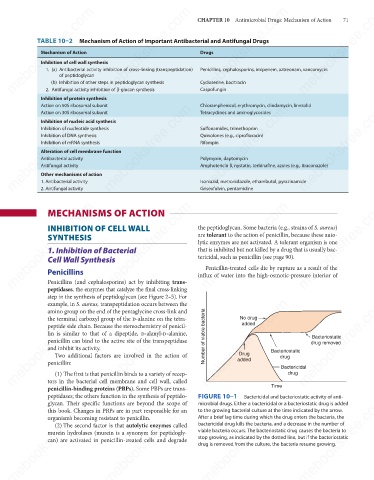
 mebooksfree.com  mebooksfree.com           mebooksfree.com              FIGURE 10–1    Bactericidal and bacteriostatic activity of anti-  mebooksfree.com
                                                                                                            mebooksfree.com
                        glycan. Their specific functions are beyond the scope of
                                                                         microbial drugs. Either a bactericidal or a bacteriostatic drug is added
                        this book. Changes in PBPs are in part responsible for an
                                                                         to the growing bacterial culture at the time indicated by the arrow.
                                                                         After a brief lag time during which the drug enters the bacteria, the
                        organism’s becoming resistant to penicillin.
                                                                         bactericidal drug kills the bacteria, and a decrease in the number of
                          (2) The second factor is that autolytic enzymes called
                                                                         viable bacteria occurs. The bacteriostatic drug causes the bacteria to
                        murein hydrolases (murein is a synonym for peptidogly-
                                                                         stop growing, as indicated by the dotted line, but if the bacteriostatic
                        can) are activated in penicillin-treated cells and degrade
                                                                         drug is removed from the culture, the bacteria resume growing.
 mebooksfree.com  mebooksfree.com           mebooksfree.com                 mebooksfree.com                 mebooksfree.com                mebooksfree.com

