


Page 22 - mathsvol1ch1to3ans
P. 22
22


                                                                               5
                                                                                               2
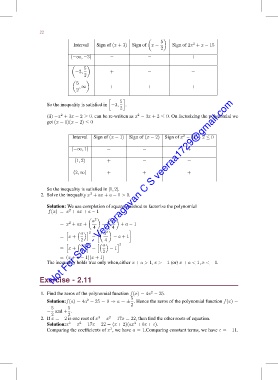
                                     Interval   Sign of (x + 3)  Sign of x −         Sign of 2x + x − 15
                                                                               2
                                   (−∞, −3)           −                  −                    +


                                          5
                                      −3,             +                  −                    −
                                          2

                                      5
                                       , ∞            +                  +                    +
                                      2

                           Not For Sale - Veeraragavan C S veeraa1729@gmail.com

                                                           5
                        So the inequality is satisfied in −3,  .
                                                           2
                               2
                                                                    2
                        (ii) −x + 3x − 2 ≥ 0. can be re-written as x − 3x + 2 ≤ 0. On factorizing the polynomial we
                        get (x − 1)(x − 2) ≤ 0

                                                                                          2
                                    Interval  Sign of (x − 1)   Sign of (x − 2)  Sign of x − 3x + 2 ≤ 0
                                    (−∞, 1)          −                −                     +


                                     (1, 2)          +                −                     −


                                     (2, ∞)          +                +                     +


                        So the inequality is satisfied in [1, 2].
                                             2
                     2. Solve the inequality x + ax + a − 1 > 0.

                        Solution: We use completion of squares method to factorize the polynomial
                                  2
                        f(x) = x + ax + a − 1
                                               2        2
                                              a        a
                                  2
                              = x + ax +          −         + a − 1
                                              4        4

                                        a          a
                                 h        i 2        2
                              = x +           −         − a + 1
                                        2           4
                                        a          a
                                 h        i 2   h         i 2
                              = x +           −       − 1
                                        2          2
                              = (x + a − 1)(x + 1)
                        The inequality holds true only when,either x + a > 1, x > −1 (or) x + a < 1, x < −1.

                    Exercise - 2.11


                                                                          2
                     1. Find the zeros of the polynomial function f(x) = 4x − 25.
                                                                 5
                                           2
                        Solution:f(a) = 4a − 25 = 0 ⇒ a = ± . Hence the zeros of the polynomial function f(x) =
                                                                 2
                          5       5
                        − and + .
                          2       2
                                                 3
                                                      2
                     2. If x = −2 is one root of x − x − 17x = 22, then find the other roots of equation.
                                        2
                                                                  2
                                  3
                        Solution:x − x − 17x − 22 = (x + 2)(ax + bx + c).
                                                       3
                        Comparing the coefficients of x , we have a = 1.Comparing constant terms, we have c = −11.

