


Page 27 - mathsvol1ch1to3ans
P. 27
27

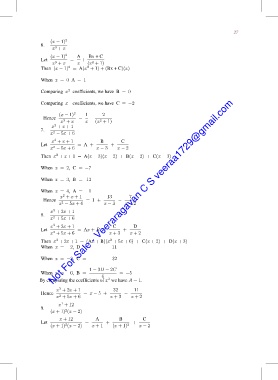
                         (x − 1) 2
                     6.
                            3
                          x + x
                         (x − 1) 2    A     Bx + C
                     Let           =     +
                          x + x        x   (x + 1)
                            3
                                              2
                                  2
                                           2
                     Then (x − 1) = A(x + 1) + (Bx + C)(x)
                     When x = 0 A = 1
                                  2
                     Comparing x coefficients, we have B = 0
                           Not For Sale - Veeraragavan C S veeraa1729@gmail.com
                     Comparing x coefficients, we have C = −2

                              (x − 1) 2    1       2
                      Hence            =     −
                                                 2
                              x + x       x    (x + 1)
                                3
                           2
                          x + x + 1
                     7.
                           2
                         x − 5x + 6
                           2
                          x + x + 1               B         C
                     Let               = A +           +
                           2
                         x − 5x + 6             x − 3     x − 2
                            2
                     Then x + x + 1 = A(x − 3)(x − 2) + B(x − 2) + C(x − 3)
                     When x = 2, C = −7

                     When x = 3, B = 13

                     When x = 4, A =        1
                                2
                              x + x + 1              13         7
                      Hence                = 1 +          −
                               2
                              x − 5x + 6           x − 3      x − 2
                           3
                         x + 2x + 1
                     8.
                           2
                         x + 5x + 6
                           3
                         x + 2x + 1                     C         D
                     Let               = Ax + B +            +
                           2
                         x + 5x + 6                   x + 3     x + 2
                            3
                                                       2
                     Then x + 2x + 1 = (Ax + B)(x + 5x + 6) + C(x + 2) + D(x + 3)
                     When x = −2, D =                 −11
                     When x = −3, C =                  32

                                            1 − 3D − 2C
                     When x =      0, B =                  = −5
                                                  6
                                                     3
                    By comparing the coefficients of x we have A = 1.
                              3
                            x + 2x + 1                  32        11
                     Hence                = x − 5 +          −
                            x + 5x + 6                x + 3      x + 2
                              2
                               1
                             x + 12
                     9.
                                 2
                         (x + 1) (x − 2)
                              x + 12           A           B          C
                     Let                  =         +            +
                                 2
                         (x + 1) (x − 2)      x + 1     (x + 1) 2   x − 2

