


Page 67 - mathsvol1ch1to3ans
P. 67
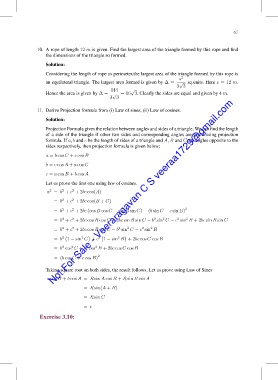
67


                   10. A rope of length 12 m is given. Find the largest area of the triangle formed by this rope and find
                       the dimensions of the triangle so formed.

                       Solution:

                       Considering the length of rope as perimeter,the largest area of the triangle formed by this rope is
                                                                                        s 2
                       an equilateral triangle. The largest area formed is given by ∆ = √ sq.units. Here s = 12 m.
                                                                                       3 3
                                                       144      √
                       Hence the area is given by ∆ = √ = 16 3. Clearly the sides are equal and given by 4 m.
                                                      3 3
                           Not For Sale - Veeraragavan C S veeraa1729@gmail.com

                   11. Derive Projection formula from (i) Law of sines, (ii) Law of cosines.

                       Solution:
                       Projection Formula gives the relation between angles and sides of a triangle. We can find the length
                       of a side of the triangle if other two sides and corresponding angles are given using projection
                       formula. If a, b and c be the length of sides of a triangle and A, B and C are angles opposite to the
                       sides respectively, then projection formula is given below:
                       a = b cos C + c cos B

                       b = c cos A + a cos C

                       c = a cos B + b cos A

                       Let us prove the first one using law of cosines.
                                    2
                               2
                         2
                        a = b + c + 2bc cos(A)
                                    2
                               2
                           = b + c + 2bc cos(B + C)
                                    2
                               2
                           = b + c + 2bc (cos B cos C − sin B sin C) − (b sin C − c sin B) 2
                                                                                2
                                                                            2
                                    2
                                                                                           2
                               2
                                                                                       2
                           = b + c + 2bc cos B cos C − 2bc sin B sin C − b sin C − c sin B + 2bc sin B sin C
                                                               2
                                                                          2
                                                           2
                                    2
                               2
                                                                      2
                           = b + c + 2bc cos B cos C − b sin C − c sin B

                                                          2
                                         2

                           = b 2  1 − sin C + c  2  1 − sin B + 2bc cos C cos B
                                               2
                                           2
                               2
                                    2
                           = b cos C + c cos B + 2bc cos C cos B
                           = (b cos C + c cos B) 2
                       Taking square root on both sides, the result follows. Let us prove using Law of Sines
                        a cos B + b cos A = R sin A cos B + R sin B cos A
                                          = R sin(A + B)
                                          = R sin C
                                          = c
                    Exercise 3.10:

