Page 66 - mathsvol1ch1to3ans
P. 66

66

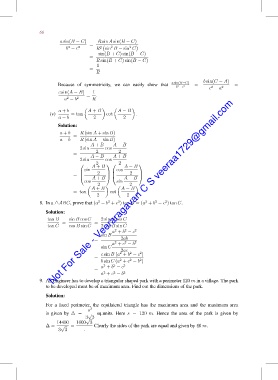
                              a sin(B − C)      R sin A sin(B − C)
                                            =
                                                                2
                                                       2
                                  2
                                 b − c 2        R 2  sin B − sin C
                                                 sin(B + C) sin(B − C)
                                            =
                                                R sin(B + C) sin(B − C)
                                                1
                                            =
                                                R
                                                                                                    b sin(C − A)
                                                                                    a sin(B−C)
                             Because of symmetricity, we can easily show that                  =                   =
                                                                                       2
                                                                                      b −c 2           c − a 2
                                                                                                        2
                             c sin(A − B)     1
                                           =    .
                                 2
                                a − b 2       R
                           Not For Sale - Veeraragavan C S veeraa1729@gmail.com

                             a + b          A + B         A − B
                         (v)       = tan             cot           .
                             a − b            2              2
                             Solution:
                              a + b     R (sin A + sin B)
                                     =
                              a − b     R (sin A − sin B)
                                             A + B      A − B
                                        2 sin       cos
                                     =          2          2
                                             A − B      A + B
                                        2 sin       cos
                                                2          2
                                              A + B          A − B
                                                                 
                                          sin             cos
                                                2               2
                                                                 
                                              A + B          A − B
                                     =                           
                                          cos             sin
                                                2
                                                                2
                                             A + B          A − B
                                     = tan            cot
                                                2              2
                                                 2
                                                                                 2
                                                     2
                                                                            2
                                                                        2
                                                          2
                    8. In a 4ABC, prove that (a − b + c ) tan B = (a + b − c ) tan C.
                       Solution:
                        tan B     sin B cos C     2 sin B cos C
                               =               =
                        tan C     cos B sin C     2 cos B sin C
                                                         2
                                                              2
                                                       a + b − c  2
                                                  sin B
                                               =            2ab
                                                         2
                                                              2
                                                       a + c − b  2
                                                  sin C
                                                            2ac
                                                                2
                                                           2
                                                                     2
                                                  c sin B (a + b − c )
                                               =
                                                                2
                                                                     2
                                                           2
                                                  b sin C (a + c − b )
                                                   2
                                                        2
                                                  a + b − c  2
                                               =
                                                        2
                                                   2
                                                  a + c − b  2
                    9. An Engineer has to develop a triangular shaped park with a perimeter 120 m in a village. The park
                       to be developed must be of maximum area. Find out the dimensions of the park.
                       Solution:
                       For a fixed perimeter, the equilateral triangle has the maximum area and the maximum area
                                            s 2
                       is given by ∆ =      √   sq.units. Here s = 120 m. Hence the area of the park is given by
                                           3 3
                                           √
                             14400    1600 3
                       ∆ =     √   =           Clearly the sides of the park are equal and given by 40 m.
                             3 3          .
   61   62   63   64   65   66   67   68