


Page 62 - mathsvol1ch1to3ans
P. 62
62
                                      √
                                        5 + 1
                         (x) cos 2θ =
                                         4
                                            ◦
                             cos 2θ = cos 36 .
                                        π
                                    ◦
                             θ = 18 =
                                        5
                                         π
                             θ = 2nπ ±
                                         5
                                  2
                         (xi) 2 cos x − 7 cos x + 3 = 0 (2 cos (x) − 1) (cos (x) − 3) = 0
                                       1
                             cos(x) =    or cos(x) = 3
                                       2
                           Not For Sale - Veeraragavan C S veeraa1729@gmail.com
                                                                                     π
                             Since cos(x) = 3 has no solution,the only solution is x =  + 2πn
                                                                                     3
                    Exercise 3.9:
                                       sin A   sin(A − B)
                                                                        2
                                                                           2
                                                                              2
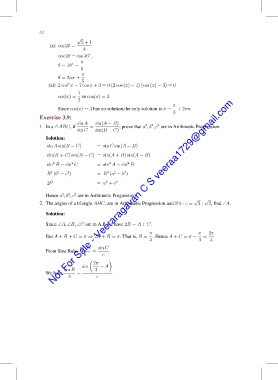
                    1. In a 4ABC, if         =             , prove that a , b , c are in Arithmetic Progression.
                                       sin C   sin(B − C)
                       Solution:
                        sin A sin(B − C)        = sin C sin(A − B)
                        sin(B + C) sin(B − C) = sin(A + B) sin(A − B)

                           2
                                                               2
                                                      2
                                    2
                        sin B − sin C           = sin A − sin B
                                                        2
                                  2
                                                     2
                                                             2
                             2
                          2
                        R (b − c )              = R (a − b )
                                                    2
                        2b 2                    = a + c  2
                                  2
                               2
                                     2
                       Hence a , b , c are in Arithmetic Progression.
                                                                                               √    √
                    2. The angles of a triangle ABC, are in Arithmetic Progression and if b : c =  3 :  2, find ∠A.
                       Solution:
                       Since ∠A, ∠B, ∠C are in A.P, we have 2B = A + C.
                                                                          π                      π    2π
                       But A + B + C = π ⇒ 2B + B = π. That is, B =        . Hence A + C = π −      =
                                                                          3                      3     3
                                        sin B    sin C
                       From Sine Rule,        =       .
                                          b        c

                                              2π
                                         sin      − A
                                sin B          3
                       We have        =
                                  b             c

