


Page 121 - CRC_One Report 2021_EN
P. 121
Business Overview and Performance      Corporate Governance     Financial Statements   Enclosure


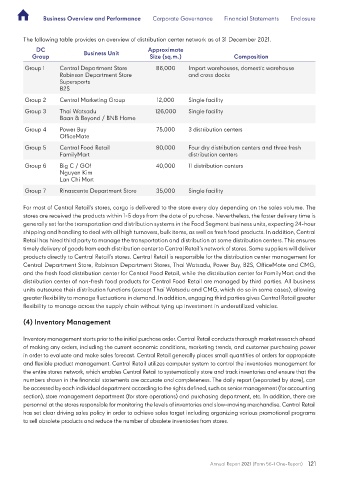
         The following table provides an overview of distribution center network as of 31 December 2021.
              DC                                     Approximate
                              Business Unit
            Group                                     Size (sq.m.)                 Composition
          Group 1     Central Department Store          86,000     Import warehouses, domestic warehouse
                      Robinson Department Store                    and cross docks
                      Supersports
                      B2S

          Group 2     Central Marketing Group           12,000     Single facility
          Group 3     Thai Watsadu                      126,000    Single facility
                      Baan & Beyond / BNB Home
          Group 4     Power Buy                         75,000     3 distribution centers
                      OfficeMate
          Group 5     Central Food Retail               80,000     Four dry distribution centers and three fresh
                      FamilyMart                                   distribution centers
          Group 6     Big C / GO!                       40,000     11 distribution centers
                      Nguyen Kim
                      Lan Chi Mart
          Group 7     Rinascente Department Store       35,000     Single facility


         For most of Central Retail’s stores, cargo is delivered to the store every day depending on the sales volume. The
         stores are received the products within 1-5 days from the date of purchase. Nevertheless, the faster delivery time is
         generally set for the transportation and distribution systems in the Food Segment business units, expecting 24-hour
         shipping and handling to deal with all high turnovers, bulk items, as well as fresh food products. In addition, Central
         Retail has hired third party to manage the transportation and distribution at some distribution centers. This ensures
         timely delivery of goods from each distribution center to Central Retail’s network of stores. Some suppliers will deliver
         products directly to Central Retail’s stores. Central Retail is responsible for the distribution center management for
         Central Department Store, Robinson Department Stores, Thai Watsadu, Power Buy, B2S, OfficeMate and CMG,
         and the fresh food distribution center for Central Food Retail, while the distribution center for FamilyMart and the
         distribution center of non-fresh food products for Central Food Retail are managed by third parties. All business
         units outsource their distribution functions (except Thai Watsadu and CMG, which do so in some cases), allowing
         greater flexibility to manage fluctuations in demand. In addition, engaging third parties gives Central Retail greater
         flexibility to manage across the supply chain without tying up investment in underutilized vehicles.

         (4) Inventory Management


         Inventory management starts prior to the initial purchase order. Central Retail conducts thorough market research ahead
         of making any orders, including the current economic conditions, marketing trends, and customer purchasing power
         in order to evaluate and make sales forecast. Central Retail generally places small quantities of orders for appropriate
         and flexible product management. Central Retail utilizes computer system to control the inventories management for
         the entire stores network, which enables Central Retail to systematically store and track inventories and ensure that the
         numbers shown in the financial statements are accurate and completeness. The daily report (separated by store), can
         be accessed by each individual department according to the rights defined, such as senior management (for accounting
         section), store management department (for store operations) and purchasing department, etc. In addition, there are
         personnel at the stores responsible for monitoring the levels of inventories and slow-moving merchandise. Central Retail
         has set clear driving sales policy in order to achieve sales target including organizing various promotional programs
         to sell obsolete products and reduce the number of obsolete inventories from stores.


                                                                           Annual Report 2021 (Form 56-1 One-Report)  121

