


Page 164 - 9780077418427.pdf
P. 164
/Users/user-f465/Desktop
          tiL12214_ch06_139-176.indd Page 141  9/3/10  8:07 PM user-f465
          tiL12214_ch06_139-176.indd Page 141  9/3/10  8:07 PM user-f465                                                /Users/user-f465/Desktop


                                                                                           (–)
                                                                                                      A neutral atom:
                                                                                        (–)  + +        +2
                                                                                                        –2
                                                                                                          0 net charge
                                                                                     A
                                                                                                    (–)

                                                                                                      Removing an electron
                                                                                                      produces a positive ion:
                                                                                        (–) +           +2
                                                                                           +            –1
                                                                                                        +1 net charge
                                                                                     B

                                                                                           (–)
                       FIGURE 6.1  The importance of electrical power seems obvious
                        in a modern industrial society. What is not so obvious is the role of         Adding an electron produces
                                                                                                      a negative ion:
                        electricity in magnetism, light, chemical change, and as the very   (–) ++
                        basis for the structure of matter. All matter, in fact, is electrical in        +2
                        nature, as you will see.                                                        –3
                                                                                     C     (–)          –1 net charge
                           Electric charges interact to produce what is called the electrical
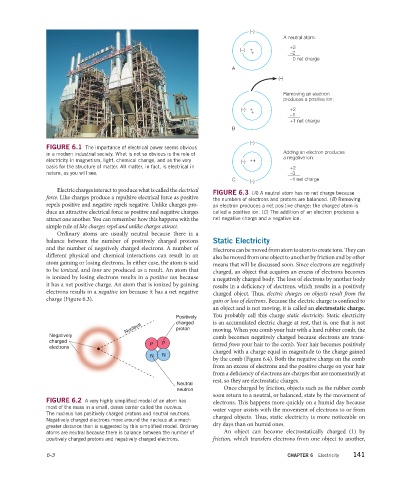
                                                                               FIGURE 6.3  (A) A neutral atom has no net charge because
                       force. Like charges produce a repulsive electrical force as positive   the numbers of electrons and protons are balanced. (B) Removing
                       repels positive and negative repels negative. Unlike charges pro-  an electron produces a net positive charge; the charged atom is
                       duce an attractive electrical force as positive and negative charges   called a positive ion. (C) The addition of an electron produces a
                       attract one another. You can remember how this happens with the   net negative charge and a negative ion.
                       simple rule of like charges repel and unlike charges attract.
                           Ordinary atoms are usually neutral because there is a
                         balance between the number of positively charged protons   Static Electricity
                       and the number of negatively charged electrons. A number of   Electrons can be moved from atom to atom to create ions. Th ey can

                        different physical and chemical interactions can result in an   also be moved from one object to another by friction and by other
                       atom gaining or losing electrons. In either case, the atom is said   means that will be discussed soon. Since electrons are negatively
                       to be ionized, and ions are produced as a result. An atom that   charged, an object that acquires an excess of electrons becomes
                       is ionized by losing electrons results in a positive ion because   a negatively charged body. The loss of electrons by another body

                       it has a net positive charge. An atom that is ionized by gaining   results in a deficiency of electrons, which results in a positively

                       electrons results in a negative ion because it has a net negative   charged object. Th us, electric charges on objects result from the
                       charge (Figure 6.3).                                    gain or loss of electrons. Because the electric charge is confi ned to
                                                                               an object and is not moving, it is called an  electrostatic charge.
                                                                  Positively   You probably call this charge  static electricity.  Static electricity
                                                  Nucleus         charged      is an accumulated electric charge at rest, that is, one that is not
                                                                  proton
                                                                               moving. When you comb your hair with a hard rubber comb, the
                         Negatively                                            comb becomes negatively charged because electrons are trans-
                         charged                          P   P
                         electrons                                             ferred from your hair to the comb. Your hair becomes positively
                                                                               charged with a charge equal in magnitude to the charge gained
                                                          N   N
                                                                               by the comb (Figure 6.4). Both the negative charge on the comb
                                                                               from an excess of electrons and the positive charge on your hair
                                                                               from a deficiency of electrons are charges that are momentarily at

                                                                               rest, so they are electrostatic charges.
                                                                   Neutral
                                                                   neutron        Once charged by friction, objects such as the rubber comb
                                                                               soon return to a neutral, or balanced, state by the movement of
                       FIGURE 6.2  A very highly simplified model of an atom has   electrons. This happens more quickly on a humid day because

                       most of the mass in a small, dense center called the nucleus.   water vapor assists with the movement of electrons to or from
                       The nucleus has positively charged protons and neutral neutrons.

                                                                               charged objects. Thus, static electricity is more noticeable on
                       Negatively charged electrons move around the nucleus at a much
                       greater distance than is suggested by this simplified model. Ordinary   dry days than on humid ones.
                       atoms are neutral because there is balance between the number of   An object can become electrostatically charged (1) by
                       positively charged protons and negatively charged electrons.  friction, which transfers electrons from one object to another,
                       6-3                                                                             CHAPTER 6  Electricity   141

