


Page 169 - 9780077418427.pdf
P. 169
/Users/user-f465/Desktop
          tiL12214_ch06_139-176.indd Page 146  9/1/10  9:40 PM user-f465
          tiL12214_ch06_139-176.indd Page 146  9/1/10  9:40 PM user-f465                                                /Users/user-f465/Desktop


                                                                             The potential difference can be measured by the work that is

                                                                          done to move the charge or by the work that the charge can do because

                                                                          of its position in the fi eld. This is perfectly analogous to the work
                                                                          that must be done to give an object gravitational potential energy
                                                                          or to the work that the object can potentially do because of its new

                                                                          position. Thus, when a 12 volt battery is charging, 12.0 joules of
                                                                          work are done to transfer 1.00 coulomb of charge from an outside
                                   1.00           1.00                    source against the electric field of the battery terminal. When the

                                 coulomb         coulomb                  12 volt battery is used, it does 12.0 joules of work for each coulomb
                                   (+)
                                                   (+)
                                    (+)            (+)
                                                                          of charge transferred from one terminal of the battery through the
                                                                          electrical system and back to the other terminal.
                                                 1.00 joule                6.2 ELECTRIC CURRENT
                                                 of work
                                                                          So far, we have considered electric charges that have been instan-
                                                                          taneously moved by friction but then generally stayed in one
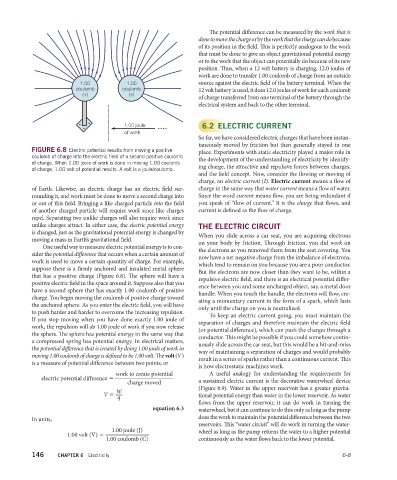
                   FIGURE 6.8  Electric potential results from moving a positive   place. Experiments with static electricity played a major role in
                   coulomb of charge into the electric field of a second positive coulomb
                                                                          the development of the understanding of electricity by identify-
                   of charge. When 1.00 joule of work is done in moving 1.00 coulomb
                   of charge, 1.00 volt of potential results. A volt is a joule/coulomb.  ing charge, the attractive and repulsive forces between charges,


                                                                          and the field concept. Now, consider the flowing or moving of
                                                                          charge, an electric current (I). Electric current means a fl ow of

                   of Earth. Likewise, an electric charge has an electric fi eld  sur-  charge in the same way that water current means a flow of water.

                   rounding it, and work must be done to move a second charge into   Since the word current means flow, you are being redundant if


                   or out of this field. Bringing a like charged particle into the fi eld   you speak of “flow of current.” It is the charge that fl ows, and


                   of another charged particle will require work since like charges   current is defined as the flow of charge.
                   repel. Separating two unlike charges will also require work since
                   unlike charges attract. In either case, the electric potential energy   THE ELECTRIC CIRCUIT
                   is changed, just as the gravitational potential energy is changed by
                                                                          When you slide across a car seat, you are acquiring electrons
                   moving a mass in Earth’s gravitational fi eld.
                                                                          on your body by friction. Through friction, you did work on

                      One useful way to measure electric potential energy is to con-
                                                                          the electrons as you removed them from the seat covering. You
                   sider the potential diff erence that occurs when a certain amount of
                                                                          now have a net negative charge from the imbalance of electrons,
                   work is used to move a certain quantity of charge. For example,
                                                                          which tend to remain on you because you are a poor conductor.
                   suppose there is a firmly anchored and insulated metal sphere

                                                                          But the electrons are now closer than they want to be, within a
                   that has a positive charge (Figure 6.8). The sphere will have a


                                                                          repulsive electric field, and there is an electrical potential diff er-
                   positive electric field in the space around it. Suppose also that you

                                                                          ence between you and some uncharged object, say, a metal door
                   have a second sphere that has exactly 1.00 coulomb of positive
                                                                          handle. When you touch the handle, the electrons will fl ow, cre-
                   charge. You begin moving the coulomb of positive charge toward
                                                                          ating a momentary current in the form of a spark, which lasts

                   the anchored sphere. As you enter the electric field, you will have
                                                                          only until the charge on you is neutralized.
                   to push harder and harder to overcome the increasing repulsion.
                                                                             To keep an electric current going, you must maintain the
                   If you stop moving when you have done exactly 1.00 joule of
                                                                          separation of charges and therefore maintain the electric fi eld
                   work, the repulsion will do 1.00 joule of work if you now release
                                                                          (or potential difference), which can push the charges through a

                   the sphere. The sphere has potential energy in the same way that

                                                                          conductor. This might be possible if you could somehow contin-

                   a compressed spring has potential energy. In electrical matters,
                                                                          uously slide across the car seat, but this would be a hit-and-miss
                   the potential diff erence that is created by doing 1.00 joule of work in
                                                                          way of maintaining a separation of charges and would probably

                   moving 1.00 coulomb of charge is defined to be 1.00 volt. Th e volt (V)
                                                                          result in a series of sparks rather than a continuous current. Th is
                   is a measure of potential difference between two points, or

                                                                          is how electrostatic machines work.
                                               work to create potential
                                              __                             A useful analogy for understanding the requirements for

                      electric potential difference =
                                                  charge moved            a sustained electric current is the decorative waterwheel device
                                                                          (Figure 6.9). Water in the upper reservoir has a greater gravita-
                                               W _
                                              V =                         tional potential energy than water in the lower reservoir. As water


                                               q
                                                                          flows from the upper reservoir, it can do work in turning the

                                                           equation 6.3   waterwheel, but it can continue to do this only as long as the pump
                                                                          does the work to maintain the potential difference between the two

                   In units,

                                                                          reservoirs. This “water circuit” will do work in turning the water-
                                             1.00 joule (J)
                                           __                             wheel as long as the pump returns the water to a higher potential
                              1.00 volt (V) =


                                           1.00 coulomb (C)               continuously as the water flows back to the lower potential.
                   146     CHAPTER 6 Electricity                                                                          6-8

