


Page 168 - 9780077418427.pdf
P. 168
/Users/user-f465/Desktop
          tiL12214_ch06_139-176.indd Page 145  9/1/10  9:40 PM user-f465
          tiL12214_ch06_139-176.indd Page 145  9/1/10  9:40 PM user-f465                                                /Users/user-f465/Desktop


                                      (–)               (+)
                                      Negative        Test
                                      charge          charge


                                      (+)               (+)
                                      Positive        Test
                                      charge          charge

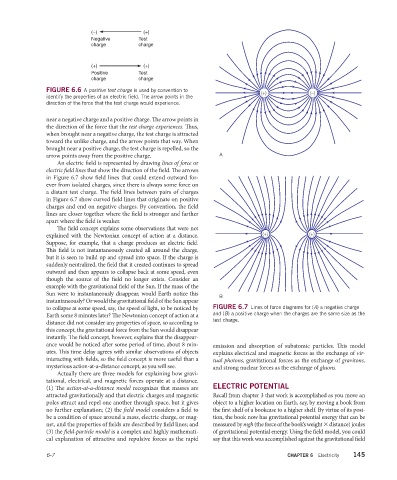
                       FIGURE 6.6  A positive test charge is used by convention to             (+)             (–)
                       identify the properties of an electric field. The arrow points in the
                       direction of the force that the test charge would experience.

                       near a negative charge and a positive charge. The arrow points in

                       the direction of the force that the test charge experiences. Th us,
                       when brought near a negative charge, the test charge is attracted
                       toward the unlike charge, and the arrow points that way. When
                       brought near a positive charge, the test charge is repelled, so the
                       arrow points away from the positive charge.               A
                           An electric field is represented by drawing lines of force or

                       electric fi eld lines that show the direction of the fi eld. Th e arrows
                       in Figure 6.7 show field lines that could extend outward for-

                       ever from isolated charges, since there is always some force on
                       a distant test charge. Th e field lines between pairs of charges

                       in Figure 6.7 show curved field lines that originate on positive

                       charges and end on negative charges. By convention, the fi eld

                       lines are closer together where the field is stronger and farther

                       apart where the field is weaker.

                           Th e field concept explains some observations that were not
                       explained with the Newtonian concept of action at a distance.           (+)             (+)
                       Suppose, for example, that a charge produces an electric fi eld.

                       Th is  field is not instantaneously created all around the charge,
                       but it is seen to build up and spread into space. If the charge is
                       suddenly neutralized, the fi eld that it created continues to spread
                       outward and then appears to collapse back at some speed, even

                       though the source of the field no longer exists. Consider an
                       example with the gravitational fi eld of the Sun. If the mass of the
                       Sun were to instantaneously disappear, would Earth notice this   B
                       instantaneously? Or would the gravitational field of the Sun appear

                       to collapse at some speed, say, the speed of light, to be noticed by   FIGURE 6.7  Lines of force diagrams for (A) a negative charge
                       Earth some 8 minutes later? The Newtonian concept of action at a   and (B) a positive charge when the charges are the same size as the

                                                                               test charge.
                       distance did not consider any properties of space, so according to
                       this concept, the gravitational force from the Sun would disappear
                       instantly. Th e field concept, however, explains that the disappear-

                       ance would be noticed after some period of time, about 8 min-  emission and absorption of subatomic particles. Th is  model

                       utes. This time delay agrees with similar observations of objects   explains electrical and magnetic forces as the exchange of vir-


                       interacting with fields, so the field concept is more useful than a   tual photons, gravitational forces as the exchange of gravitons,

                       mysterious action-at-a-distance concept, as you will see.  and strong nuclear forces as the exchange of gluons.
                           Actually there are three models for explaining how gravi-
                       tational, electrical, and magnetic forces operate at a distance.
                       (1) Th e action-at-a-distance model recognizes that masses are   ELECTRIC POTENTIAL
                       attracted gravitationally and that electric charges and magnetic   Recall from chapter 3 that work is accomplished as you move an
                       poles attract and repel one another through space, but it gives   object to a higher location on Earth, say, by moving a book from
                       no further explanation; (2) the fi eld model considers a fi eld to   the first shelf of a bookcase to a higher shelf. By virtue of its posi-

                       be a condition of space around a mass, electric charge, or mag-  tion, the book now has gravitational potential energy that can be


                       net, and the properties of fields are described by field lines; and   measured by mgh (the force of the book’s weight × distance) joules

                       (3) the fi eld-particle model is a complex and highly mathemati-  of gravitational potential energy. Using the field model, you could
                       cal explanation of attractive and repulsive forces as the rapid   say that this work was accomplished against the gravitational fi eld
                       6-7                                                                             CHAPTER 6  Electricity   145

