


Page 165 - 9780077418427.pdf
P. 165
/Users/user-f465/Desktop
          tiL12214_ch06_139-176.indd Page 142  9/1/10  9:40 PM user-f465
          tiL12214_ch06_139-176.indd Page 142  9/1/10  9:40 PM user-f465                                                /Users/user-f465/Desktop


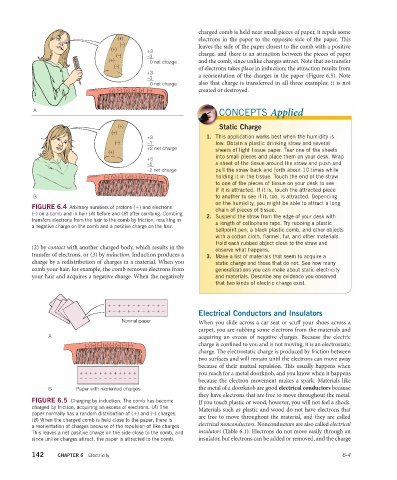
                                                                          charged comb is held near small pieces of paper, it repels some
                                               (+)
                                               (+)                        electrons in the paper to the opposite side of the paper. Th is
                                                (–)
                                             (+)         +3               leaves the side of the paper closest to the comb with a positive
                                               (–)       –3               charge, and there is an attraction between the pieces of paper
                                            (+)            0 net charge   and the comb, since unlike charges attract. Note that no transfer
                                              (–)                         of electrons takes place in induction; the attraction results from
                                                         +3
                                                         –3               a reorientation of the charges in the paper (Figure 6.5). Note
                                                           0 net charge   also that charge is transferred in all three examples; it is not
                                            (+) (–) (+) (–) (+) (–)       created or destroyed.


                   A                                                             CONCEPTS Applied

                                               (+)                                 Static Charge
                                             (+)
                                                         +3                  1.  This application works best when the humidity is
                                              (–)        –1                     low. Obtain a plastic drinking straw and several
                                                         +2 net charge
                                            (+)                                 sheets of light tissue paper. Tear one of the sheets
                                                         +3                     into small pieces and place them on your desk. Wrap
                                                         –5                     a sheet of the tissue around the straw and push and
                                                         –2 net charge          pull the straw back and forth about 10 times while
                                           (–) (+) (–) (+) (–) (+) (–) (–)      holding it in the tissue. Touch the end of the straw
                                                                                to one of the pieces of tissue on your desk to see
                                                                                if it is attracted. If it is, touch the attracted piece
                   B                                                            to another to see if it, too, is attracted. Depending
                                                                                on the humidity, you might be able to attract a long
                   FIGURE 6.4  Arbitrary numbers of protons (+) and electrons
                                                                                chain of pieces of tissue.
                   (–) on a comb and in hair (A) before and (B) after combing. Combing   2.  Suspend the straw from the edge of your desk with
                   transfers electrons from the hair to the comb by friction, resulting in
                                                                                a length of cellophane tape. Try rubbing a plastic
                   a negative charge on the comb and a positive charge on the hair.
                                                                                ballpoint pen, a black plastic comb, and other objects
                                                                                with a cotton cloth, flannel, fur, and other materials.
                                                                                Hold each rubbed object close to the straw and
                   (2) by contact with another charged body, which results in the
                                                                                observe what happens.
                   transfer of electrons, or (3) by induction. Induction produces a   3.  Make a list of materials that seem to acquire a
                   charge by a redistribution of charges in a material. When you   static charge and those that do not. See how many
                   comb your hair, for example, the comb removes electrons from   generalizations you can make about static electricity
                   your hair and acquires a negative charge. When the negatively   and materials. Describe any evidence you observed
                                                                                that two kinds of electric charge exist.


                                            + – + – + – + – + – + –
                                            + – + – + – + – + – + –
                                                                          Electrical Conductors and Insulators
                                                Normal paper              When you slide across a car seat or scuff your shoes across a

                                                                          carpet, you are rubbing some electrons from the materials and
                        A                                                 acquiring an excess of negative charges. Because the electric

                                    (–) (+) (–) (+) (–) (+) (–) (–)       charge is confined to you and is not moving, it is an electrostatic

                                                                          charge. The electrostatic charge is produced by friction between
                                                                          two surfaces and will remain until the electrons can move away
                                                                          because of their mutual repulsion. This usually happens when

                                   + + + + + + + + + + + +                you reach for a metal doorknob, and you know when it happens
                                   – – – – – – – – – – – –
                                                                          because the electron movement makes a spark. Materials like
                        B        Paper with reoriented charges            the metal of a doorknob are good electrical conductors because
                                                                          they have electrons that are free to move throughout the metal.
                   FIGURE 6.5  Charging by induction. The comb has become   If you touch plastic or wood, however, you will not feel a shock.
                   charged by friction, acquiring an excess of electrons. (A) The   Materials such as plastic and wood do not have electrons that
                   paper normally has a random distribution of (+) and (–) charges.
                                                                          are free to move throughout the material, and they are called
                   (B) When the charged comb is held close to the paper, there is
                   a reorientation of charges because of the repulsion of like charges.   electrical nonconductors. Nonconductors are also called electrical
                   This leaves a net positive charge on the side close to the comb, and   insulators (Table 6.1). Electrons do not move easily through an
                   since unlike charges attract, the paper is attracted to the comb.  insulator, but electrons can be added or removed, and the charge

                   142     CHAPTER 6 Electricity                                                                          6-4

