


Page 252 - 9780077418427.pdf
P. 252
/Users/user-f465/Desktop
          tiL12214_ch09_229-250.indd Page 229  9/3/10  10:07 PM user-f465
          tiL12214_ch09_229-250.indd Page 229  9/3/10  10:07 PM user-f465                                               /Users/user-f465/Desktop


                                                                                                  Chemical


                                                                                   9 9 Bonds


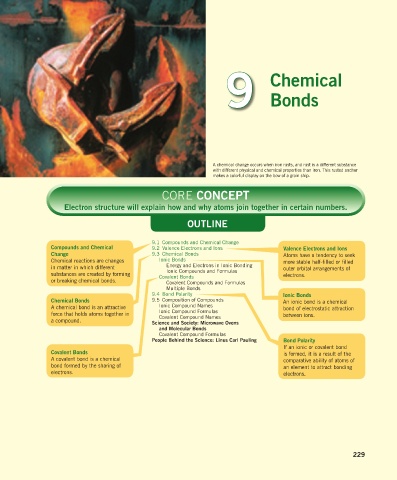
                                                                               A chemical change occurs when iron rusts, and rust is a different substance
                                                                               with different  physical and chemical properties than iron. This rusted anchor
                                                                               makes a colorful display on the bow of a grain ship.


                                                              CORE CONCEPT

                             Electron structure will explain how and why atoms join together in certain numbers.

                                                                      OUTLINE


                                                          9.1  Compounds and Chemical Change
                         Compounds and Chemical           9.2  Valence Electrons and Ions             Valence Electrons and Ions
                         Change                           9.3 Chemical Bonds                          Atoms have a tendency to seek
                         Chemical reactions are changes        Ionic Bonds                            more stable half-filled or filled
                         in matter in which different          Energy and Electrons in Ionic Bonding  outer orbital arrangements of
                                                               Ionic Compounds and Formulas
                         substances are created by forming   Covalent Bonds                           electrons.
                         or breaking chemical bonds.           Covalent Compounds and Formulas
                                                               Multiple Bonds
                                                          9.4 Bond Polarity                           Ionic Bonds
                         Chemical Bonds                   9.5  Composition of Compounds               An ionic bond is a chemical
                         A chemical bond is an attractive    Ionic Compound Names                     bond of electrostatic attraction
                         force that holds atoms together in   Ionic Compound Formulas                 between ions.
                                                             Covalent Compound Names
                         a compound.                      Science and Society: Microwave Ovens
                                                             and Molecular Bonds
                                                             Covalent Compound Formulas
                                                          People Behind the Science: Linus Carl  Pauling  Bond Polarity
                                                                                                      If an ionic or covalent bond
                         Covalent Bonds                                                               is formed, it is a result of the
                         A covalent bond is a chemical                                                comparative ability of atoms of
                         bond formed by the sharing of                                                an element to attract bonding
                         electrons.                                                                   electrons.


                                                                                                                             229

