


Page 256 - 9780077418427.pdf
P. 256
/Users/user-f465/Desktop
          tiL12214_ch09_229-250.indd Page 233  9/3/10  10:07 PM user-f465
          tiL12214_ch09_229-250.indd Page 233  9/3/10  10:07 PM user-f465                                               /Users/user-f465/Desktop


                                           First        Second       Third     ions. The electrostatic attraction between oppositely charged
                                           energy       energy       energy    ions forms ionic bonds, and ionic compounds are the result. In
                                           level        level        level
                                                                               general, ionic compounds are formed when a metal from the
                                                                               left side of the periodic table reacts with a nonmetal from the
                                                                               right side.

                        Na        11 p +      2 e –      8 e –        1 e –
                        atom      12 n                                         EXAMPLE 9.1
                               A                                               What are the symbol and charge for a calcium ion?


                                                                               SOLUTION

                        Na +      11 p +      2 e –      8 e –                 From the list of elements on the inside back cover, the symbol for cal-
                                                                               cium is Ca, and the atomic number is 20. The periodic table tells you
                        ion       12 n
                                                                               that Ca is in family IIA, which means that calcium has 2 valence elec-
                               B                                               trons. According to the octet rule, the calcium ion must lose 2 electrons
                                                                               to acquire the stable outer arrangement of the noble gases. Since the
                                                                               atomic number is 20, a calcium atom has 20  protons (20+) and  20 elec-
                                                                               trons (20–). When it is ionized, the  calcium ion will lose 2  electrons for
                                                                               a total charge of (20+) + (18–), or 2+. The calcium ion is represented
                                                                                      2+
                        Ne        10 p +      2 e –      8 e –                 by the chemical symbol for calcium and the charge shown as a super-
                                                                               script: Ca .
                        atom      10 n
                               C
                                                                               EXAMPLE 9.2
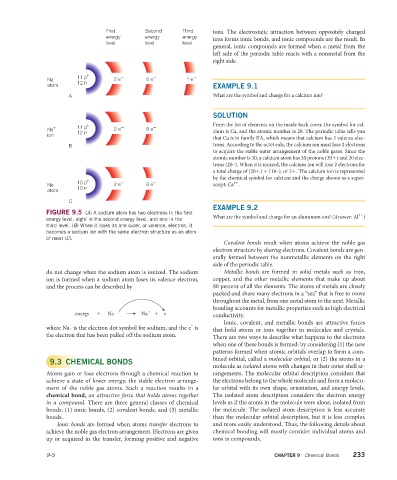
                       FIGURE 9.5  (A) A sodium atom has two electrons in the first                                            3+
                                                                               What are the symbol and charge for an aluminum ion? (Answer:  Al )
                        energy level, eight in the second energy level, and one in the
                        third level. (B) When it loses its one outer, or valence, electron, it
                        becomes a sodium ion with the same electron structure as an atom
                        of neon (C).
                                                                                  Covalent bonds result when atoms achieve the noble gas
                                                                               electron structure by sharing electrons. Covalent bonds are gen-
                                                                               erally formed between the nonmetallic elements on the right
                                                                               side of the periodic table.
                       do not change when the sodium atom is ionized. The sodium   Metallic bonds are formed in solid metals such as iron,
                       ion is formed when a sodium atom loses its valence electron,   copper, and the other metallic elements that make up about
                       and the process can be described by                     80 percent of all the elements. The atoms of metals are closely
                                                                               packed and share many electrons in a “sea” that is free to move
                                                                               throughout the metal, from one metal atom to the next. Metallic
                                                                               bonding accounts for metallic properties such as high electrical
                                 energy      Na N             Na      e        conductivity.
                                                                                  Ionic, covalent, and metallic bonds are attractive forces
                                                                       –
                       where Na· is the electron dot symbol for sodium, and the e  is   that hold atoms or ions together in molecules and crystals.
                       the electron that has been pulled off the sodium atom.  There are two ways to describe what happens to the electrons
                                                                               when one of these bonds is formed: by considering (1) the new
                                                                               patterns formed when atomic orbitals overlap to form a com-
                                                                               bined orbital, called a molecular orbital, or (2) the atoms in a
                         9.3 CHEMICAL BONDS
                                                                               molecule as isolated atoms with changes in their outer shell ar-
                       Atoms gain or lose electrons through a chemical reaction to   rangements. The molecular orbital description considers that
                       achieve a state of lower energy, the stable electron arrange-  the electrons belong to the whole molecule and form a molecu-
                       ment of the noble gas atoms. Such a reaction results in a   lar orbital with its own shape, orientation, and energy levels.
                       chemical bond, an attractive force that holds atoms together   The isolated atom description considers the electron energy
                       in a compound. There are three general classes of chemical   levels as if the atoms in the molecule were alone, isolated from
                       bonds: (1) ionic bonds, (2) covalent bonds, and (3) metallic   the molecule. The isolated atom description is less accurate
                       bonds.                                                  than the molecular orbital  description, but it is less complex
                           Ionic bonds are formed when atoms transfer electrons to   and more easily understood. Thus, the following details about
                       achieve the noble gas electron arrangement. Electrons are given   chemical bonding will mostly consider individual atoms and
                       up or acquired in the transfer, forming positive and negative   ions in  compounds.

                       9-5                                                                         CHAPTER 9  Chemical Bonds   233

