


Page 289 - 9780077418427.pdf
P. 289
/Users/user-f465/Desktop
          tiL12214_ch10_251-274.indd Page 266  9/3/10  6:11 PM user-f465
          tiL12214_ch10_251-274.indd Page 266  9/3/10  6:11 PM user-f465                                                /Users/user-f465/Desktop


                                                                                                                     23
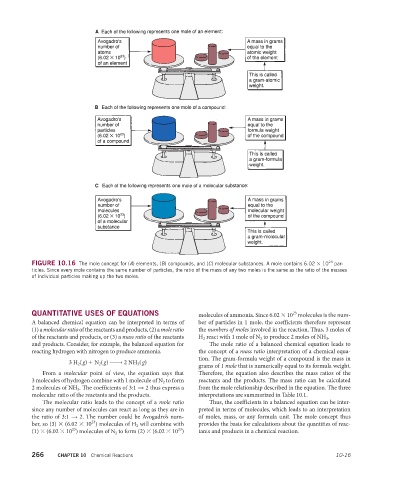
                   FIGURE 10.16  The mole concept for (A) elements, (B) compounds, and (C) molecular substances. A mole contains 6.02 × 10  par-
                   ticles. Since every mole contains the same number of particles, the ratio of the mass of any two moles is the same as the ratio of the masses
                   of individual particles making up the two moles.


                   QUANTITATIVE USES OF EQUATIONS                         molecules of ammonia. Since 6.02 × 10  molecules is the num-
                                                                                                         23
                   A balanced chemical equation can be interpreted in terms of   ber of particles in 1 mole, the coefficients therefore represent
                   (1) a molecular ratio of the reactants and products, (2) a mole  ratio   the numbers of moles involved in the reaction. Thus, 3 moles of
                   of the reactants and products, or (3) a mass ratio of the  reactants   H 2  react with 1 mole of N 2  to produce 2 moles of NH 3 .
                   and products. Consider, for example, the balanced equation for   The mole ratio of a balanced chemical equation leads to
                   reacting hydrogen with nitrogen to produce  ammonia.   the concept of a mass ratio interpretation of a chemical equa-
                                                                          tion. The gram-formula weight of a compound is the mass in
                               3 H 2 ( g)   + N 2 ( g)  → 2 NH 3 ( g)
                                                                          grams of 1 mole that is numerically equal to its formula weight.
                      From a  molecular point of view, the equation says that   Therefore, the equation also describes the mass ratios of the
                     3 molecules of hydrogen combine with 1 molecule of N 2  to form   reactants and the products. The mass ratio can be calculated
                   2 molecules of NH 3 . The coefficients of 3:1 → 2 thus  express a   from the mole relationship described in the equation. The three
                   molecular ratio of the reactants and the products.       interpretations are summarized in Table 10.1.
                      The molecular ratio leads to the concept of a mole ratio   Thus, the coefficients in a balanced equation can be inter-
                   since any number of molecules can react as long as they are in   preted in terms of molecules, which leads to an interpretation
                   the ratio of 3:1 → 2. The number could be Avogadro’s num-  of moles, mass, or any formula unit. The mole concept thus
                                      23
                   ber, so (3) × (6.02 × 10 ) molecules of H 2  will combine with     provides the basis for calculations about the quantities of reac-
                                23
                                                                   23
                   (1) × (6.02 × 10 ) molecules of N 2  to form (2) × (6.02 × 10 )   tants and products in a chemical reaction.
                   266     CHAPTER 10 Chemical Reactions                                                               10-16

