


Page 287 - 9780077418427.pdf
P. 287
/Users/user-f465/Desktop
          tiL12214_ch10_251-274.indd Page 264  9/3/10  6:11 PM user-f465
          tiL12214_ch10_251-274.indd Page 264  9/3/10  6:11 PM user-f465                                                /Users/user-f465/Desktop


                   products had a total mass of 36 u. Again, this is in accord with
                   the law of conservation of mass.
                      The equation says that 4 u of hydrogen will combine with
                   32 u of oxygen. Thus, hydrogen and oxygen combine in a mass
                   ratio of 4:32, which reduces to 1:8. So 1 g of hydrogen will com-  Hydrogen  +  Chlorine  Hydrogen chloride  Hydrogen chloride
                   bine with 8 g of oxygen, and, in fact, they will combine in this
                   ratio no matter what the measurement units are (gram, kilo-
                   gram, pound, etc.). They always combine in this mass ratio
                     because this is the mass of the individual reactants.  A
                      Back in the early 1800s, John Dalton (1766–1844)  attempted
                   to work out a table of atomic weights as he developed his atomic
                   theory.  Dalton made two major errors in determining the atomic
                   weights, including (1) measurement errors about mass ratios of
                   combining elements and (2) incorrect assumptions about the
                   formula of the resulting compound. For water, for example,   Hydrogen  Hydrogen  +  Oxygen     Water vapor  Water vapor
                     Dalton incorrectly measured that 5.5 g of oxygen combined
                   with 1.0 g of hydrogen. He assumed that one atom of hydrogen
                   combined with one atom of oxygen, resulting in a formula of
                   HO. Thus, Dalton concluded that the atomic mass of oxygen   B
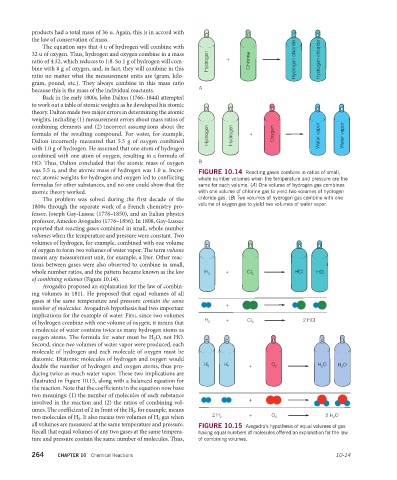
                   was 5.5 u, and the atomic mass of hydrogen was 1.0 u. Incor-  FIGURE 10.14  Reacting gases combine in ratios of small,
                   rect atomic weights for hydrogen and oxygen led to conflicting   whole number volumes when the temperature and pressure are the
                     formulas for other substances, and no one could show that the   same for each volume. (A) One volume of hydrogen gas combines
                   atomic theory worked.                                  with one volume of chlorine gas to yield two volumes of hydrogen
                      The problem was solved during the first decade of the   chloride gas. (B) Two volumes of hydrogen gas combine with one
                   1800s through the separate work of a French chemistry pro-  volume of oxygen gas to yield two volumes of water vapor.
                   fessor, Joseph Gay-Lussac (1778–1850), and an Italian physics
                   professor, Amedeo Avogadro (1776–1856). In 1808, Gay-Lussac
                   reported that reacting gases combined in small, whole number
                   volumes when the temperature and pressure were constant. Two
                   volumes of hydrogen, for example, combined with one volume
                   of oxygen to form two volumes of water vapor. The term volume
                   means any measurement unit, for example, a liter. Other reac-
                   tions between gases were also observed to combine in small,
                   whole number ratios, and the pattern became known as the law   H 2  +  CI 2            HCI    HCI
                   of combining volumes (Figure 10.14).
                      Avogadro proposed an explanation for the law of combin-
                   ing volumes in 1811. He proposed that equal volumes of all
                   gases at the same temperature and pressure contain the same     +
                   number of molecules. Avogadro’s hypothesis had two important
                   implications for the example of water. First, since two volumes
                   of hydrogen combine with one volume of oxygen, it means that   H 2  +  CI 2               2 HCI
                   a molecule of water contains twice as many hydrogen atoms as
                   oxygen atoms. The formula for water must be H 2 O, not HO.
                   Second, since two volumes of water vapor were produced, each
                   molecule of hydrogen and each molecule of oxygen must be
                   diatomic. Diatomic molecules of hydrogen and oxygen would
                   double the number of hydrogen and  oxygen atoms, thus pro-  H 2  H 2    +      O  2           H 2 O  H 2 O
                   ducing twice as much water vapor. These two implications are
                   illustrated in Figure 10.15, along with a balanced equation for
                   the reaction. Note that the  coefficients in the equation now have
                   two meanings: (1) the number of molecules of each substance             +
                   involved in the reaction and (2) the ratios of combining vol-
                   umes. The coefficient of 2 in front of the H 2 , for example, means
                   two molecules of H 2 . It also means two volumes of H 2  gas when   2 H 2  +   O 2               2 H 2 O
                   all volumes are measured at the same temperature and pressure.   FIGURE 10.15  Avogadro’s hypothesis of equal volumes of gas
                   Recall that equal volumes of any two gases at the same tempera-  having equal numbers of molecules offered an explanation for the law
                   ture and pressure contain the same number of molecules. Thus,   of combining volumes.

                   264     CHAPTER 10 Chemical Reactions                                                               10-14

