


Page 290 - 9780077418427.pdf
P. 290
/Users/user-f465/Desktop
          tiL12214_ch10_251-274.indd Page 267  9/3/10  6:11 PM user-f465
          tiL12214_ch10_251-274.indd Page 267  9/3/10  6:11 PM user-f465                                                /Users/user-f465/Desktop


                                                                                  Science and Society


                                                                                             The Catalytic Converter
                             he modern automobile produces two   explains why chemical reactions proceed   lowered. Some catalysts do this better with
                          Ttroublesome products in the form of   at a faster rate at higher temperatures.   some specific compounds than others,
                          (1) nitrogen monoxide and (2) hydrocar-  At higher temperatures, molecules have   and extensive chemical research programs
                          bons from the incomplete combustion of   greater average kinetic energies; thus, they   are devoted to finding new and more effec-
                          gasoline. These products from the exhaust   already have part of the minimum energy   tive catalysts.
                          enter the air to react in sunlight, eventually   needed for a reaction to take place.  Automobile catalytic converters use
                          producing an irritating haze known as photo-  The rate at which a chemical reaction   metals such as platinum and transition
                            chemical  smog. To reduce photochemical   proceeds is affected by a catalyst, a material   metal oxides such as copper(II) oxide and
                          smog, modern automobiles are fitted with   that speeds up a chemical reaction without   chromium(III) oxide. Catalytic reactions
                          a catalytic converter as part of their exhaust   being permanently changed by the reac-  that occur in the converter can reduce or
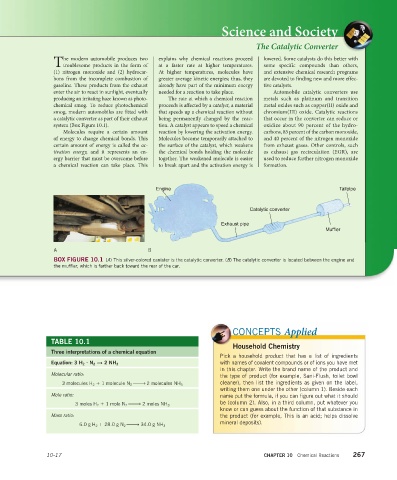
                          system (Box Figure 10.1).          tion. A catalyst appears to speed a chemical   oxidize about 90 percent of the hydro-
                             Molecules require a certain amount   reaction by lowering the activation energy.     carbons, 85 percent of the carbon monoxide,
                          of energy to change chemical bonds. This   Molecules become temporarily attached to   and 40 percent of the nitrogen monoxide
                          certain amount of energy is called the ac-  the surface of the catalyst, which weakens   from exhaust gases. Other controls, such
                          tivation energy, and it represents an en-  the chemical bonds holding the molecule   as exhaust gas recirculation (EGR), are
                          ergy barrier that must be overcome before     together. The weakened molecule is easier   used to reduce further nitrogen monoxide
                          a chemical reaction can take place. This   to break apart and the activation energy is    formation.


                                                            Engine                                                       Tailpipe


                                                                                           Catalytic converter
                                                                                 Exhaust pipe
                                                                                                                    Muffler


                          A                              B
                            BOX FIGURE 10.1 (A) This silver-colored canister is the catalytic converter. (B) The catalytic converter is located between the engine and
                          the muffler, which is farther back toward the rear of the car.


                                                                                     CONCEPTS Applied

                         TABLE 10.1
                                                                                     Household Chemistry
                         Three interpretations of a chemical equation
                                                                                 Pick a household product that has a list of ingredients
                                                                                 with names of covalent compounds or of ions you have met
                         Equation: 3 H 2  ∙ N 2  → 2 NH 3
                                                                                 in this chapter. Write the brand name of the product and
                         Molecular ratio:                                        the type of product (for example, Sani-Flush, toilet bowl
                                                                                 cleaner), then list the ingredients as given on the label,
                             3 molecules H 2  + 1 molecule N 2  →   2 molecules NH 3
                                                                                 writing them one under the other (column 1). Beside each
                         Mole ratio:                                             name put the formula, if you can figure out what it should
                                                                                 be (column 2). Also, in a third column, put whatever you
                                 3 moles H 2  + 1 mole N 2  → 2 moles NH 3
                                                                                 know or can guess about the function of that substance in
                         Mass ratio:                                             the product (for example, This is an acid; helps  dissolve
                                                                                 mineral deposits).
                                  6.0 g H 2  + 28.0 g N 2  → 34.0 g NH 3


                       10-17                                                                    CHAPTER 10  Chemical Reactions   267

