


Page 291 - 9780077418427.pdf
P. 291
/Users/user-f465/Desktop
          tiL12214_ch10_251-274.indd Page 268  9/3/10  6:11 PM user-f465
          tiL12214_ch10_251-274.indd Page 268  9/3/10  6:11 PM user-f465                                                /Users/user-f465/Desktop


                           People Behind the Science


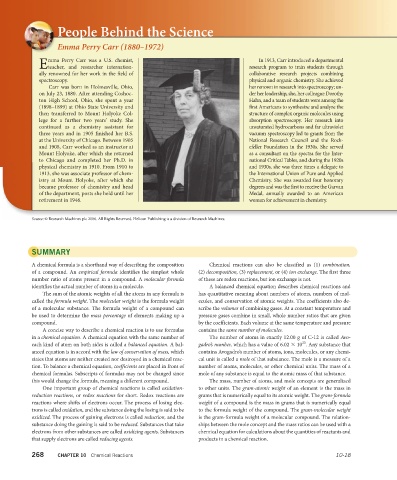
                           Emma Perry Carr (1880–1972)

                        mma Perry Carr was a U.S. chemist,                                    In 1913, Carr introduced a departmental
                     Eteacher, and researcher internation-                                 research program to train students through
                     ally renowned for her work in the field of                            collaborative research projects  combining
                     spectroscopy.                                                         physical and organic chemistry. She achieved
                        Carr was born in Holmesville, Ohio,                                her renown in  research into spectroscopy; un-
                     on July 23, 1880. After attending Coshoc-                             der her leadership, she, her colleague Dorothy
                     ton High School, Ohio, she spent a year                               Hahn, and a team of  students were among the
                     (1898–1899) at Ohio State University and                              first Americans to synthesize and analyze the
                     then transferred to Mount Holyoke Col-                                structure of complex organic molecules using
                     lege for a further two years’ study. She                              absorption spectroscopy. Her research into
                     continued as a chemistry assistant for                                unsaturated hydrocarbons and far ultraviolet
                     three years and in 1905 finished her B.S.                             vacuum spectroscopy led to grants from the
                     at the University of Chicago. Between 1905                            National Research Council and the Rock-
                     and 1908, Carr worked as an instructor at                             efeller Foundation in the 1930s. She served
                     Mount Holyoke, after which she returned                               as a consultant on the spectra for the Inter-
                     to Chicago and completed her Ph.D. in                                 national Critical Tables, and during the 1920s
                     physical chemistry in 1910. From 1910 to                              and 1930s, she was three times a delegate to
                     1913, she was associate professor of chem-                            the International Union of Pure and Applied
                     istry at Mount Holyoke, after which she                               Chemistry. She was awarded four honorary
                     became professor of chemistry and head                                degrees and was the first to receive the  Garvan
                     of the department, posts she held until her                           Medal, annually awarded to an American
                     retirement in 1946.                                                   woman for achievement in chemistry.


                   Source: © Research Machines plc 2006. All Rights Reserved. Helicon Publishing is a division of  Research Machines.


                   SUMMARY

                   A chemical formula is a shorthand way of describing the composition   Chemical reactions can also be classified as (1)  combination,
                   of a compound. An  empirical formula identifies the simplest whole   (2) decomposition, (3) replacement, or (4) ion exchange. The first three
                   number ratio of atoms present in a compound. A molecular formula   of these are redox reactions, but ion exchange is not.
                   identifies the actual number of atoms in a molecule.       A balanced chemical equation describes chemical reactions and
                      The sum of the atomic weights of all the atoms in any formula is   has quantitative meaning about numbers of atoms, numbers of mol-
                   called the formula weight. The molecular weight is the formula weight   ecules, and conservation of atomic weights. The coefficients also de-
                   of a molecular substance. The formula weight of a compound can   scribe the volumes of combining gases. At a constant temperature and
                   be used to determine the mass percentage of elements making up a   pressure gases combine in small, whole number ratios that are given
                    compound.                                             by the coefficients. Each volume at the same temperature and pressure
                      A concise way to describe a chemical reaction is to use formulas   contains the same number of molecules.
                   in a chemical equation. A chemical equation with the same number of   The number of atoms in exactly 12.00 g of C-12 is called Avo-
                                                                                                            23
                   each kind of atom on both sides is called a balanced equation. A bal-  gadro’s number, which has a value of 6.02 × 10 . Any substance that
                   anced equation is in accord with the law of conservation of mass, which   contains Avogadro’s number of atoms, ions, molecules, or any chemi-
                   states that atoms are neither created nor destroyed in a chemical reac-  cal unit is called a mole of that substance. The mole is a mea sure of a
                   tion. To balance a chemical equation, coefficients are placed in front of   number of atoms, molecules, or other chemical units. The mass of a
                   chemical formulas. Subscripts of formulas may not be changed since   mole of any substance is equal to the atomic mass of that substance.
                   this would change the formula, meaning a different compound.  The mass, number of atoms, and mole concepts are generalized
                      One important group of chemical reactions is called oxidation-  to other units. The gram-atomic weight of an element is the mass in
                   reduction reactions, or redox reactions for short. Redox reactions are   grams that is numerically equal to its atomic weight. The gram-formula
                   reactions where shifts of electrons occur. The process of losing elec-  weight of a compound is the mass in grams that is numerically equal
                   trons is called oxidation, and the substance doing the losing is said to be   to the formula weight of the compound. The gram-molecular weight
                     oxidized. The process of gaining electrons is called reduction, and the   is the gram-formula weight of a molecular compound. The relation-
                   substance doing the gaining is said to be reduced. Substances that take   ships  between the mole concept and the mass ratios can be used with a
                   electrons from other substances are called oxidizing agents. Substances   chemical equation for calculations about the quantities of reactants and
                   that supply electrons are called reducing agents.      products in a chemical reaction.

                   268     CHAPTER 10 Chemical Reactions                                                               10-18

