


Page 565 - 9780077418427.pdf
P. 565
/Volume/201/MHDQ233/tat78194_disk1of1/0073378194/tat78194_pagefiles
          tiL12214_ch22_541-564.indd Page 542  9/23/10  11:08 AM user-f465
          tiL12214_ch22_541-564.indd Page 542  9/23/10  11:08 AM user-f465             /Volume/201/MHDQ233/tat78194_disk1of1/0073378194/tat78194_pagefile


                   OVERVIEW


                     Earth’s atmosphere has a unique composition because of the cyclic flow of materials that takes place between
                     different parts. These cycles involve the movement of materials between the surface and the interior (see chapter 18)
                     and the building-up and tearing-down cycles on the surface (see chapters 19 and 20). Materials also cycle in and out
                     of Earth’s  atmosphere. Carbon dioxide, for example, is the major component of the atmospheres around Venus and
                     Mars, and early Earth had a similar atmosphere. Today, carbon dioxide is a very minor part of Earth’s atmosphere. It
                     has been maintained as a minor component in a mostly balanced state for about the past 570 million years, cycling
                     into and out of the atmosphere.
                         Water is also involved in a global cyclic flow between the atmosphere and the surface. Water on the surface
                     is mostly in the ocean, with lesser amounts in lakes, streams, and underground. Not much water is found in the
                     atmosphere at any one time on a worldwide basis, but billions of tons are constantly evaporating into the atmosphere
                     each year and returning as precipitation in an ongoing cycle.
                         The cycling of carbon dioxide and water to and from the atmosphere takes place in a dynamic system that is
                     energized by the Sun. Radiant energy from the Sun heats some parts of Earth more than others. Winds redistribute
                     this energy with temperature changes, rain, snow, and other changes that are generally referred to as the weather.
                         Understanding and predicting the weather is the subject of meteorology. Meteorology is the science of the
                     atmosphere and weather phenomena, from understanding everyday rain and snow to predicting not-so-common
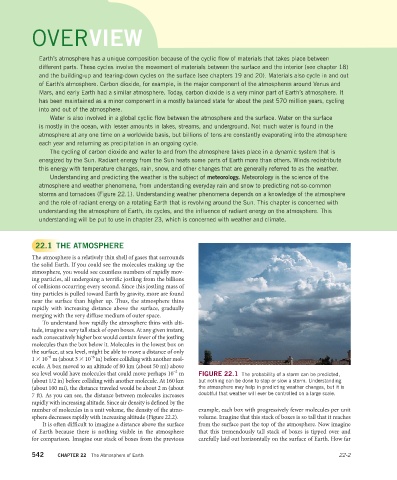
                     storms and tornadoes (Figure 22.1). Understanding weather phenomena depends on a knowledge of the atmosphere
                     and the role of radiant energy on a rotating Earth that is revolving around the Sun. This chapter is concerned with
                     understanding the atmosphere of Earth, its cycles, and the influence of radiant energy on the atmosphere. This
                     understanding will be put to use in chapter 23, which is  concerned with weather and climate.


                    22.1 THE ATMOSPHERE
                   The atmosphere is a relatively thin shell of gases that surrounds
                   the solid Earth. If you could see the molecules making up the
                     atmosphere, you would see countless numbers of rapidly mov-
                   ing particles, all undergoing a terrific jostling from the billions
                   of collisions occurring every second. Since this jostling mass of
                   tiny particles is pulled toward Earth by gravity, more are found
                   near the surface than higher up. Thus, the atmosphere thins
                   rapidly with increasing distance above the surface, gradually
                   merging with the very diffuse medium of outer space.
                      To understand how rapidly the atmosphere thins with alti-
                   tude, imagine a very tall stack of open boxes. At any given instant,
                   each consecutively higher box would contain fewer of the jostling
                   molecules than the box below it. Molecules in the lowest box on
                   the surface, at sea level, might be able to move a distance of only
                        –8
                                      –6
                   1 × 10  m (about 3 × 10  in) before colliding with another mol-
                   ecule. A box moved to an altitude of 80 km (about 50 mi) above
                                                                  –2
                   sea level would have molecules that could move perhaps 10  m   FIGURE 22.1  The probability of a storm can be predicted,
                   (about 1/2 in) before colliding with another molecule. At 160 km   but nothing can be done to stop or slow a storm. Understanding
                   (about 100 mi), the distance traveled would be about 2 m (about   the atmosphere may help in predicting weather changes, but it is
                   7 ft). As you can see, the distance between molecules increases   doubtful that weather will ever be controlled on a large scale.
                   rapidly with increasing altitude. Since air density is defined by the
                   number of molecules in a unit volume, the density of the atmo-  example, each box with progressively fewer molecules per unit
                   sphere decreases rapidly with increasing altitude (Figure 22.2).  volume. Imagine that this stack of boxes is so tall that it reaches
                      It is often difficult to imagine a distance above the surface   from the surface past the top of the atmosphere. Now imagine
                   of Earth because there is nothing visible in the atmosphere   that this tremendously tall stack of boxes is tipped over and
                   for comparison. Imagine our stack of boxes from the previous   carefully laid out horizontally on the surface of Earth. How far

                   542     CHAPTER 22  The Atmosphere of Earth                                                          22-2

