


Page 570 - 9780077418427.pdf
P. 570
/Volume/201/MHDQ233/tat78194_disk1of1/0073378194/tat78194_pagefile
          tiL12214_ch22_541-564.indd Page 547  9/23/10  11:08 AM user-f465
          tiL12214_ch22_541-564.indd Page 547  9/23/10  11:08 AM user-f465             /Volume/201/MHDQ233/tat78194_disk1of1/0073378194/tat78194_pagefiles


                       greenhouse glass allows the short wavelengths of solar radia-  This often leads to an  increase of air pollution because the inver-
                       tion to pass into the greenhouse but does not allow all of the   sion prevents dispersion of the pollutants.
                       longer infrared radiation to leave. This analogy is misleading,   Temperature decreases with height at the observed lapse rate
                       however, because carbon dioxide and water vapor molecules do   until an average altitude of about 11 km (about 6.7 mi), where
                       not “trap” infrared radiation, but they are involved in a dynamic   it then begins to remain more or less constant with increasing
                         absorption and downward reemission process that increases     altitude. The layer of the atmosphere from the surface up to
                       the surface temperature. The more carbon dioxide molecules   where the temperature stops decreasing with height is called
                       that are involved in this dynamic process, the more infrared ra-  the troposphere. Almost all weather occurs in the troposphere,
                       diation that will be redirected back to Earth and the more the   which is derived from Greek words meaning “turning layer.” The
                       temperature will increase. More layers of glass on a greenhouse   upper boundary of the troposphere is called the  tropopause.
                       will not increase the temperature significantly. The significant   The tro popause is identified by the altitude where the temper-
                       heating factor in a real greenhouse is the blockage of convection   ature stops decreasing and remains constant with  increasing
                       by the glass, a process that does not occur from the presence     altitude. This altitude varies with latitude and with the season. In
                       of carbon dioxide and water vapor in the  atmosphere (see also   general, the tropopause is nearly one and one-half times higher
                       chapter 23).                                            than the average over the equator and about one-half the average
                                                                               altitude over the poles. It is also higher in the summer than in the
                                                                               winter at a given latitude. Whatever its  altitude, the tropopause
                       STRUCTURE OF THE ATMOSPHERE                             marks the upper boundary of the atmospheric turbulence and
                       Convection currents and the repeating absorption and reemission   the weather that occurs in the troposphere. The average temper-
                       processes of the greenhouse effect tend to heat the atmo sphere   ature at the tropopause is about –60°C (about –80°F).
                       from the ground up. In addition, the higher-altitude parts of the   Above the tropopause is the second layer of the atmosphere
                       atmosphere lose radiation to space more readily than the lower-  called the stratosphere. This layer’s name is derived from the
                       altitude parts. Thus, the lowest part of the atmosphere is warmer,   Greek for “stratified layer.” It is stratified, or layered, because
                       and the temperature decreases with increasing altitude. On aver-  the temperature increases with height. Cooler air  below means
                       age, the temperature  decreases about 6.5°C for each kilometer of   that consecutive layers of air are denser on the bottom, which
                       altitude (3.5°F/1,000 ft). This change of temperature with altitude   leads to a stable situation rather than the turning turbulence of
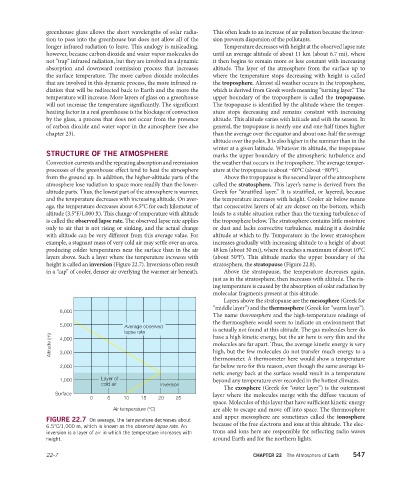
                       is called the observed lapse rate. The  observed lapse rate applies   the troposphere below. The stratosphere contains little moisture
                       only to air that is not rising or sinking, and the actual change   or dust and lacks convective turbulence, making it a desirable
                       with altitude can be very different from this average value. For   altitude at which to fly. Temperature in the lower stratosphere
                       example, a stagnant mass of very cold air may  settle over an area,   increases gradually with increasing altitude to a height of about
                       producing colder temperatures near the surface than in the air   48 km (about 30 mi), where it reaches a maximum of about 10°C
                       layers above. Such a layer where the temperature increases with   (about 50°F). This altitude marks the upper boundary of the
                       height is called an inversion (Figure 22.7). Inversions often result   stratosphere, the stratopause (Figure 22.8).
                       in a “cap” of cooler, denser air overlying the warmer air beneath.   Above the stratopause, the temperature decreases again,
                                                                               just as in the stratosphere, then increases with altitude. The ris-
                                                                               ing temperature is caused by the absorption of solar radiation by
                                                                               molecular fragments present at this altitude.
                                                                                  Layers above the stratopause are the mesosphere (Greek for
                                                                               “middle layer”) and the thermosphere (Greek for “warm layer”).
                            6,000
                                                                               The name thermosphere and the high-temperature readings of
                            5,000                Average observed              the thermosphere would seem to indicate an environment that
                                                 lapse rate                    is actually not found at this altitude. The gas molecules here do
                         Altitude (m)  4,000                                   molecules are far apart. Thus, the average  kinetic energy is very
                                                                               have a high kinetic energy, but the air here is very thin and the
                            3,000
                                                                               high, but the few molecules do not transfer much energy to a
                                                                               thermometer. A thermometer here would show a temperature
                            2,000                                              far below zero for this reason, even though the same average ki-
                                                                               netic energy back at the surface would result in a temperature
                            1,000         Layer of                             beyond any temperature ever recorded in the hottest climates.
                                          cold air           Inversion
                                                                                  The exosphere (Greek for “outer layer”) is the outermost
                          Surface
                                      0     5    10    15    20   25           layer where the molecules merge with the diffuse vacuum of
                                                                               space. Molecules of this layer that have sufficient kinetic energy
                                              Air temperature (°C)             are able to escape and move off into space. The thermosphere
                                                                               and upper mesosphere are sometimes called the  ionosphere
                       FIGURE 22.7  On average, the temperature decreases about
                       6.5°C/1,000 m, which is known as the observed lapse rate. An     because of the free electrons and ions at this altitude. The elec-
                       inversion is a layer of air in which the temperature increases with   trons and ions here are responsible for reflecting radio waves
                       height.                                                 around Earth and for the northern lights.

                       22-7                                                                 CHAPTER 22  The Atmosphere of Earth   547

