


Page 568 - 9780077418427.pdf
P. 568
/Volume/201/MHDQ233/tat78194_disk1of1/0073378194/tat78194_pagefile
tiL12214_ch22_541-564.indd Page 545 9/23/10 11:08 AM user-f465
tiL12214_ch22_541-564.indd Page 545 9/23/10 11:08 AM user-f465 /Volume/201/MHDQ233/tat78194_disk1of1/0073378194/tat78194_pagefiles
EXAMPLE 22.2
3
A helium balloon at sea level had a volume of 825.0 cm when it was
Vacuum
filled. The barometric pressure at sea level was 1013 millibars. What
3
was the volume of the balloon, in cm , when it reached an altitude
76.00 cm (29.92 in) tall no effect on the gas.) (Answer: 983 cm .)
where the pressure was 850 millibars? (Assume the balloon itself has
3
Atmospheric
pressure WARMING THE ATMOSPHERE
Temperature, heat, and the heat transfer processes were dis-
cussed in chapter 4. The temperature of a substance is related to
the kinetic energy of the molecules making up that substance.
The higher the temperature, the greater the kinetic energy. Thus,
a high temperature means high molecular kinetic energy, and
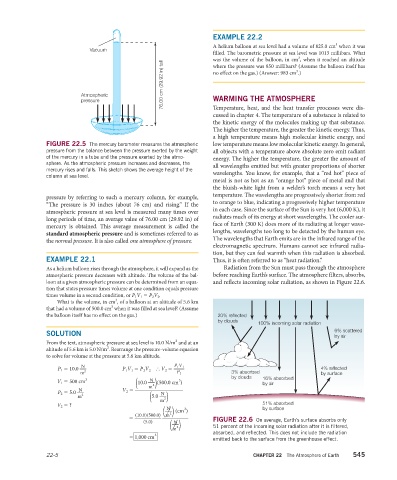
FIGURE 22.5 The mercury barometer measures the atmospheric low temperature means low molecular kinetic energy. In general,
pressure from the balance between the pressure exerted by the weight all objects with a temperature above absolute zero emit radiant
of the mercury in a tube and the pressure exerted by the atmo- energy. The higher the temperature, the greater the amount of
sphere. As the atmo s pheric pressure increases and decreases, the all wavelengths emitted but with greater proportions of shorter
mercury rises and falls. This sketch shows the average height of the
column at sea level. wavelengths. You know, for example, that a “red hot” piece of
metal is not as hot as an “orange hot” piece of metal and that
the bluish-white light from a welder’s torch means a very hot
temperature. The wavelengths are progressively shorter from red
pressure by referring to such a mercury column, for example,
to orange to blue, indicating a progressively higher temperature
“The pressure is 30 inches (about 76 cm) and rising.” If the
in each case. Since the surface of the Sun is very hot (6,000 K), it
atmospheric pressure at sea level is measured many times over
radiates much of its energy at short wavelengths. The cooler sur-
long periods of time, an average value of 76.00 cm (29.92 in) of
face of Earth (300 K) does more of its radiating at longer wave-
mercury is obtained. This average measurement is called the
lengths, wavelengths too long to be detected by the human eye.
standard atmospheric pressure and is sometimes referred to as
The wavelengths that Earth emits are in the infrared range of the
the normal pressure. It is also called one atmosphere of pressure.
electromagnetic spectrum. Humans cannot see infrared radia-
tion, but they can feel warmth when this radiation is absorbed.
EXAMPLE 22.1 Thus, it is often referred to as “heat radiation.”
As a helium balloon rises through the atmosphere, it will expand as the Radiation from the Sun must pass through the atmosphere
atmospheric pressure decreases with altitude. The volume of the bal- before reaching Earth’s surface. The atmosphere filters, absorbs,
loon at a given atmospheric pressure can be determined from an equa- and reflects incoming solar radiation, as shown in Figure 22.6.
tion that states pressure times volume at one condition equals pressure
times volume in a second condition, or P 1 V 1 = P 2 V 2 .
3
What is the volume, in cm , of a balloon at an altitude of 5.6 km
3
that had a volume of 500.0 cm when it was filled at sea level? (Assume
the balloon itself has no effect on the gas.) 20% reflected
by clouds 100% incoming solar radiation
6% scattered
SOLUTION by air
2
From the text, atmospheric pressure at sea level is 10.0 N/m and at an
2
altitude of 5.6 km is 5.0 N/m . Rearrange the pressure-volume equation
to solve for volume at the pressure at 5.6 km altitude.
1 _
N _ P V 1
P 1 = 10.0 P V = P V ∴ V = 4% reflected
1
1
2
2
2
m 2 P 2 3% absorbed by surface
by clouds
N _
2)
3
V 1 = 500 cm 3 ( 10.0 (500.0 c m ) 16% absorbed
by air
__
m
_ V =
N
P 2 = 5.0 2 N _
2)
m 2 ( 5.0
m
V 2 = ? 51% absorbed
N _
( (c m ) by surface
2)
3
_
(10.0)(500.0)
_ m
=
2)
( 51 percent of the incoming solar radiation after it is filtered,
(5.0) N _ FIGURE 22.6 On average, Earth’s surface absorbs only
m
absorbed, and reflected. This does not include the radiation
3
= 1,000 c m emitted back to the surface from the greenhouse effect.
22-5 CHAPTER 22 The Atmosphere of Earth 545

